What Is a SaaS E-Commerce Platform?
A SaaS e-commerce platform is cloud-based e-commerce software that allows businesses to build, operate and scale an online store without managing the underlying server infrastructure. SaaS, or Software as a Service, delivers e-commerce technology through the internet, typically using a subscription-based model.
Unlike traditional self-hosted e-commerce software that requires businesses to purchase, install, maintain and update their own servers and applications, a SaaS e-commerce platform is hosted and maintained by the platform provider. This allows businesses to focus on selling products, managing customers, processing orders and growing their digital commerce operations rather than maintaining the technology infrastructure.
Modern SaaS e-commerce platforms can support far more than a traditional online store. Depending on the platform, businesses can manage B2B e-commerce, B2C and retail e-commerce, marketplaces, product catalogs, pricing, inventory, orders, quotations, customer accounts, payments, shipping, SEO, analytics and integrations from a centralized commerce platform.
For manufacturers and distributors selling electronic components and electrical components, a SaaS e-commerce platform can also provide the scalability, product-data management, search, inventory and ERP integrations required to manage complex digital commerce operations.
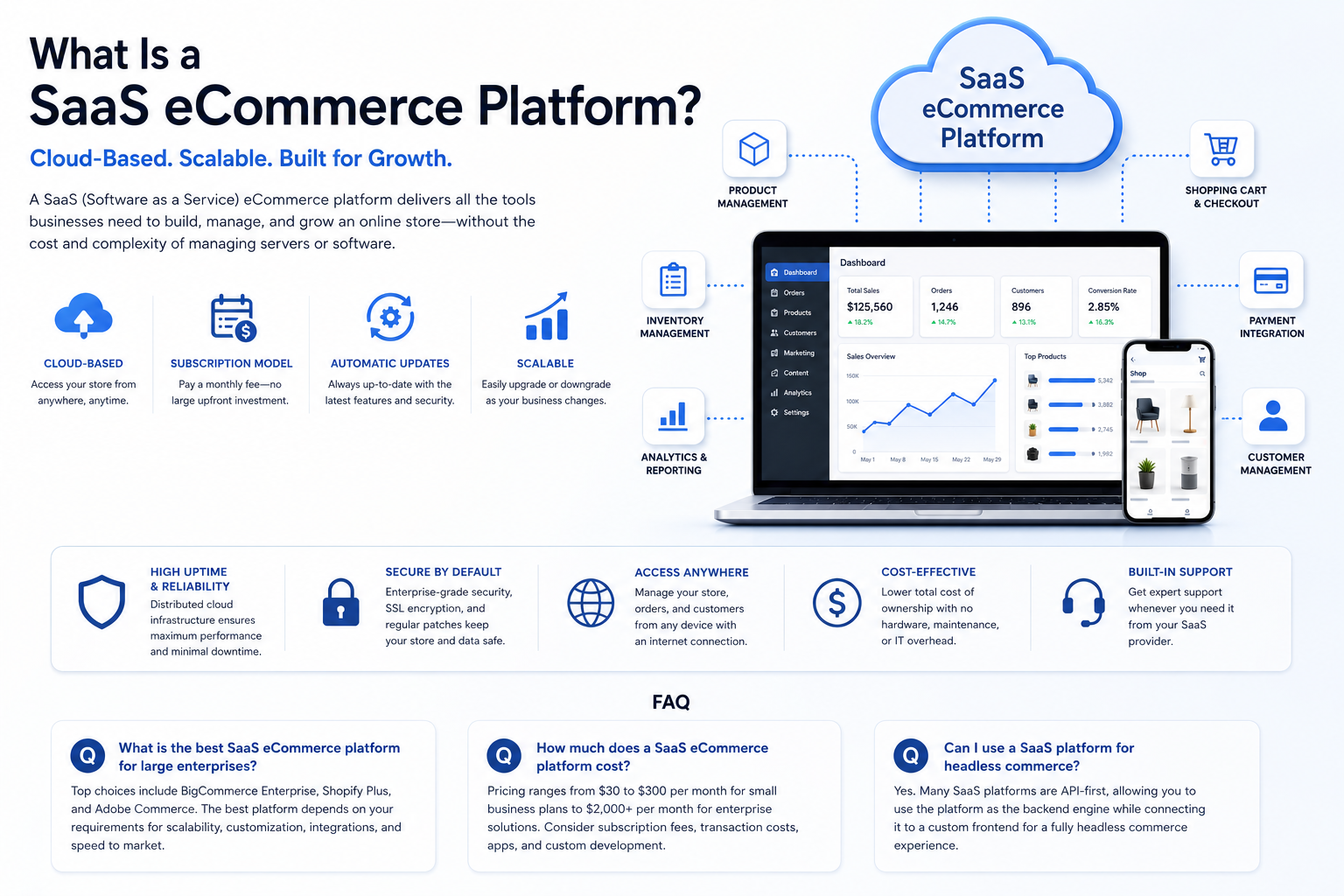
How Does a SaaS E-Commerce Platform Work?
A SaaS e-commerce platform provides the technology required to operate an online commerce website through a centrally managed cloud environment. The platform provider is responsible for much of the underlying infrastructure, including hosting, software updates, security, backups and system maintenance.
Businesses typically access the platform through a web browser and configure their e-commerce website, product catalog, customer accounts, pricing, content, payment methods and business processes within the platform.
Common SaaS e-commerce platform capabilities include:
- Website and storefront development
- Product catalog and product information management
- Shopping cart and checkout
- Order management
- Customer account management
- Payment gateway integration
- Shipping and tax management
- Inventory and availability management
- Advanced product search and filtering
- SEO and content management
- Analytics and reporting
- Marketing integrations
- ERP and CRM integrations
- API connectivity
- Automated data synchronization
- Marketplace and sales-channel integration
- Mobile and responsive commerce
For manufacturers, distributors and large product organizations, the ability to connect e-commerce directly with business systems can be particularly important. An API-first SaaS e-commerce platform can connect with ERP, CRM, PIM, inventory, pricing, fulfillment, accounting and other networked applications to automate the movement of commerce data.
SaaS E-Commerce vs. Traditional E-Commerce Platforms
Traditional self-hosted e-commerce software requires the business or its technology partner to manage servers, software installations, upgrades, security patches, backups and other infrastructure.
A SaaS e-commerce platform moves much of this responsibility to the platform provider. Businesses can use the commerce software without maintaining the underlying infrastructure themselves.
This can reduce technical overhead and make it easier to launch, maintain and scale an e-commerce website.
However, not every SaaS platform provides the same level of flexibility. Some SaaS platforms are designed primarily for straightforward retail stores, while others are built to support complex enterprise commerce requirements.
For businesses with large product catalogs, multiple sales channels, complex pricing structures, ERP integrations or specialized ordering processes, the underlying architecture of the SaaS platform becomes especially important.
Benefits of a SaaS E-Commerce Platform
Scalability
One of the primary benefits of SaaS e-commerce is scalability. A cloud-based platform can support businesses as their product catalog, customer base, order volume and website traffic increase.
Enterprise e-commerce platforms should be capable of handling large catalogs and high transaction volumes while maintaining consistent performance during traffic spikes and periods of increased demand.
Scalability is especially important for distributors and manufacturers that may have hundreds of thousands or millions of products, multiple customer types and continuously changing inventory and pricing data.
Managed Hosting and Infrastructure
With SaaS e-commerce, hosting infrastructure is managed as part of the platform rather than requiring the business to operate its own e-commerce servers.
This can simplify infrastructure management and reduce the amount of technical administration required by the business.
Modern commerce platforms can also incorporate technologies such as content delivery networks (CDNs), caching, load balancing, redundancy, monitoring, firewalls and automated backups to improve availability and performance.
Automatic Software Updates
SaaS platforms can provide centrally managed software updates, improvements and security patches without requiring customers to manually install every update.
This allows businesses to spend less time maintaining the core e-commerce software and more time improving their products, content, customer experience and digital sales channels.
Faster Deployment
Because the infrastructure and core application are already provided by the SaaS platform, businesses can generally deploy an e-commerce website faster than building an entire commerce environment from the ground up.
This can be particularly valuable for organizations launching new brands, product catalogs, regional websites, B2B portals, marketplaces or additional digital sales channels.
API and ERP Integration
For modern commerce operations, e-commerce rarely operates as an isolated website.
A sophisticated SaaS e-commerce platform should be able to exchange information with ERP, CRM, PIM, warehouse, accounting, marketing, fulfillment and other systems.
API integration allows businesses to automate the exchange of products, inventory, pricing, customers, orders, shipping information and other data between systems.
For distributors and manufacturers, ERP integration can be particularly important because product availability, customer-specific pricing, product specifications and order information may originate outside the e-commerce website.
Advanced Search and Product Discovery
Large e-commerce catalogs require more than a basic keyword search.
Advanced SaaS e-commerce platforms can provide configurable search, filtering, faceted navigation, product attributes, category structures, synonyms and other tools that help customers quickly find the products they need.
This becomes increasingly important for businesses selling large numbers of technical products, components, SKUs, replacement parts or products with complex specifications.
For electronic components and electrical components, advanced product search can allow customers to search by manufacturer, part number, product family, technical specifications, package type, availability and other attributes.
B2B and Retail E-Commerce
A modern SaaS commerce platform can support multiple commerce models from a common technology foundation.
For example, a business may need to support:
- B2B e-commerce
- B2C and retail e-commerce
- Distributor and dealer portals
- Wholesale ordering
- Marketplace commerce
- Multi-channel sales
- Customer-specific catalogs
- Account-based pricing
- Quantity pricing
- Contract pricing
- Credit and payment terms
- Quote requests
- Quick orders
- Sample requests
Supporting these requirements from one platform can reduce the need to maintain separate systems for different customers and sales channels.
SaaS E-Commerce for Manufacturers and Distributors
Manufacturers and distributors often have significantly more complex e-commerce requirements than a typical consumer retailer.
A distributor may need to manage hundreds of thousands or millions of SKUs, multiple manufacturers, real-time inventory, customer-specific pricing, quantity discounts, multiple warehouses, technical specifications and ERP-generated product data.
A manufacturer may need to connect its e-commerce website to ERP, PIM, CRM, inventory, marketing and dealer systems while maintaining a consistent brand experience across multiple channels.
This makes enterprise SaaS e-commerce and B2B e-commerce platforms particularly valuable for organizations that need a combination of scalability, automation, integrations and flexible commerce processes.
DistyMan SaaS E-Commerce Platform
DistyMan is a SaaS e-commerce platform designed for manufacturers, distributors, retailers and businesses with complex product catalogs and digital commerce requirements.
The platform combines e-commerce, integrations, catalog management, search, inventory visibility, pricing, ordering and digital commerce capabilities within a cloud-based architecture.
DistyMan can support B2B e-commerce, B2C and retail e-commerce, and marketplace commerce, allowing businesses to build different sales channels without necessarily maintaining completely separate commerce platforms.
The platform is also designed for integration with external business systems through APIs and automated processes. This allows e-commerce websites to connect with ERP systems, inventory systems, CRM platforms, product databases, marketing systems and other networked applications.
For businesses with complex commerce requirements, DistyMan can provide capabilities including:
- SaaS e-commerce hosting
- B2B e-commerce
- B2C and retail e-commerce
- Marketplace e-commerce
- ERP and API integration
- Advanced product search and filtering
- Large product catalog management
- Real-time inventory visibility
- Multi-level pricing
- Customer-specific pricing
- Quantity and volume pricing
- Quote and RFQ management
- Quick order functionality
- Sample order requests
- Tax and shipping management
- Customer account management
- SEO-friendly e-commerce architecture
- Automated data synchronization
- Multi-channel commerce
- Custom storefront design and development
The result is a commerce platform designed to support both the customer-facing e-commerce experience and the complex business processes operating behind it.
SaaS E-Commerce and SEO
An e-commerce platform also plays an important role in search engine optimization (SEO).
A technically strong SaaS e-commerce platform should provide the ability to create search-friendly URLs, page titles, meta descriptions, structured product information, optimized category pages, canonical URLs, XML sitemaps and other technical SEO elements.
Website performance is also increasingly important for search visibility and user experience. Fast page loading, responsive design, efficient code, CDN delivery, caching and optimized assets can help create a better experience for both users and search engines.
For businesses with large product catalogs, SEO capabilities become even more important. Each product, category, manufacturer, brand and technical specification can represent an opportunity to attract qualified organic search traffic.
For companies selling electronic components and electrical components, a technically optimized e-commerce platform can turn a large product catalog into thousands of potential organic search landing pages.
SaaS E-Commerce and AI Search
Modern e-commerce SEO is also expanding beyond traditional search engines.
Customers increasingly use AI-powered search and answer engines to research products, compare suppliers, identify manufacturers and find solutions to specific purchasing requirements.
A well-structured e-commerce website can provide the product data, technical specifications, category information, organization information and supporting content that AI systems can more easily interpret.
For this reason, modern SaaS e-commerce should consider SEO, structured product data, technical content and AI search optimization as part of the overall commerce strategy.
Potential Disadvantages of SaaS E-Commerce
While SaaS e-commerce provides significant benefits, businesses should evaluate the limitations of each platform before making a decision.
Some SaaS platforms restrict access to the underlying infrastructure or limit the level of customization available. Businesses with highly specialized workflows may therefore need to evaluate API access, customization capabilities, data portability, integrations and available development tools.
Businesses should also understand the platform's pricing structure, transaction fees, application costs, storage limits, API limitations, support model, service-level commitments and data policies.
The key consideration is not simply whether a platform is SaaS. The important question is whether the SaaS e-commerce platform can support the company's current requirements and future growth.
How Much Does a SaaS E-Commerce Platform Cost?
SaaS e-commerce pricing varies significantly depending on the platform, number of products, order volume, required integrations, features, traffic and level of customization.
Entry-level SaaS e-commerce platforms may cost relatively little per month, while enterprise e-commerce platforms can cost substantially more depending on the required functionality and services.
Businesses should evaluate the total cost of ownership, not just the monthly subscription. Costs can include:
- Platform subscription
- Transaction fees
- Payment processing
- Premium applications
- Custom development
- ERP and API integrations
- Design and development
- SEO services
- Data migration
- Product data management
- Marketing integrations
- Marketplace integrations
- Professional services
For a complex B2B or enterprise e-commerce project, the right platform can ultimately provide greater value by reducing manual processes, improving automation, increasing sales efficiency and eliminating the need to maintain multiple disconnected systems.
Can a SaaS Platform Support Headless Commerce?
Yes. Many modern SaaS e-commerce platforms can support headless commerce, where the commerce engine is separated from the customer-facing frontend.
In a headless architecture, the e-commerce platform manages functions such as products, customers, pricing, carts, orders and commerce logic while APIs connect that information to a custom frontend.
Headless commerce can be useful for businesses that need highly customized digital experiences, multiple frontend applications, mobile experiences, marketplaces or multiple digital sales channels.
However, headless architecture is not automatically better for every business. Organizations should consider the additional development, maintenance and technical resources required before choosing a headless approach.
What Should You Look for in a SaaS E-Commerce Platform?
When evaluating SaaS e-commerce software, businesses should look beyond the storefront and consider the complete commerce architecture.
Important capabilities to evaluate include:
- Scalability and performance
- Product catalog capacity
- B2B and B2C functionality
- Marketplace support
- API availability
- ERP integration
- Inventory integration
- Advanced search
- Pricing flexibility
- Customer-specific catalogs
- Order and quote management
- SEO capabilities
- Mobile responsiveness
- Security and reliability
- Data migration capabilities
- Analytics and reporting
- Customization options
- Multi-channel commerce
- Ongoing platform development
- Support and implementation services
For distributors and manufacturers, it is especially important to determine whether the platform can handle large product catalogs, complex pricing, real-time inventory, technical product information, ERP integrations and automated data processes.
SaaS E-Commerce Frequently Asked Questions
What is a SaaS e-commerce platform?
A SaaS e-commerce platform is cloud-based e-commerce software delivered as a service over the internet. The platform provider manages the core software and infrastructure, allowing businesses to operate online stores without maintaining the underlying e-commerce servers themselves.
What are the advantages of SaaS e-commerce?
The primary advantages include managed hosting, scalability, automatic software updates, security maintenance, faster deployment, reduced infrastructure management and access to integrations and commerce tools through a cloud-based platform.
What is the best SaaS e-commerce platform for large enterprises?
The best SaaS e-commerce platform depends on the organization's products, sales channels, integrations, transaction volume, customization requirements and business processes. Large enterprises should evaluate scalability, API capabilities, ERP integration, product catalog capacity, security, performance, B2B functionality and total cost of ownership rather than selecting a platform based solely on subscription price.
How much does SaaS e-commerce cost?
SaaS e-commerce costs vary considerably. Pricing can range from relatively low monthly plans for smaller businesses to customized enterprise pricing for organizations with large catalogs, high transaction volumes, complex integrations and advanced functionality. Businesses should also consider development, integration, payment, application, migration and professional-service costs.
Can SaaS e-commerce support B2B commerce?
Yes. Many enterprise SaaS e-commerce platforms support B2B commerce features such as customer-specific pricing, account management, purchase orders, credit terms, quote requests, quantity pricing, approval workflows, quick ordering and ERP integration. The depth of B2B functionality varies considerably between platforms.
Can I use a SaaS platform for headless commerce?
Yes. SaaS e-commerce platforms with robust APIs can be used as the commerce backend in a headless architecture. The platform can manage products, customers, pricing, inventory, carts and orders while a separate frontend delivers the customer experience.
Can SaaS e-commerce integrate with an ERP?
Yes. API-based SaaS e-commerce platforms can integrate with ERP systems to exchange information such as products, inventory, pricing, customers, orders, shipping information and other business data. ERP integration is particularly important for manufacturers and distributors that need to synchronize e-commerce with their existing business systems.
Is SaaS e-commerce good for large product catalogs?
It can be, but businesses should evaluate the platform's catalog architecture, search technology, database performance, API capabilities, product attribute management and synchronization processes. Large distributors and manufacturers should select a platform specifically designed to handle complex catalogs and large volumes of product data.
Is SaaS e-commerce better than self-hosted e-commerce?
Neither approach is universally better. SaaS e-commerce can reduce infrastructure management and simplify updates, security and scalability. Self-hosted platforms can provide greater control over infrastructure and certain types of customization. The best choice depends on the organization's technical resources, business requirements, integrations, budget and long-term commerce strategy.
Build a More Flexible SaaS E-Commerce Operation with DistyMan
For manufacturers, distributors, retailers and other organizations with complex digital commerce requirements, choosing an e-commerce platform is about more than launching an online store.
The right SaaS e-commerce platform should provide the performance, scalability, integrations, product management, search, pricing, inventory, ordering, SEO and flexibility required to operate a modern digital commerce business.
DistyMan brings these capabilities together in a SaaS e-commerce platform built for B2B, B2C, retail and marketplace commerce. With API connectivity, ERP integration, advanced search, large catalog support, real-time inventory capabilities, flexible pricing and automated commerce processes, DistyMan is designed to support businesses as their digital sales operations grow.
Whether you are replacing an existing e-commerce platform, launching a new B2B portal, building a retail storefront, connecting an ERP to e-commerce or developing a multi-channel commerce strategy, DistyMan provides a scalable foundation for modern digital commerce.
For electronic component and electrical component companies, DistyMan combines e-commerce technology, product data, design, development, SEO and marketing to create a complete digital commerce solution.