Modern businesses increasingly need to serve more than one type of customer. A manufacturer or distributor may sell to individual retail customers, small businesses, dealers, distributors, OEMs, contractors and large enterprise accounts—all from the same product catalog.
The challenge is that these customers rarely buy the same way.
A retail customer may expect instant pricing, promotions and credit-card checkout. A B2B customer may require negotiated pricing, account-specific products, purchase orders, credit terms, quantity discounts or restricted access.
Unified e-commerce brings retail and B2B commerce together on a single platform while allowing each customer to receive the products, prices, access and purchasing experience appropriate for their account.
For manufacturers and distributors, this can eliminate the need to maintain separate retail and B2B websites while providing centralized control over customers, products, pricing, inventory and orders.
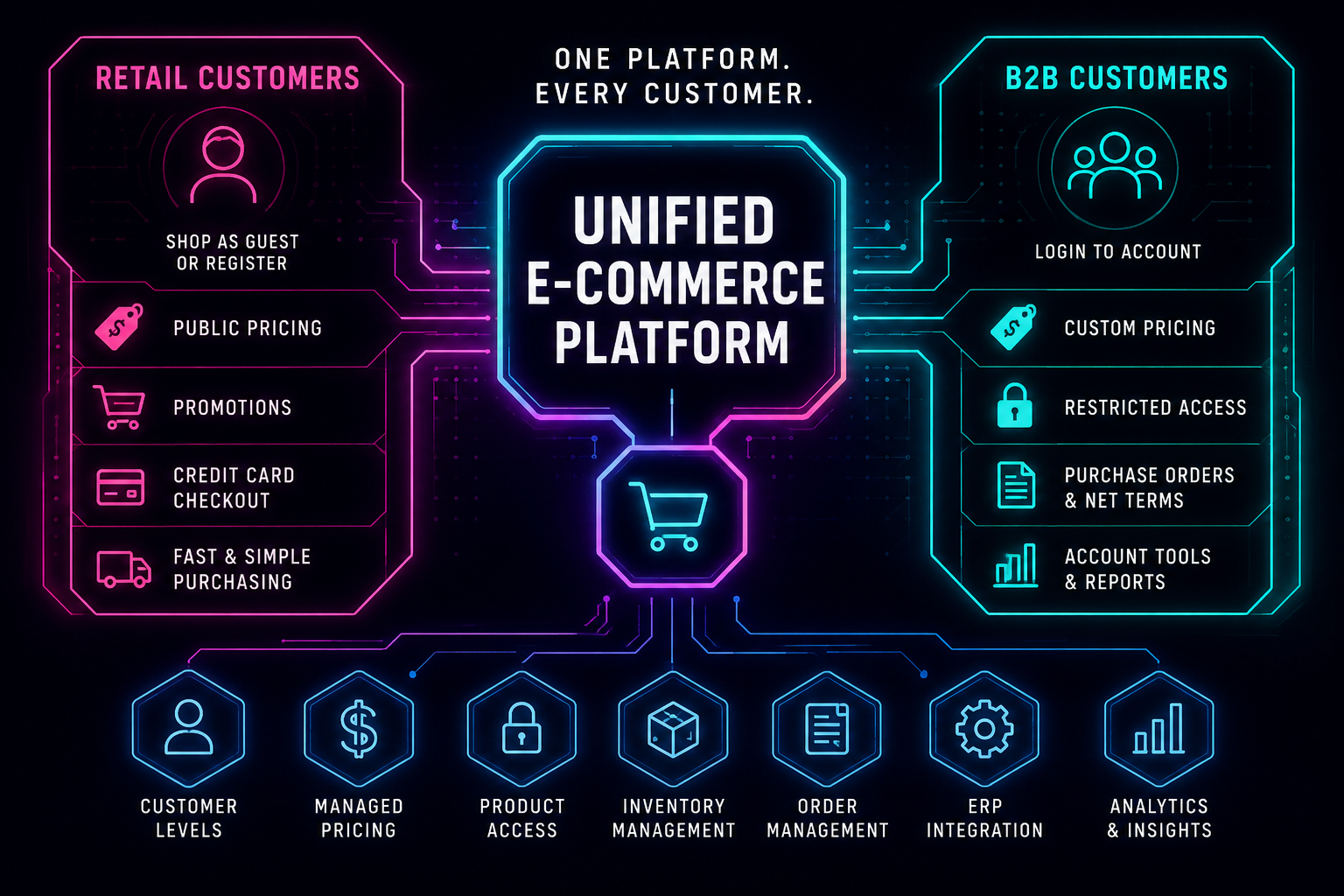
What Is Unified E-Commerce?
Unified e-commerce is an approach to digital commerce in which multiple customer types, sales channels and business processes operate through a common commerce platform and shared data.
Instead of maintaining independent systems for retail e-commerce, B2B e-commerce, dealer portals and other digital sales channels, businesses can manage them through a centralized architecture.
A unified e-commerce platform can bring together:
- Retail and B2C customers
- B2B customers
- Dealers and distributors
- OEM and enterprise accounts
- Customer levels and classifications
- Managed and contract pricing
- Product and category access
- Inventory availability
- Customer accounts
- Orders and order history
- Quotes and purchase orders
- Promotions and quantity discounts
- Payment and credit terms
- Shipping and fulfillment
- ERP and business-system data
The objective is not to give every customer the same experience. It is to use one commerce platform to create the right experience for every customer.
Unified Retail + B2B E-Commerce
Retail and B2B e-commerce have traditionally been treated as separate systems because their requirements can be very different.
Retail e-commerce generally emphasizes simplicity and speed. Customers browse products, see public pricing, add products to their cart and complete checkout.
B2B commerce can be considerably more complex.
Business customers may require:
- Customer-specific prices
- Contract pricing
- Volume discounts
- Approved product lists
- Restricted products
- Purchase orders
- Net payment terms
- Quotes
- Tax-exempt purchasing
- Multiple buyers
- Account-level permissions
- Reordering
- ERP-connected inventory and pricing
A unified retail and B2B e-commerce platform allows both purchasing models to operate from the same underlying product catalog and commerce infrastructure.
The website recognizes the customer and applies the appropriate rules automatically.
Customer Levels: One Store, Different Buying Experiences
Customer levels are one of the most important capabilities of a unified e-commerce platform.
Rather than building a different website for every customer type, customers can be assigned to classifications or levels that determine what they can see and how they can purchase.
Retail Customers
Public products, standard retail pricing, promotions and immediate checkout.
Trade Customers
Trade pricing, quantity discounts and additional product access.
Dealers
Dealer-specific prices, product availability, payment terms and purchasing rules.
Distributors
Distributor pricing, larger quantity breaks, restricted products and account terms.
OEM Customers
Contract pricing, approved products, custom catalogs and negotiated purchasing terms.
Enterprise Accounts
Account-specific products, prices, users, permissions, payment terms and workflows.
Customer levels make it possible to manage a complex customer base without maintaining completely separate e-commerce systems.
Managed Pricing for Retail and B2B Customers
Pricing is one of the biggest differences between retail and B2B e-commerce.
Retail stores may have one publicly displayed price. Manufacturers and distributors, however, can have thousands of customers with different pricing agreements.
A unified e-commerce platform can support multiple pricing strategies, including:
- Retail pricing
- Customer-level pricing
- Customer-specific pricing
- Contract pricing
- Dealer pricing
- Distributor pricing
- Quantity pricing
- Volume discounts
- Promotional pricing
- Sale pricing
- MAP pricing
- Account-specific discounts
When a customer signs in, the platform can identify the account and automatically display the appropriate prices.
This creates a more efficient purchasing experience while reducing the need for customers to contact sales representatives simply to confirm pricing.
Managed Product and Category Access
Not every customer should necessarily see every product.
Unified e-commerce can use customer profiles and classifications to control access to products, categories, pricing and purchasing capabilities.
A business might make certain products available only to authorized dealers, restrict specific product lines to qualified customers or create private catalogs for major accounts.
Access controls can also determine whether customers are permitted to:
- View a product
- View pricing
- Purchase a product
- Request a quote
- Use purchase orders
- Receive credit terms
- Access specific categories
- View account documentation
- Use special shipping methods
This makes unified commerce particularly valuable for manufacturers and distributors with complex sales agreements or channel relationships.
One Product Catalog Across Multiple Customer Types
Maintaining separate product databases for retail and B2B websites creates unnecessary work.
Descriptions change. Specifications change. Images are updated. Datasheets are replaced. Inventory changes continuously.
A unified e-commerce platform can maintain a centralized product catalog containing:
- Part numbers
- Manufacturer information
- Product descriptions
- Technical specifications
- Attributes
- Product images
- Datasheets
- Documentation
- Categories
- Inventory
- Pricing
- Related products
- Cross-references
- SEO information
Customer rules then determine how that information is presented.
A retail buyer and an enterprise purchasing department may therefore access the same underlying product while seeing different prices, availability and purchasing options.
Unified Inventory
Inventory is another critical component of unified commerce.
When separate systems maintain separate inventory information, discrepancies can create customer frustration and lost sales.
Connecting e-commerce with ERP, warehouse and inventory systems can provide more consistent product availability across retail and B2B channels.
Depending on the business requirements, customers may be able to view:
- Available inventory
- Multiple warehouse quantities
- Estimated availability
- Incoming inventory
- Lead times
- Backorder availability
- Location-specific stock
For electronic and electrical component distributors, where customers frequently make purchasing decisions based on immediate availability, accurate inventory information can be especially important.
Unified Checkout with Different Payment Options
The checkout process can also adapt according to customer level.
A retail customer might pay by credit card. An approved B2B account might purchase the same product using a purchase order or established credit terms.
Unified checkout can potentially support:
- Credit cards
- Digital payments
- Purchase orders
- Net terms
- Account credit
- Quotes
- Tax-exempt purchases
- Customer-specific shipping
- Multiple shipping addresses
This allows businesses to maintain a common checkout infrastructure while accommodating different purchasing requirements.
Unified Customer Accounts
Customer accounts should do more than store a username and password.
For B2B commerce, an account may represent an entire organization with multiple buyers, locations, pricing agreements and purchasing permissions.
A unified platform can centralize account information such as:
- Customer classification
- Pricing level
- Product access
- Billing information
- Shipping addresses
- Payment terms
- Order history
- Quotes
- Purchase orders
- Saved products
- Reorder lists
- Account users
- User permissions
Customers receive a personalized buying environment without requiring an entirely separate website.
ERP Integration and Unified Commerce
For many manufacturers and distributors, the ERP system remains an important source of operational business data.
Connecting e-commerce with ERP and related business systems can automate the movement of information between systems.
ERP to E-Commerce
- Products
- Inventory
- Customer accounts
- Customer pricing
- Credit terms
- Order status
- Availability
E-Commerce to ERP
- Customers
- Orders
- Purchase orders
- Payment information
- Shipping information
API-based integrations can help reduce duplicate data entry while keeping customers better informed.
Why Unified Commerce Matters for Electronic and Electrical Component Companies
Electronic and electrical component manufacturers and distributors often have commerce requirements that conventional retail platforms were not designed to handle.
A single company may simultaneously sell to:
- Consumers
- Engineers
- Purchasing departments
- OEMs
- Contract manufacturers
- Dealers
- Distributors
- Government customers
- Enterprise accounts
The product catalog itself may contain hundreds of thousands—or even millions—of SKUs with detailed technical attributes, documentation, inventory and pricing.
Unified e-commerce provides a way to serve these different customers without duplicating the entire commerce infrastructure.
Benefits of Unified E-Commerce
Centralized Management
Manage customers, products, prices, access and commerce rules from a centralized environment.
Personalized Customer Experiences
Present products, prices and purchasing options based on customer classifications and account rules.
Reduced Duplication
Maintain a common product catalog instead of managing separate retail and B2B product databases.
Better Pricing Control
Automatically apply retail, customer-level, contract and account-specific pricing.
Improved B2B Self-Service
Allow business customers to check prices, inventory, previous orders and account information without contacting sales for every transaction.
Easier Expansion
New customer levels, sales channels and purchasing models can be introduced without necessarily creating an entirely new commerce operation.
Consistent Product Data
Centralized product information helps maintain consistent specifications, images, documentation and product content across customer groups.
Unified Commerce vs. Omnichannel Commerce
Unified commerce and omnichannel commerce are closely related, but they are not exactly the same.
Omnichannel commerce focuses primarily on creating a consistent customer experience across multiple sales channels.
Unified commerce goes further by bringing the underlying customer, product, pricing, inventory and transaction data together through a common platform or architecture.
An omnichannel strategy might connect several independent systems. A unified commerce strategy aims to reduce those system boundaries.
For businesses with both retail and complex B2B requirements, this distinction can become important because customer pricing, access and purchasing rules need to remain consistent regardless of how the customer interacts with the company.
Best Practices for Implementing Unified E-Commerce
A successful unified commerce strategy starts with understanding customers rather than simply combining technology.
Define Customer Levels
Identify the major customer classifications your business serves and determine how their requirements differ.
Define Pricing Rules
Document retail, dealer, distributor, contract, quantity and customer-specific pricing requirements.
Establish Access Rules
Determine which customers can view products, categories, prices and purchasing options.
Centralize Product Information
Create a structured product catalog that can support all customer types and sales channels.
Integrate Business Systems
Connect ERP, inventory, CRM, payment, shipping and other systems where real-time or automated data exchange provides value.
Optimize Performance
Unified e-commerce should not mean slower e-commerce. Large catalogs, complex customer rules and real-time integrations require an architecture designed for performance and scalability.
Build for Search Visibility
Public products and categories should remain accessible to search engines where appropriate, with optimized URLs, metadata, structured content, internal linking and product schema.
Private customer pricing and restricted B2B information can remain protected behind account authentication.
Unified Commerce and SEO
Unified e-commerce can also simplify SEO by reducing unnecessary duplication across multiple websites.
Instead of maintaining separate public product pages for multiple commerce systems, businesses can establish authoritative product and category pages supported by centralized product data.
An effective unified e-commerce SEO strategy should include:
- Search-friendly URLs
- Unique title tags
- Optimized meta descriptions
- Product schema
- Structured product specifications
- Optimized category content
- Internal linking
- Canonical URLs
- XML sitemaps
- Fast page performance
- Mobile optimization
- Crawlable product pages
- Helpful technical content
For manufacturers and distributors, detailed specifications, applications, product documentation and technical information can provide additional search value beyond basic product descriptions.
One Platform. Every Customer.
The goal of unified e-commerce is not to force retail and B2B customers through the same purchasing process.
It is to manage different purchasing experiences through a common commerce foundation.
With customer levels, managed pricing, controlled access, centralized product data, inventory integration and flexible checkout, manufacturers and distributors can serve a much broader range of customers without maintaining disconnected commerce environments.
DistyMan Unified E-Commerce
DistyMan provides unified retail and B2B e-commerce solutions designed for manufacturers, distributors and companies with complex product catalogs and customer requirements.
The DistyMan platform can combine retail e-commerce and advanced B2B capabilities while managing customer levels, pricing, product access, inventory and checkout from one integrated commerce environment.
Businesses can create different purchasing experiences for retail customers, dealers, distributors, OEMs and enterprise accounts while maintaining centralized control over their products and commerce data.
Whether you need a public retail store, advanced B2B purchasing capabilities or both, DistyMan can design, develop, integrate and optimize a unified e-commerce solution around your business requirements.
Frequently Asked Questions About Unified E-Commerce
What is a unified e-commerce platform?
A unified e-commerce platform brings customer, product, pricing, inventory, order and transaction data together so multiple customer types and sales channels can operate from a common commerce environment.
Can one e-commerce website support both retail and B2B customers?
Yes. A unified retail and B2B e-commerce website can provide public retail shopping while authenticated business customers receive account-specific products, prices, terms and purchasing capabilities.
What are customer levels in e-commerce?
Customer levels classify customers into groups such as retail, trade, dealer, distributor, OEM or enterprise. Each level can receive different prices, product access, discounts and purchasing rules.
Can different customers see different prices?
Yes. A B2B e-commerce platform can display pricing based on customer level, account, contract, quantity or other business rules.
Can products be restricted to certain customers?
Yes. Product and category access can be controlled according to customer classification or account permissions.
Can B2B customers use purchase orders?
Yes. Approved business customers can be provided with purchasing options such as purchase orders, account credit or established payment terms while retail customers continue using conventional checkout methods.
Can unified e-commerce integrate with an ERP?
Yes. ERP integration can synchronize information such as products, inventory, customer accounts, pricing, orders and order status between business systems and the e-commerce platform.
Is unified commerce the same as omnichannel commerce?
Not exactly. Omnichannel commerce focuses on creating a connected customer experience across channels. Unified commerce additionally seeks to centralize the systems and data supporting those experiences.
Who benefits most from unified e-commerce?
Unified e-commerce is particularly useful for manufacturers, distributors and retailers that serve multiple customer types or require customer-specific pricing, account access, inventory integration and complex purchasing rules.