Modern e-commerce is rarely limited to one website, one customer type or one sales channel.
Manufacturers and distributors may simultaneously sell to retail customers, dealers, distributors, OEMs, contract manufacturers, enterprise accounts and other business buyers. Customers may interact through an e-commerce website, B2B portal, marketplace, sales representative or other digital channel.
The challenge is keeping products, customer information, pricing, inventory and orders consistent across all of them.
Unified commerce connects these channels and the data behind them through one integrated commerce environment.
For electronic and electrical component manufacturers and distributors, unified commerce can provide a centralized way to manage complex product catalogs, customer levels, managed prices, product access, inventory, orders and business-system integrations.
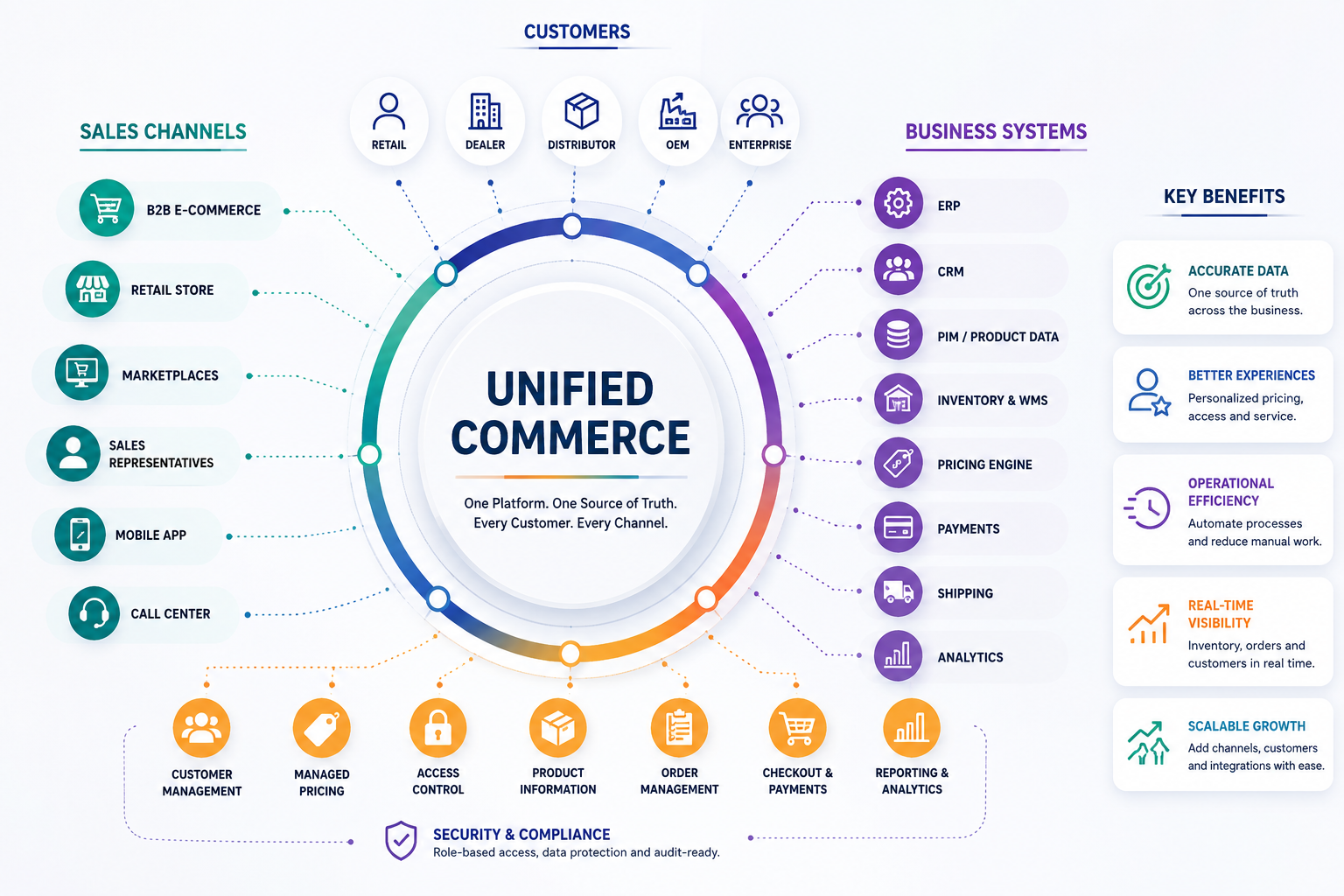
What Is Unified Commerce?
Unified commerce is an e-commerce strategy that connects customer-facing sales channels with the systems and information operating behind them.
Instead of managing websites, B2B portals, inventory systems, product information, customer accounts and orders independently, unified commerce brings these functions together through a connected platform and shared data architecture.
A unified commerce platform may connect:
- Retail e-commerce
- B2B e-commerce
- Customer accounts
- Customer levels and classifications
- Managed pricing
- Customer-specific pricing
- Product and category access
- Product information
- Inventory
- Warehouses
- Orders
- Quotes
- Purchase orders
- ERP systems
- CRM systems
- PIM systems
- Marketplaces
- Shipping and fulfillment
- Payments
- Analytics
The goal is to create a single connected commerce environment rather than a collection of disconnected systems.
Why Unified Commerce Matters
Disconnected commerce systems create problems that customers eventually notice.
A product may have one description on the website and another in a marketplace. Inventory may show as available online when the warehouse is actually out of stock. A B2B customer may see the wrong price. An order placed online may require manual entry into an ERP.
Unified commerce reduces these inconsistencies by connecting the systems responsible for products, customers, inventory, pricing and orders.
This creates a stronger foundation for both customer experience and operational efficiency.
One Source of Product Information
Product information is at the center of e-commerce, particularly for manufacturers and distributors with large technical catalogs.
Electronic and electrical components can include extensive product data such as:
- Manufacturer part numbers
- Product names
- Descriptions
- Technical specifications
- Electrical characteristics
- Dimensions
- Package types
- Attributes
- Product images
- Datasheets
- Certifications
- Compliance information
- Technical documentation
- Cross references
- Related products
When product information is distributed across multiple systems, maintaining consistency becomes difficult.
Unified commerce can connect the e-commerce platform with product information management, ERP and other data sources so product information can be centrally managed and distributed across sales channels.
PIM and Unified Commerce
Product Information Management, or PIM, can play an important role in unified commerce.
A PIM system provides a centralized location for organizing, enriching and maintaining product information before distributing it to e-commerce websites, marketplaces, catalogs and other sales channels.
For manufacturers and distributors with complex catalogs, PIM can help manage:
- Product attributes
- Technical specifications
- Descriptions
- Images
- Datasheets
- Category assignments
- Product relationships
- Cross references
- Digital assets
- Channel-specific content
Connecting PIM with unified e-commerce creates a stronger product-data foundation and helps ensure customers receive consistent product information regardless of where they shop.
Unified Retail and B2B E-Commerce
Unified commerce becomes especially valuable when the same company serves both retail and B2B customers.
Retail customers typically expect a simple shopping experience with public prices, promotions and immediate checkout.
B2B customers may require considerably more complex purchasing capabilities.
B2B requirements can include:
- Customer-specific pricing
- Contract pricing
- Quantity discounts
- Private products
- Restricted categories
- Quotes
- Purchase orders
- Credit terms
- Tax exemptions
- Multiple account users
- Account permissions
- Reordering
- Multiple shipping locations
- ERP-connected account data
A unified retail and B2B e-commerce platform can support these different buying experiences while maintaining a common product catalog and commerce infrastructure.
Customer Levels Create Personalized Commerce
Not every customer should see the same products, prices or purchasing options.
Unified commerce can classify customers into levels that determine the experience each customer receives.
Common customer levels may include:
- Retail
- Trade
- Dealer
- Distributor
- OEM
- Contract customer
- Government
- Enterprise
Each customer level can have different pricing, products, discounts, payment terms and access permissions.
Individual customers can also receive account-specific rules when required.
This allows a single e-commerce website to provide multiple purchasing experiences without maintaining separate websites for each type of customer.
Managed Pricing and Customer-Specific Prices
B2B pricing is often considerably more complex than retail pricing.
A manufacturer or distributor may simultaneously manage retail pricing, dealer pricing, distributor pricing, quantity breaks and negotiated contract prices.
Unified commerce can connect pricing rules directly with customer profiles.
Pricing options can include:
- Public retail prices
- Customer-level prices
- Customer-specific prices
- Contract prices
- Dealer prices
- Distributor prices
- Quantity pricing
- Volume discounts
- Promotional pricing
- Sale pricing
- Account-specific discounts
Once a customer signs in, the platform can identify the account and display the correct pricing automatically.
Managed Product Access
Unified commerce can also control which products or categories customers are allowed to view or purchase.
This can be important when manufacturers and distributors have authorized dealer programs, negotiated customer catalogs or products restricted to specific markets.
Access rules may control whether a customer can:
- See a product
- See a category
- View pricing
- Purchase a product
- Request a quote
- Use purchase orders
- Receive credit terms
- View technical documentation
- Use specific shipping methods
Customer-level and account-level access creates a personalized B2B purchasing environment within the same e-commerce platform.
Real-Time Inventory Visibility
Accurate inventory is one of the most important requirements in modern e-commerce.
When inventory information is stored separately across warehouses, ERP systems and online stores, customers can receive outdated availability information.
Unified commerce can connect e-commerce with inventory and warehouse systems so availability information is updated throughout the purchasing experience.
Customers may be able to view:
- Current inventory
- Warehouse quantities
- Incoming inventory
- Lead times
- Backorder status
- Estimated availability
- Location-specific stock
This is especially valuable in electronic component distribution, where buyers frequently search for specific part numbers based on immediate availability.
Unified Order Management
Orders can originate from many different sources.
A manufacturer or distributor may receive orders from:
- Retail e-commerce
- B2B e-commerce
- Sales representatives
- Dealer portals
- Marketplaces
- Phone orders
- Purchase orders
- EDI
Unified order management brings these transactions into a connected workflow.
This gives businesses greater visibility into orders, inventory, fulfillment and customer activity while reducing manual processing.
ERP Integration and Unified Commerce
For many manufacturers and distributors, ERP systems remain the operational center of the business.
A unified commerce platform can exchange information with the ERP so critical business data moves automatically between systems.
ERP to E-Commerce
- Products
- Inventory
- Customer records
- Customer classifications
- Customer pricing
- Credit terms
- Order status
- Shipping information
E-Commerce to ERP
- Customers
- Orders
- Purchase orders
- Payments
- Shipping selections
- Account updates
API-based integration can help eliminate repetitive data entry while providing customers with more current information.
CRM Integration
Customer information may also be shared with a CRM system.
This can help sales teams understand customer activity while giving customers a more consistent experience across digital and traditional sales channels.
Connected CRM data can include:
- Customer profiles
- Purchasing history
- Quotes
- Sales activity
- Account relationships
- Customer inquiries
- Opportunities
For B2B companies, this helps connect digital self-service with traditional account management and sales relationships.
Unified Commerce vs. Omnichannel Commerce
Unified commerce and omnichannel commerce are closely related, but there is an important difference.
Omnichannel Commerce
Omnichannel commerce focuses primarily on creating a consistent customer experience across multiple sales channels.
A customer may interact through a website, mobile device, marketplace, physical location or salesperson while receiving a connected brand experience.
Unified Commerce
Unified commerce goes further by connecting the systems and data operating behind those channels.
Products, customers, inventory, pricing and orders are shared across the commerce ecosystem.
Omnichannel commerce connects customer experiences. Unified commerce connects the data, systems and processes behind those experiences.
The Four Foundations of Unified Commerce
A strong unified commerce strategy can be built around four core foundations.
1. Connected Systems
E-commerce, ERP, CRM, PIM, inventory, payment, shipping and other systems need to exchange information reliably.
2. Centralized Data
Product, customer, pricing, inventory and order information should be managed through authoritative data sources rather than duplicated across disconnected systems.
3. Consistent Customer Experiences
Customers should receive accurate product information, pricing and purchasing capabilities regardless of the channel they use.
4. Operational Efficiency
Automated data exchange and centralized processes reduce manual work and improve the speed and accuracy of commerce operations.
Benefits of Unified Commerce
Consistent Product Information
Centralized product data helps ensure customers see accurate descriptions, specifications, images and documentation across channels.
Better Customer Experiences
Customers receive more relevant prices, products and purchasing options based on their account and customer level.
Improved Inventory Accuracy
Connected inventory systems provide more current stock and availability information.
Fewer Data Silos
Connecting e-commerce, ERP, CRM, PIM and other systems reduces duplicated and conflicting data.
Reduced Manual Work
Automated synchronization can reduce repetitive product updates, pricing changes and order entry.
Greater Scalability
Businesses can add new customers, products, integrations and sales channels without rebuilding their commerce infrastructure.
Better Business Intelligence
Connected commerce data provides greater visibility into customer activity, products, inventory and sales performance.
Unified Commerce for Electronic Component Distributors
Electronic component distributors often have commerce requirements that traditional retail platforms were not designed to manage.
A distributor may have hundreds of thousands or millions of parts containing extensive technical data while serving many different types of customers.
These customers may include:
- Engineers
- Purchasing departments
- OEMs
- Contract manufacturers
- Dealers
- Resellers
- Government buyers
- Enterprise customers
Each account may have different pricing, product access, purchasing terms and inventory requirements.
Unified commerce provides a framework for managing this complexity from one connected e-commerce environment.
Unified Commerce for Manufacturers
Manufacturers can use unified commerce to support multiple routes to market simultaneously.
A manufacturer might sell directly to retail customers while also supporting distributors, dealers, OEMs and enterprise customers.
A unified commerce platform can maintain centralized product information while presenting different prices, catalogs and purchasing rules to each customer type.
This allows manufacturers to expand digital sales without creating an entirely separate e-commerce operation for every channel.
Unified Commerce and E-Commerce SEO
Unified product and commerce data can also create a stronger foundation for search engine optimization.
Instead of duplicating product information across multiple disconnected websites, companies can maintain authoritative public product and category pages.
An effective e-commerce SEO strategy should include:
- SEO-friendly URLs
- Unique page titles
- Optimized meta descriptions
- Product schema
- Structured specifications
- Category content
- Internal linking
- Canonical URLs
- XML sitemaps
- Fast page performance
- Optimized images
- Mobile optimization
- Crawlable product pages
Public product information can remain visible and optimized for search engines while customer-specific B2B prices and restricted products remain protected behind authenticated accounts.
Unified Product Data and AI Search
Product discovery is expanding beyond conventional search engines.
AI-powered search and commerce tools increasingly depend on structured, accurate and consistent product information.
Manufacturers and distributors can improve readiness for both traditional and AI-driven discovery by maintaining:
- Structured product data
- Technical specifications
- Clear descriptions
- Manufacturer information
- Product relationships
- Schema markup
- Technical documentation
- FAQs
- Application information
A unified product-data strategy makes this information easier to manage and distribute consistently.
Choosing a Unified Commerce Platform
Businesses evaluating unified commerce should look beyond basic storefront functionality.
Important capabilities include:
- Retail and B2B e-commerce
- Customer levels
- Managed pricing
- Customer-specific pricing
- Product access controls
- Large product catalogs
- Technical product data
- PIM integration
- ERP integration
- CRM integration
- Inventory synchronization
- Order management
- API connectivity
- Marketplace integration
- SEO capabilities
- Fast performance
- Security
- Scalability
The technology should support the business model rather than force the business to restructure its operations around the limitations of the e-commerce platform.
DistyMan Unified Commerce
DistyMan provides unified e-commerce solutions designed for electronic and electrical component manufacturers, distributors and businesses with complex retail and B2B requirements.
The DistyMan platform can bring together product information, customer levels, managed pricing, account-specific access, inventory, orders and checkout through a connected commerce environment.
Integration capabilities can connect e-commerce with ERP, CRM, PIM, inventory, payment, shipping and other business systems while supporting large technical product catalogs.
DistyMan can design, develop and integrate unified commerce solutions using its proprietary e-commerce platform or third-party technologies based on the requirements of the business.
One platform. One source of product data. Every customer. Every channel.
Frequently Asked Questions About Unified Commerce
What is unified commerce?
Unified commerce connects e-commerce channels with product, customer, pricing, inventory, order and business-system data through one integrated commerce environment.
How is unified commerce different from omnichannel commerce?
Omnichannel commerce focuses on creating consistent customer experiences across channels. Unified commerce also connects the systems and data behind those channels, creating a more centralized commerce architecture.
Can unified commerce support B2B and retail customers?
Yes. A unified platform can provide public retail shopping while authenticated B2B customers receive customer-specific prices, product access, payment terms and account features.
What are customer levels?
Customer levels classify accounts into groups such as retail, dealer, distributor, OEM or enterprise. Each level can receive different pricing, product access and purchasing capabilities.
Can unified commerce provide customer-specific pricing?
Yes. Pricing can be managed according to customer level, individual account, contract, quantity or other business rules.
What is PIM in unified commerce?
Product Information Management, or PIM, provides a centralized system for managing product attributes, specifications, descriptions, images, documentation and other product data used across commerce channels.
Can unified commerce connect with ERP systems?
Yes. ERP integration can synchronize products, inventory, customer information, pricing, orders, credit terms and other operational data with the e-commerce platform.
Can unified commerce manage restricted products?
Yes. Product and category access can be controlled by customer level, account permissions or other business rules.
Why is unified commerce valuable for distributors?
Distributors often serve many customer types with different pricing, product access, purchasing terms and inventory requirements. Unified commerce helps centralize these rules while connecting product, inventory and business data.
Can unified commerce support large electronic component catalogs?
Yes. A properly designed unified commerce platform can manage large technical catalogs containing extensive product attributes, specifications, documentation, inventory and customer-specific pricing.
Does unified commerce help with SEO?
It can. Centralized product information, structured data, optimized product pages, technical content, schema markup and fast performance can provide a stronger foundation for e-commerce SEO.
What systems can a unified commerce platform integrate with?
Depending on the business requirements, a unified commerce platform can integrate with ERP, CRM, PIM, inventory, warehouse, payment, shipping, marketplace, analytics and other business systems.