E-commerce has evolved far beyond a standalone online store.
Manufacturers, distributors and retailers now sell through websites, B2B portals, marketplaces, sales representatives, dealer networks and other digital channels. At the same time, customers expect accurate pricing, real-time inventory, fast ordering and consistent account information wherever they interact with a business.
Managing those requirements with disconnected systems can create duplicated data, inconsistent pricing, inventory errors and unnecessary manual work.
Unified commerce connects e-commerce, customers, products, pricing, inventory, orders and business systems through a common commerce environment.
For electronic and electrical component manufacturers and distributors, unified commerce can be particularly valuable because a single organization may need to support retail customers alongside dealers, distributors, OEMs, engineers and enterprise purchasing accounts.
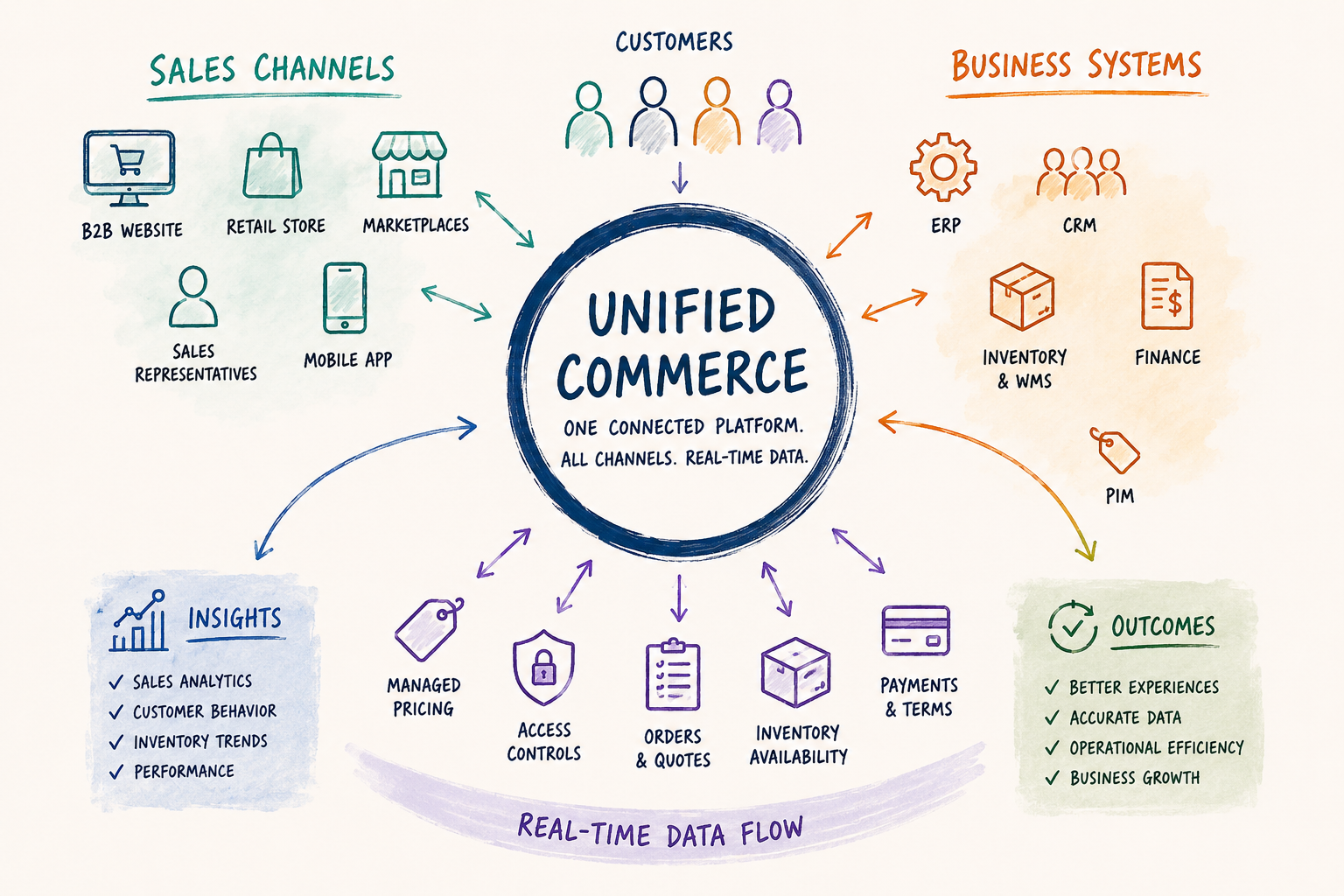
What Is Unified Commerce?
Unified commerce is an e-commerce strategy that connects sales channels with the business systems operating behind them.
Rather than allowing e-commerce, inventory, customer information, pricing and order management to operate as independent systems, unified commerce creates a connected infrastructure where information can move between them.
A unified commerce environment can connect:
- B2B e-commerce
- Retail e-commerce
- Customer accounts
- Customer levels
- Customer-specific pricing
- Product access
- Product catalogs
- Inventory
- Warehouses
- Orders
- Quotes
- Purchase orders
- Payment terms
- ERP systems
- CRM systems
- Marketplaces
- Shipping systems
- Analytics
The result is a more centralized approach to managing digital commerce.
Unified Commerce Creates a Single Source of Commerce Data
One of the biggest problems with disconnected commerce systems is data fragmentation.
A business may have product information in one database, inventory in an ERP, customer information in a CRM, orders in an e-commerce platform and additional information in accounting or warehouse systems.
When these platforms do not communicate efficiently, problems can appear throughout the customer experience.
Pricing may be outdated. Inventory may be inaccurate. Orders may require manual entry. Customer information may differ between systems.
Unified commerce connects these systems so information can be shared and updated throughout the commerce environment.
The goal is to create a more reliable single source of truth for products, customers, prices, inventory and orders.
Unified Retail and B2B E-Commerce
Unified commerce becomes even more valuable when a company sells to both retail and B2B customers.
Retail customers typically expect:
- Public pricing
- Promotions
- Simple registration
- Credit-card payments
- Fast checkout
- Immediate order confirmation
B2B customers may require:
- Customer-specific pricing
- Contract pricing
- Quantity discounts
- Product restrictions
- Purchase orders
- Credit terms
- Quotes
- Tax exemptions
- Multiple account users
- Reordering
- Custom shipping options
- ERP-connected account information
A unified retail and B2B e-commerce platform can support both types of customers without requiring completely separate commerce infrastructures.
The platform identifies the customer and delivers the appropriate products, pricing, access and purchasing capabilities.
Customer Levels and Account Management
Not every customer should receive the same e-commerce experience.
Unified commerce can organize customers into levels or classifications that determine how the website behaves.
Customer levels might include:
- Retail
- Trade
- Dealer
- Distributor
- OEM
- Contract customer
- Government
- Enterprise
Each customer level can have its own rules for pricing, products, discounts, payment options and account access.
Individual customers can also receive account-specific exceptions.
This allows a business to manage hundreds or thousands of customer relationships without creating a separate website for every customer type.
Managed and Customer-Specific Pricing
Pricing is often one of the most complicated requirements in B2B e-commerce.
Manufacturers and distributors may have retail prices, dealer prices, distributor prices, quantity breaks and negotiated contract prices operating simultaneously.
Unified commerce can centralize pricing rules and automatically display the correct price after identifying the customer.
Pricing strategies can include:
- Public retail pricing
- Customer-level pricing
- Customer-specific pricing
- Contract pricing
- Dealer pricing
- Distributor pricing
- Quantity pricing
- Volume discounts
- Promotional pricing
- Sale pricing
- Account discounts
A customer signs in and sees the pricing associated with that customer's account.
This helps transform an e-commerce website from a public catalog into a personalized B2B purchasing system.
Managed Product and Category Access
Pricing is only part of the equation.
Different customers may also require different product access.
A manufacturer might sell one product line directly to consumers while reserving another for authorized distributors. A distributor may have products available only to approved accounts. An OEM customer might have a private catalog containing products negotiated under a supply agreement.
Unified commerce can control:
- Product visibility
- Category visibility
- Pricing visibility
- Purchasing permissions
- Quote access
- Purchase-order privileges
- Payment terms
- Shipping options
- Documentation
- Account features
Customer levels and account permissions determine what each customer can see and do.
Real-Time Inventory Across E-Commerce
Inventory accuracy can directly affect conversion rates and customer satisfaction.
A product shown as available online when it is actually out of stock can result in canceled orders, delayed shipments and frustrated customers.
Unified commerce connects e-commerce with inventory and warehouse systems so product availability can be updated throughout the buying experience.
Depending on the company's systems, customers may see:
- Current inventory
- Warehouse availability
- Incoming stock
- Lead times
- Backorder status
- Estimated availability
- Location-specific quantities
This is particularly important in electronic component distribution, where buyers frequently search for specific part numbers based on immediate stock availability.
ERP Integration
The ERP is often at the center of a manufacturer's or distributor's operations.
A unified commerce strategy can integrate the ERP directly with the e-commerce platform.
ERP to E-Commerce
- Products
- Inventory
- Customers
- Customer levels
- Customer pricing
- Credit terms
- Order status
- Shipping information
E-Commerce to ERP
- New customers
- Orders
- Purchase orders
- Payments
- Shipping selections
- Account updates
API-based integration can automate these processes and reduce duplicate data entry.
CRM Integration
Unified commerce can also connect customer activity with CRM systems.
Sales representatives can gain greater visibility into what customers are doing online, while customers receive a more consistent experience when interacting with sales teams.
Connected CRM information can help businesses understand:
- Customer activity
- Order history
- Quotes
- Sales opportunities
- Account relationships
- Purchasing patterns
- Customer inquiries
For B2B companies, this can help connect digital self-service with traditional sales relationships.
Unified Order Management
Orders may originate from multiple channels.
A business might receive orders from:
- Retail e-commerce
- B2B e-commerce
- Sales representatives
- Marketplaces
- Dealer portals
- Phone orders
- EDI
- Purchase orders
Unified commerce provides an opportunity to bring these orders into a common workflow.
This improves visibility into demand while making it easier to coordinate inventory, fulfillment, customer service and reporting.
Unified Commerce vs. Omnichannel Commerce
Unified commerce and omnichannel commerce are related, but they describe different aspects of modern e-commerce.
Omnichannel Commerce
Omnichannel commerce focuses primarily on providing a consistent customer experience across multiple channels.
A customer might interact with a company through a website, marketplace, mobile device, sales representative or physical location while receiving a consistent brand experience.
Unified Commerce
Unified commerce focuses on connecting the technology and data behind those experiences.
Products, customers, prices, inventory and orders are connected so information can move between systems and channels.
Omnichannel connects customer experiences. Unified commerce connects the data and systems behind those experiences.
The strongest commerce strategy can incorporate both.
API-First Unified Commerce
Modern unified commerce depends heavily on APIs.
APIs allow e-commerce platforms to communicate with ERP, CRM, inventory, payment, shipping, marketplace and other business systems.
An API-first commerce architecture can make it easier to:
- Synchronize inventory
- Retrieve customer pricing
- Exchange orders
- Update product data
- Connect marketplaces
- Integrate payment services
- Connect shipping providers
- Build custom applications
- Support headless storefronts
This approach also provides greater flexibility as business requirements change.
Rather than forcing every operation into one rigid application, businesses can connect specialized technologies through a common commerce architecture.
Unified Product Information
Product data is particularly important for manufacturers and distributors.
Electronic and electrical components can include extensive technical information, such as:
- Manufacturer part numbers
- Specifications
- Electrical characteristics
- Dimensions
- Package types
- Compliance information
- Product images
- Datasheets
- Technical documents
- Cross references
- Related products
Unified commerce can help centralize this information and distribute it consistently across e-commerce websites and other sales channels.
This improves both the customer experience and product-data management.
Unified Commerce for Electronic and Electrical Component Distributors
Component distribution presents commerce challenges that ordinary retail stores rarely encounter.
A distributor may manage hundreds of thousands or millions of products while simultaneously supporting:
- Retail buyers
- Engineers
- Procurement departments
- OEMs
- Contract manufacturers
- Dealers
- Resellers
- Enterprise accounts
Each customer may have different pricing, payment terms, product access and inventory requirements.
Unified commerce provides a framework for managing these differences through one connected e-commerce environment.
Unified Commerce for Manufacturers
Manufacturers can also use unified commerce to support multiple routes to market.
A manufacturer might sell directly to consumers while simultaneously supporting distributors, dealers, OEM customers and enterprise accounts.
A unified platform can support these different channels while maintaining centralized product information, pricing rules and customer relationships.
This allows manufacturers to expand digital sales without necessarily creating disconnected systems for every customer group.
Unified Commerce and Marketplaces
Marketplaces have become another important sales channel for manufacturers, distributors and retailers.
Unified product and inventory information can be distributed to external marketplaces while orders and inventory updates flow back into the company's business systems.
This can help businesses manage:
- Product listings
- Pricing
- Inventory
- Orders
- Product feeds
- Marketplace availability
Centralizing this information reduces the risk of conflicting product or inventory data across channels.
Benefits of Unified Commerce
Better Data Accuracy
Connected systems reduce inconsistencies between e-commerce, ERP, inventory and customer information.
Improved Inventory Visibility
Customers and employees can access more current availability information.
Personalized B2B Experiences
Customer levels, pricing and permissions can create account-specific purchasing environments.
Fewer Manual Processes
Automated data exchange can reduce repetitive order entry, pricing updates and inventory synchronization.
Better Customer Service
Sales and customer-service teams can access more complete customer and order information.
Faster Decision-Making
Centralized commerce information provides greater visibility into products, customers, inventory and sales activity.
Greater Scalability
A connected architecture makes it easier to add customer types, sales channels and technologies as a business grows.
Unified Commerce and E-Commerce SEO
Unified commerce can also provide advantages for search engine optimization when product information is structured and managed correctly.
Instead of maintaining duplicate product information across disconnected websites, businesses can establish authoritative public product and category pages.
An effective e-commerce SEO architecture should support:
- SEO-friendly URLs
- Unique page titles
- Meta descriptions
- Product schema
- Structured specifications
- Category content
- Internal linking
- Canonical URLs
- XML sitemaps
- Optimized images
- Mobile performance
- Fast page loads
- Crawlable product pages
Public product information can remain optimized for Google and other search engines while private B2B pricing and restricted customer information remains protected behind authenticated accounts.
Unified Commerce and AI Search
Search is expanding beyond traditional search engines.
AI-powered discovery systems increasingly rely on structured, consistent and understandable product information.
Manufacturers and distributors can prepare their product catalogs for both traditional and AI-driven discovery by maintaining:
- Structured product data
- Detailed specifications
- Clear product descriptions
- Manufacturer information
- Product schema
- Category relationships
- Technical documentation
- FAQs
- Application information
A unified product-data strategy can make it easier to maintain this information consistently across digital channels.
Performance Matters
Connecting more systems should not result in a slower customer experience.
Complex pricing calculations, customer authentication, inventory requests and ERP integrations can create performance challenges if the commerce architecture is not designed correctly.
A high-performance unified commerce platform should be engineered to handle complex operations while delivering fast product, category, search and checkout experiences.
For large electronic and electrical component catalogs, speed becomes especially important because customers may perform repeated searches, filtering and product comparisons during a single session.
Choosing a Unified Commerce Platform
Businesses evaluating unified commerce should consider more than basic shopping-cart functionality.
Important capabilities include:
- Retail and B2B support
- Customer levels
- Managed pricing
- Product access controls
- Large catalog management
- Advanced product search
- Inventory integration
- ERP connectivity
- CRM integration
- API capabilities
- Order management
- Marketplace integration
- SEO capabilities
- Performance
- Security
- Scalability
The right solution should adapt to the company's business model rather than forcing the company to change established processes simply to accommodate the software.
One Connected Commerce Environment
Unified commerce is ultimately about connecting the information required to sell effectively.
Customers need products, prices, availability and purchasing options.
Businesses need accurate customer information, inventory, orders and reporting.
When those systems operate independently, commerce becomes more difficult to manage.
When they operate as part of a connected environment, businesses can create faster, more personalized and more scalable purchasing experiences.
DistyMan Unified Commerce
DistyMan provides unified e-commerce solutions designed for electronic and electrical component manufacturers, distributors and businesses with complex B2B and retail requirements.
The DistyMan platform can connect retail and B2B e-commerce while managing customer levels, customer-specific pricing, product access, inventory, orders and checkout through a unified commerce environment.
Integration capabilities can connect e-commerce with ERP, CRM, inventory, payment, shipping and other business systems while supporting large technical product catalogs and complex customer relationships.
DistyMan can also design, develop and integrate unified commerce solutions using its proprietary platform or third-party e-commerce technologies based on the requirements of the business.
One platform. Connected data. Every customer.
Frequently Asked Questions About Unified Commerce
What is unified commerce?
Unified commerce connects e-commerce sales channels with customer, product, pricing, inventory, order and business-system data through a common commerce environment.
What is the difference between unified commerce and omnichannel commerce?
Omnichannel commerce focuses primarily on creating consistent experiences across customer touchpoints. Unified commerce connects the systems and data behind those experiences, including e-commerce, inventory, ERP, CRM, pricing and order management.
Can unified commerce support retail and B2B customers?
Yes. A unified e-commerce platform can serve public retail customers while providing authenticated B2B customers with customer-specific pricing, product access, payment terms and account functionality.
What are customer levels in unified e-commerce?
Customer levels classify customers into groups such as retail, dealer, distributor, OEM or enterprise. Each customer level can receive different pricing, products, discounts, payment options and access permissions.
Can unified commerce provide customer-specific pricing?
Yes. Pricing can be managed according to customer level, individual account, contract, quantity, promotion or other business rules.
Can unified commerce integrate with an ERP?
Yes. ERP integration can synchronize products, inventory, customers, pricing, orders, credit terms and other business information with an e-commerce platform.
Can unified commerce support large product catalogs?
Yes. A properly designed unified commerce platform can support large catalogs containing extensive product attributes, specifications, documentation, images, inventory and pricing.
Why is unified commerce important for distributors?
Distributors frequently serve many different customer types with different prices, products, purchasing terms and account requirements. Unified commerce helps centralize these rules while connecting e-commerce with inventory, ERP and other business systems.
Is unified commerce useful for manufacturers?
Yes. Manufacturers can use unified commerce to support direct retail sales, distributors, dealers, OEM customers and enterprise accounts through a connected commerce infrastructure.
Does unified commerce help with SEO?
It can. Centralized product information, structured product data, fast pages, crawlable catalogs, product schema and consistent URLs can provide a stronger foundation for e-commerce SEO.
What systems can be connected to unified commerce?
Depending on the platform and business requirements, unified commerce can connect ERP, CRM, inventory, warehouse, payment, shipping, marketplace, analytics, PIM and other business systems.
What should I look for in a unified commerce platform?
Look for support for B2B and retail e-commerce, customer levels, managed pricing, access controls, large catalogs, ERP integration, APIs, inventory synchronization, SEO, performance, security and scalability.