SaaS eCommerce has become a powerful approach for businesses that need to build, operate and scale modern online commerce without managing their own eCommerce infrastructure. Instead of purchasing and maintaining servers and eCommerce software, businesses use a SaaS eCommerce platform hosted and maintained in the cloud.
For manufacturers, distributors, retailers and companies selling complex products such as electronic components and electrical components, SaaS eCommerce can provide much more than a traditional online store. Modern platforms can connect product catalogs, inventory, pricing, customers, orders, ERP systems, marketplaces and multiple sales channels through a centralized commerce environment.
A modern SaaS eCommerce platform can support B2B eCommerce, B2C eCommerce, retail commerce, marketplace commerce and omnichannel commerce, while providing the infrastructure required to manage large catalogs, complex product data, advanced search and integrations.
This guide explains what SaaS eCommerce is, how SaaS eCommerce platforms work, the benefits and challenges of cloud-based commerce, and what businesses should consider when selecting an eCommerce platform.
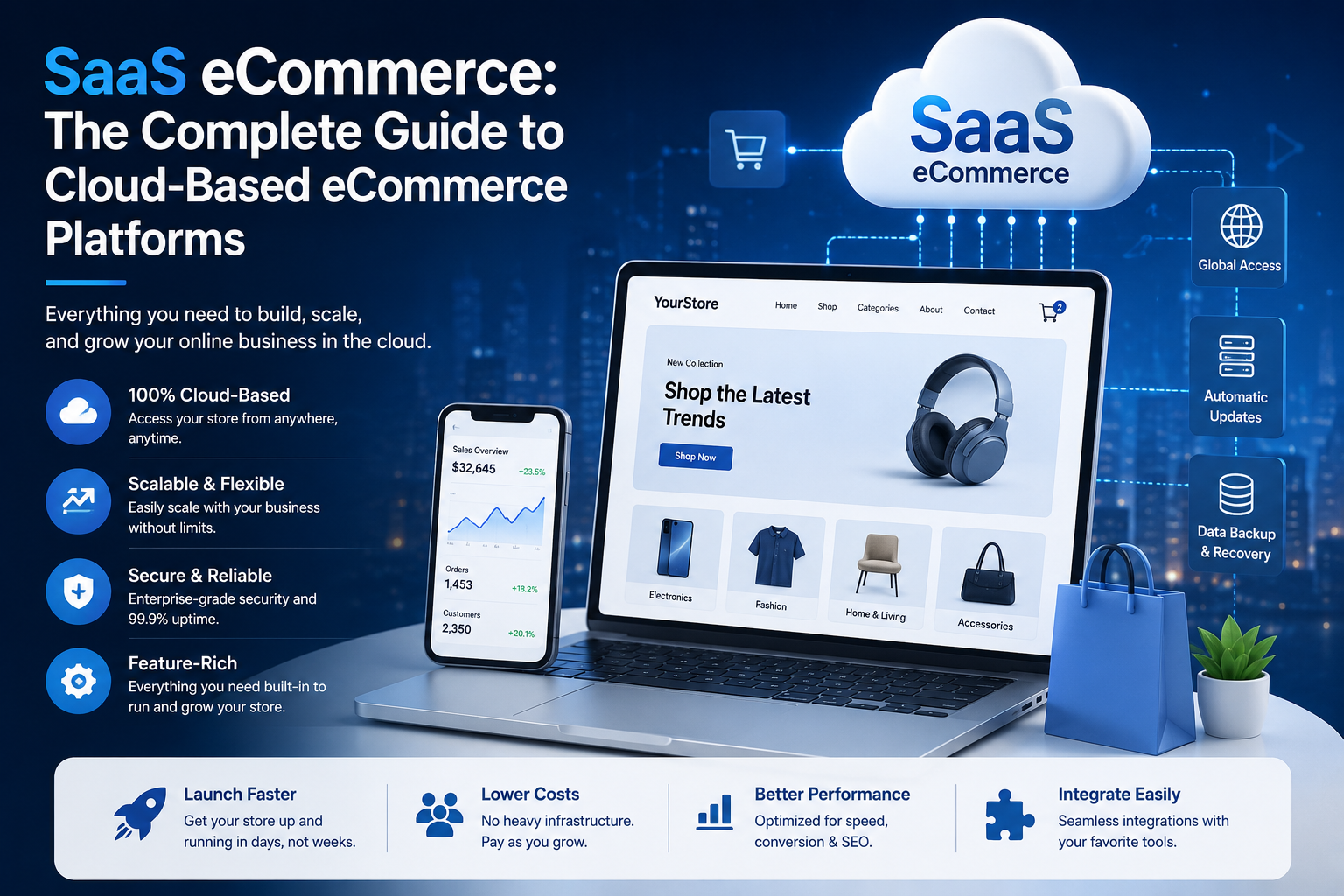
What Is SaaS eCommerce?
SaaS eCommerce refers to eCommerce software delivered as a cloud-based service rather than software that a business installs and maintains on its own servers.
SaaS stands for Software as a Service. In an eCommerce environment, the platform provider manages the core software and much of the underlying infrastructure while the business uses the platform to manage products, customers, orders, content, pricing, inventory and digital sales channels.
A modern SaaS eCommerce platform can provide:
- eCommerce website and storefront management
- Product catalog management
- Product information management
- Shopping cart and checkout
- Payment processing
- Order management
- Customer account management
- Inventory management
- Product search and filtering
- Pricing and discount management
- Tax and shipping management
- SEO tools
- Analytics and reporting
- Marketing integrations
- ERP and CRM integrations
- API connectivity
- Marketplace integrations
- Mobile and responsive commerce
The SaaS model removes much of the infrastructure management associated with traditional self-hosted eCommerce software.
For businesses selling electronic components, electrical components and other technical products, this can be particularly valuable because the eCommerce platform may need to manage extensive product specifications, large catalogs, manufacturer information, inventory, pricing and technical documentation.
What Does SaaS Mean in eCommerce?
In eCommerce, SaaS means the commerce application is hosted, maintained, updated and operated as a service.
Rather than purchasing eCommerce software and installing it on company-owned servers, businesses access the platform through the internet.
The SaaS provider typically manages:
- Hosting infrastructure
- Software updates
- Security patches
- System monitoring
- Backups
- Infrastructure scaling
- Performance optimization
- Core platform maintenance
Businesses generally pay a recurring subscription or platform fee based on features, usage, transaction volume or service requirements.
This model allows companies to spend less time maintaining eCommerce infrastructure and more time focusing on products, customers, sales, marketing and digital commerce growth.
How Does a SaaS eCommerce Platform Work?
A SaaS eCommerce platform operates using cloud infrastructure managed by the platform provider.
The eCommerce website, commerce application, databases and supporting infrastructure are hosted within the provider's environment. Businesses access the platform through an administration interface, web browser, APIs or other development tools.
When a customer visits an eCommerce website, the platform handles the underlying commerce functions required to display products, manage the shopping cart, calculate pricing and taxes, process orders and communicate with connected business systems.
Depending on the platform, SaaS eCommerce can connect to:
- ERP systems
- CRM platforms
- PIM systems
- Inventory systems
- Warehouse management systems
- Accounting software
- Payment gateways
- Shipping systems
- Marketing platforms
- Marketplaces
- Customer service systems
This connectivity is especially important for B2B eCommerce, manufacturer eCommerce and distributor eCommerce, where product, pricing, inventory and customer information frequently originates in other business systems.
SaaS eCommerce vs. Traditional eCommerce
The primary difference between SaaS and traditional self-hosted eCommerce is who manages the underlying technology infrastructure.
With self-hosted eCommerce, the business or development partner may be responsible for servers, operating systems, databases, software updates, security, backups, performance and infrastructure scaling.
With SaaS eCommerce, much of this responsibility is managed by the platform provider.
| Feature | SaaS eCommerce | Self-Hosted eCommerce |
|---|---|---|
| Hosting | Managed by provider | Managed by business or partner |
| Software updates | Typically provider-managed | Business responsibility |
| Security patches | Centrally managed | Business responsibility |
| Infrastructure | Cloud-based | Business or third-party managed |
| Scaling | Platform-managed | Requires infrastructure planning |
| Maintenance | Lower infrastructure burden | Greater technical responsibility |
| Customization | Depends on platform | Greater infrastructure control |
| Costs | Recurring platform fees | Hosting, development and maintenance |
| Deployment | Generally faster | Often more involved |
Neither architecture is automatically right for every organization. Businesses should consider their commerce requirements, technical resources, integrations, customization needs, performance requirements and long-term costs.
Why Is SaaS eCommerce Growing?
The growth of SaaS eCommerce is closely connected to the broader adoption of cloud computing and digital commerce.
Businesses increasingly expect their eCommerce platforms to be:
- Fast
- Scalable
- Secure
- Mobile-friendly
- API-connected
- SEO-friendly
- Easy to maintain
- Capable of supporting multiple sales channels
SaaS platforms can reduce the time and technical resources required to launch and operate an online store.
For smaller businesses, this can mean launching eCommerce without building a large IT infrastructure.
For larger organizations, SaaS can provide a scalable commerce foundation that connects with existing enterprise systems.
Key Benefits of SaaS eCommerce
1. Faster Time to Market
One of the major advantages of SaaS eCommerce is faster deployment.
Because the core infrastructure is already available, businesses do not need to build an entire hosting environment before beginning development.
This can make it easier to launch:
- New eCommerce websites
- B2B customer portals
- Retail storefronts
- New brands
- Regional websites
- Marketplace channels
- Product catalogs
- Digital ordering systems
Faster deployment can help businesses respond more quickly to changing markets and new digital commerce opportunities.
2. Lower Infrastructure Complexity
A SaaS eCommerce platform can reduce the need for businesses to manage servers, operating systems, databases, security infrastructure and software upgrades.
This does not eliminate the need for technical expertise. Complex eCommerce operations still require developers, designers, integration specialists, SEO professionals and digital commerce expertise.
However, technical resources can focus more on commerce functionality and business requirements instead of maintaining the underlying infrastructure.
3. Automatic Software Updates
One of the defining advantages of SaaS is centrally managed software updates.
Instead of requiring the business to manually install every platform update, the provider manages improvements and updates to the core software.
This can reduce maintenance requirements and help businesses operate on a continuously maintained commerce platform.
4. Managed Hosting and Infrastructure
SaaS eCommerce platforms include hosting infrastructure as part of the service.
Depending on the platform, infrastructure may incorporate:
- Cloud hosting
- Content delivery networks (CDNs)
- Caching
- Load balancing
- Monitoring
- Redundancy
- Automated backups
- Security controls
- Performance optimization
Managed infrastructure allows businesses to focus on the eCommerce operation rather than the physical and software infrastructure supporting it.
5. Scalability
Scalability is particularly important for growing eCommerce businesses.
An eCommerce platform may need to accommodate increases in:
- Website traffic
- Product catalog size
- Customer accounts
- Orders
- API requests
- Inventory data
- Transaction volume
- Sales channels
For large electronic component and electrical component distributors, scalability can also mean supporting hundreds of thousands or millions of products with continuously changing specifications, pricing and inventory.
SaaS eCommerce Security
Security is one of the most important considerations when selecting an eCommerce platform.
Online stores process valuable information, including customer accounts, order information, addresses, payment information and business data.
A modern eCommerce security strategy should use multiple layers of protection rather than relying on a single technology.
Depending on the platform, SaaS eCommerce security can include:
- HTTPS encryption
- Web application firewalls
- DDoS protection
- Access controls
- Multi-factor authentication
- Security monitoring
- Automated security updates
- Backup systems
- Fraud detection
- Payment security
Businesses should evaluate the specific security architecture and responsibilities of each SaaS provider rather than assuming all SaaS eCommerce platforms provide identical protection.
SaaS eCommerce for B2B and Enterprise Commerce
SaaS eCommerce is not limited to consumer retail.
Modern enterprise eCommerce platforms can support sophisticated B2B eCommerce requirements, including:
- Customer-specific pricing
- Account management
- Contract pricing
- Credit terms
- Purchase orders
- Quotations
- Quantity discounts
- Approval workflows
- Quick ordering
- ERP integration
- Customer-specific catalogs
For manufacturers and distributors, an eCommerce website may need to manage significantly more data and processes than a traditional retail store.
A B2B SaaS eCommerce platform may need to support:
- Large product catalogs
- Multiple manufacturers
- Customer-specific pricing
- Contract pricing
- Quantity pricing
- Real-time inventory
- Multiple warehouses
- Product specifications
- Quote requests
- Quick orders
- Sample requests
- Customer accounts
- Credit terms
- ERP integration
- Automated product synchronization
- Automated inventory synchronization
This is why businesses should evaluate SaaS eCommerce platforms based on their complete commerce architecture, rather than simply comparing storefront features.
SaaS eCommerce for Electronic Components and Electrical Components
Electronic components and electrical components present unique eCommerce challenges.
Customers may search by:
- Part number
- Manufacturer
- Component type
- Electrical specification
- Voltage
- Current
- Resistance
- Capacitance
- Frequency
- Package type
- Dimensions
- Compatibility
- Product series
- Technical specifications
A specialized eCommerce platform must therefore support more than basic product names and descriptions.
It may need sophisticated product attributes, technical specifications, product documents, manufacturer relationships, product substitutions, availability, pricing and advanced search.
For component manufacturers and distributors, large catalog management and product data architecture can be just as important as the shopping cart.
SaaS eCommerce and ERP Integration
For many businesses, ERP integration is one of the most important considerations when selecting an eCommerce platform.
An ERP system may contain critical business information such as:
- Product data
- Inventory
- Pricing
- Customer accounts
- Orders
- Tax information
- Shipping information
- Purchasing information
Connecting ERP and eCommerce can automate the movement of information between systems.
A strong SaaS eCommerce platform should provide APIs, integration tools, scheduled processes, webhooks or other mechanisms for connecting commerce with external business applications.
For manufacturers and distributors, ERP integration can reduce manual data entry and help keep products, pricing, inventory, customers and orders synchronized.
SaaS eCommerce and Large Product Catalogs
Large product catalogs create unique challenges for eCommerce platforms.
A distributor or manufacturer may have hundreds of thousands or even millions of products, with each product containing multiple specifications, images, documents, manufacturers, categories, attributes and inventory records.
The platform must therefore support more than simply storing product records.
It should provide efficient:
- Product search
- Faceted navigation
- Filtering
- Category management
- Product attributes
- Product synchronization
- Inventory synchronization
- Pricing synchronization
- API access
- SEO management
Advanced search is especially important for technical products because customers need to find products based on part numbers, manufacturers, specifications, dimensions, electrical characteristics, compatibility and other technical attributes.
SaaS eCommerce and SEO
The eCommerce platform provides an important technical foundation for eCommerce SEO.
Important SaaS eCommerce SEO capabilities can include:
- SEO-friendly URLs
- Editable page titles
- Meta descriptions
- Canonical URLs
- XML sitemaps
- Structured data
- Product schema
- Category optimization
- Image optimization
- Internal linking
- Mobile optimization
- Fast page performance
- Crawlable product pages
For large product catalogs, technical SEO becomes especially important because thousands or millions of product and category pages can represent potential search opportunities.
A fast, well-structured eCommerce platform can support both organic search visibility and customer experience.
SaaS eCommerce and AI Search
Search is evolving beyond traditional search engines.
Customers increasingly use AI-powered tools to research products, compare solutions, identify suppliers and answer product-related questions.
This creates new opportunities for eCommerce businesses to improve their product content and technical information.
Well-structured product data, detailed specifications, category content, FAQs, structured data and authoritative supporting content can make information easier for search engines and AI systems to interpret.
Modern SaaS eCommerce strategies should therefore consider traditional SEO, technical SEO and AI search optimization as part of the broader digital commerce strategy.
Types of SaaS eCommerce Solutions
Hosted SaaS Store Platforms
Hosted store platforms provide an integrated environment for creating and managing an online store.
These platforms generally include storefront functionality, product management, checkout, order management, hosting and administrative tools.
They are often suited to businesses looking for a relatively straightforward way to launch and operate an online store.
Enterprise SaaS eCommerce Platforms
Enterprise SaaS eCommerce platforms are designed for organizations with more complex requirements.
They may support:
- Large product catalogs
- High traffic volumes
- Multiple customer types
- Multiple sales channels
- Advanced integrations
- Complex pricing
- Custom business processes
Enterprise platforms are often used by manufacturers, distributors, retailers and organizations operating across multiple markets.
Headless SaaS eCommerce
Headless eCommerce separates the customer-facing frontend from the backend commerce platform.
The commerce platform manages products, customers, pricing, carts and orders, while APIs connect commerce functionality to a separate frontend.
Headless commerce can provide greater flexibility for businesses requiring highly customized digital experiences or multiple frontend applications.
API-First SaaS eCommerce
An API-first eCommerce platform emphasizes connecting commerce functionality with external applications.
API connectivity can be particularly valuable for manufacturers and distributors because it allows eCommerce to exchange information with ERP, CRM, PIM, inventory, warehouse, accounting and other systems.
SaaS eCommerce and Omnichannel Commerce
Customers increasingly interact with businesses through multiple channels.
An organization may sell through:
- Its eCommerce website
- B2B portals
- Retail websites
- Marketplaces
- Mobile applications
- Social channels
- Dealer portals
- Sales representatives
- Other digital sales channels
An omnichannel eCommerce platform can help businesses manage these channels from a connected commerce environment.
The objective is not simply to sell through more channels. It is to provide consistent product information, pricing, inventory, customer information and ordering processes across those channels.
How to Choose the Right SaaS eCommerce Platform
Choosing a SaaS eCommerce platform should begin with business requirements rather than a platform's feature list.
Evaluate Your Product Catalog
Consider:
- Number of products
- Product attributes
- Product variations
- Technical specifications
- Number of categories
- Manufacturer relationships
- Product documentation
- Inventory complexity
Large catalogs require significantly different technology from small retail catalogs.
Evaluate Your Sales Channels
Determine whether the business requires:
- B2B eCommerce
- B2C eCommerce
- Retail commerce
- Marketplaces
- Dealer portals
- Mobile commerce
- Omnichannel commerce
Evaluate Integrations
Identify systems that must connect with eCommerce, including:
- ERP
- CRM
- PIM
- Inventory
- Accounting
- Warehouse management
- Payment processing
- Shipping
- Marketing automation
- Marketplaces
Evaluate Performance and Scalability
Ask how the platform handles:
- Traffic spikes
- Large catalogs
- High transaction volumes
- API requests
- Inventory updates
- Search queries
- Concurrent users
Performance should be evaluated against real-world business requirements.
Evaluate Total Cost of Ownership
Look beyond the advertised monthly subscription.
Consider:
- Platform fees
- Transaction fees
- Payment processing
- Applications
- Development
- Integrations
- Data migration
- Design
- SEO
- Maintenance
- Professional services
Potential Challenges of SaaS eCommerce
SaaS eCommerce provides substantial advantages, but businesses should also understand its potential limitations.
Platform Dependency
Businesses depend on the SaaS provider for core infrastructure, platform availability, updates and many technology decisions.
Before selecting a provider, understand service commitments, support policies, data access, backup policies and migration options.
Customization Limitations
Some SaaS platforms restrict access to the underlying infrastructure or limit certain types of customization.
Businesses with specialized commerce processes should evaluate APIs, integrations, frontend flexibility and available development options.
Recurring Costs
SaaS eliminates many infrastructure expenses but replaces them with recurring platform costs.
Businesses should evaluate the total cost over the expected life of the eCommerce operation.
Data Portability
Businesses should understand how easily products, customers, orders, content and other information can be exported if they eventually move to another platform.
Data portability is an important consideration for any long-term eCommerce investment.
The Future of SaaS eCommerce
SaaS eCommerce continues to evolve as businesses adopt new technologies and customers use more digital channels.
Several trends are shaping the future of cloud-based commerce.
AI-Powered eCommerce
Artificial intelligence is increasingly being used for:
- Product recommendations
- Search
- Personalization
- Customer service
- Product content
- Marketing automation
- Demand forecasting
- Merchandising
Headless and Composable Commerce
Headless and composable architectures provide businesses with greater flexibility in how frontend experiences and backend commerce systems are assembled.
Omnichannel Commerce
Businesses are increasingly connecting websites, marketplaces, mobile experiences, dealer portals and other channels through centralized commerce infrastructure.
API-Driven Commerce
APIs will continue to connect eCommerce with ERP, CRM, PIM, inventory, warehouse, marketing, AI and other business systems.
For enterprise organizations, the ability to connect commerce data across the business can be as important as the storefront itself.
Why Choose DistyMan for SaaS eCommerce?
DistyMan is a SaaS eCommerce platform designed for manufacturers, distributors, retailers and businesses with complex digital commerce requirements.
Rather than focusing exclusively on storefront creation, DistyMan combines eCommerce technology, design, development, product data and digital marketing to support the broader commerce operation.
DistyMan supports:
- B2B eCommerce
- B2C and retail eCommerce
- Marketplace commerce
- Large product catalogs
- Advanced product search
- ERP integration
- API connectivity
- Inventory visibility
- Flexible pricing
- Order management
- Quote requests
- Automated commerce processes
- SEO-focused eCommerce architecture
The platform is particularly suited to businesses that need to connect eCommerce with existing ERP, inventory, product, customer and other networked systems.
DistyMan SaaS eCommerce Capabilities
- SaaS eCommerce hosting
- B2B eCommerce
- B2C and retail eCommerce
- Marketplace eCommerce
- ERP integration
- API-first connectivity
- Advanced product search
- Large catalog management
- Real-time inventory visibility
- Multi-level pricing
- Customer-specific pricing
- Quote management
- Quick order tools
- Sample order requests
- Tax and shipping management
- SEO-focused eCommerce architecture
- Automated data synchronization
- Omnichannel commerce
- Custom storefront design and development
For organizations evaluating SaaS eCommerce platforms, the most important consideration is not simply how quickly an online store can be launched. The platform should provide a foundation capable of supporting the business as its products, customers, transactions, integrations and digital sales channels grow.
SaaS eCommerce Frequently Asked Questions
What is SaaS eCommerce?
SaaS eCommerce is a cloud-based model in which eCommerce software is hosted and maintained by a provider and delivered to businesses over the internet. The platform typically includes storefront, product, order, customer, payment and commerce management functionality.
What is a SaaS eCommerce platform?
A SaaS eCommerce platform is cloud-based software used to create and operate an online store or digital commerce operation. The platform provider generally manages hosting, infrastructure, software updates, security and core maintenance.
What are the benefits of SaaS eCommerce?
Benefits can include faster deployment, reduced infrastructure management, automatic updates, managed security, scalability, predictable platform costs and access to integrated commerce functionality.
Is SaaS eCommerce good for B2B?
Yes. Enterprise SaaS eCommerce platforms can support B2B requirements such as customer-specific pricing, account management, credit terms, quotes, purchase orders, quantity pricing, approval workflows, quick ordering and ERP integration.
Can SaaS eCommerce integrate with ERP systems?
Yes. SaaS eCommerce platforms with APIs and integration capabilities can connect with ERP systems to synchronize products, inventory, pricing, customers, orders, shipping information and other business data.
Is SaaS eCommerce suitable for large product catalogs?
Yes, provided the platform is designed to support large catalogs. Businesses with hundreds of thousands or millions of products should evaluate catalog architecture, search performance, filtering, API capabilities, product synchronization, inventory synchronization and SEO scalability.
Can SaaS eCommerce support headless commerce?
Yes. SaaS platforms with robust APIs can serve as the backend commerce engine in a headless architecture. A separate frontend can communicate with the platform through APIs to create a customized customer experience.
Is SaaS eCommerce secure?
A reputable SaaS eCommerce platform can provide multiple layers of security, including encrypted connections, managed infrastructure, firewalls, monitoring, access controls, security updates and backups. Businesses should evaluate the specific security architecture and responsibilities of each provider.
How much does SaaS eCommerce cost?
SaaS eCommerce pricing varies based on platform capabilities, traffic, product catalog size, transaction volume, integrations and customization. Businesses should consider total cost of ownership, including platform fees, development, applications, integrations, payment processing, migration and ongoing services.
Is SaaS eCommerce better than self-hosted eCommerce?
It depends on the business. SaaS eCommerce can reduce infrastructure management and simplify updates, security and scaling. Self-hosted platforms can provide greater control over infrastructure and certain types of customization. The appropriate approach depends on technical resources, business processes, integrations and long-term strategy.
Build a More Flexible SaaS eCommerce Operation with DistyMan
For manufacturers, distributors, retailers and other organizations with complex digital commerce requirements, choosing an eCommerce platform is about more than launching an online store.
The right SaaS eCommerce platform should provide the performance, scalability, integrations, product management, search, pricing, inventory, ordering, SEO and flexibility required to operate a modern digital commerce business.
DistyMan brings these capabilities together in a SaaS eCommerce platform built for B2B, B2C, retail, distributor, manufacturer and marketplace commerce.
Whether you are replacing an existing eCommerce platform, launching a new B2B portal, building a retail storefront, connecting an ERP to eCommerce or developing a multi-channel commerce strategy, DistyMan provides a scalable foundation for modern digital commerce.
From electronic components and electrical components to complex industrial product catalogs, DistyMan combines eCommerce technology with design, development, product data and digital marketing to help businesses build and grow their online commerce operations.