Customers no longer follow a single path when researching and purchasing electronic components and electrical components. An engineer may discover a product through Google, review specifications on a manufacturer's website, check inventory through a distributor, request a quote from a sales representative and ultimately place the order through a B2B e-commerce portal.
Other customers may purchase through a retail website, marketplace, mobile device, procurement system or directly from a salesperson.
For electronic component distributors and manufacturers, simply participating in multiple channels is no longer enough. Products, inventory, customers, pricing, orders and product information need to move between those channels.
That is the foundation of omnichannel e-commerce.
A successful omnichannel strategy connects digital and traditional sales channels so customers receive a consistent purchasing experience regardless of where or how they interact with your business.
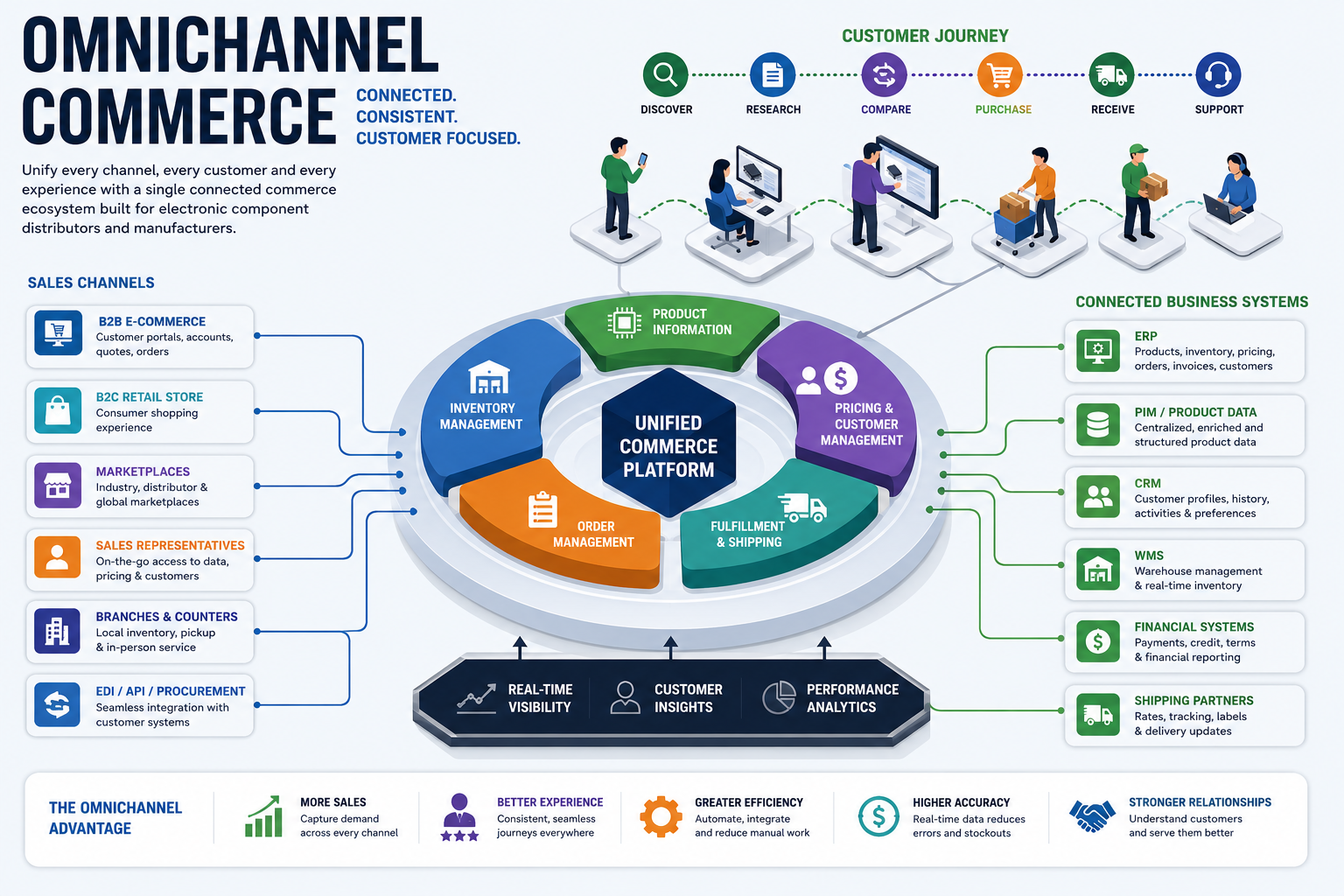
What Is Omnichannel E-Commerce?
Omnichannel e-commerce is a commerce strategy that connects customer experiences, product information and business operations across multiple sales channels.
For a distributor or manufacturer, those channels might include:
- B2B e-commerce websites
- B2C retail websites
- Manufacturer websites
- Distributor websites
- Online marketplaces
- Customer portals
- Dealer portals
- Sales representatives
- Inside sales teams
- Physical locations and counters
- Mobile devices
- Procurement platforms
- EDI connections
- API-connected customers
The objective is to allow customers to move between these channels without encountering disconnected product information, inaccurate inventory, conflicting pricing or fragmented account information.
Instead of maintaining separate commerce environments, an omnichannel strategy connects them through a common technology and data infrastructure.
Omnichannel vs. Multichannel E-Commerce
Multichannel and omnichannel are not the same thing.
A multichannel company sells through several channels, but those channels may operate independently.
For example, a distributor could have:
- A B2B website
- A retail website
- A marketplace account
- A sales department
- A customer service department
- Multiple warehouses
If each channel maintains separate information and processes, the company is operating a multichannel model.
Omnichannel commerce connects those channels.
The distinction can be summarized as:
Multichannel = Selling through multiple channels.
Omnichannel = Connecting those channels into a unified customer experience.
That connection is especially important for electronic and electrical component companies where product data, customer pricing and inventory can be significantly more complicated than traditional retail e-commerce.
The Foundation of Omnichannel Commerce: One Connected Platform
A true omnichannel strategy requires more than a modern website.
The underlying commerce platform must be capable of connecting the information customers and employees need throughout the purchasing process.
That typically includes:
- Products
- Technical specifications
- Customers
- Pricing
- Inventory
- Orders
- Quotations
- Shipping
- Payments
- Product documentation
- Sales history
When these systems work together, the customer can receive a much more consistent experience across B2B, B2C, marketplace and traditional sales channels.
Unified Product Data Across Every Channel
Product information is one of the most important foundations of omnichannel e-commerce for the electronic component industry.
Electronic and electrical components can contain dozens or hundreds of technical attributes, including:
- Manufacturer
- Manufacturer part number
- Product family
- Description
- Voltage
- Current
- Power
- Frequency
- Resistance
- Capacitance
- Dimensions
- Operating temperature
- Package or case
- Material
- Compliance information
- Datasheets
- Drawings
- Images
- Certifications
This information should not need to be independently created and maintained for every sales channel.
A better approach is to establish a structured product-data foundation that can distribute accurate information to:
E-Commerce + Marketplaces + Mobile + Sales Teams + Customer Portals + Digital Marketing
Centralizing product information can improve accuracy while reducing duplicate content management.
Real-Time Inventory Across Warehouses and Sales Channels
Inventory visibility is another critical component of omnichannel e-commerce for distributors and manufacturers.
Component inventory may be distributed across:
- Primary warehouses
- Regional warehouses
- Branch locations
- Manufacturer inventory
- Supplier inventory
- Third-party logistics providers
- Drop-ship partners
- Marketplace sellers
Customers should be able to see accurate availability regardless of the channel they use.
An omnichannel platform can consolidate these inventory sources and determine which inventory is available for each customer, product and order.
For component buyers, this is particularly important because inventory availability and lead time can directly affect engineering, purchasing and production decisions.
Customer-Specific Pricing Across Channels
Pricing presents another challenge for B2B omnichannel commerce.
Unlike traditional retail, many electronic and electrical component distributors do not sell every product to every customer at the same price.
Pricing may depend on:
- Customer classification
- Contract pricing
- Negotiated pricing
- Quantity
- Order volume
- Manufacturer agreements
- Customer location
- Sales territory
- Product category
- Payment terms
An omnichannel platform should recognize the customer and apply the appropriate pricing rules regardless of whether that customer is interacting with the website, a salesperson or another connected purchasing channel.
This helps create a consistent B2B customer experience and reduces conflicts between online and offline pricing.
Create a Unified Customer Account
Customer information should also follow the customer across channels.
Instead of maintaining separate identities for web customers, marketplace customers and traditional sales accounts, businesses should work toward creating a unified customer profile.
A B2B customer account might include:
- Company information
- Multiple users
- Customer classification
- Contract pricing
- Product access
- Payment terms
- Credit limits
- Shipping addresses
- Order history
- Quotes
- Saved product lists
- Purchase history
This provides customers with greater self-service capabilities while giving sales and customer service teams access to a more complete picture of the relationship.
Connect Online E-Commerce With Your Sales Team
Omnichannel commerce does not eliminate the traditional sales representative.
For many B2B distributors and manufacturers, it can make salespeople more effective.
Sales representatives can benefit from access to the same information customers use online, including:
- Current inventory
- Customer-specific pricing
- Order history
- Open quotations
- Product specifications
- Customer activity
- Related products
- Product availability
A customer might research products online and then contact a sales representative for assistance.
The representative should be able to continue that purchasing process rather than forcing the customer to start again.
Likewise, a salesperson can create a quote that the customer later reviews and converts into an online order.
This creates a connected digital + human B2B sales experience.
Integrate Marketplaces Into Your Omnichannel Strategy
Online marketplaces can become another important component of an omnichannel commerce strategy.
Distributors and manufacturers may sell products through:
- Industry marketplaces
- General marketplaces
- Distributor marketplaces
- Procurement marketplaces
- Private B2B marketplaces
- Company-operated multivendor marketplaces
The challenge is managing marketplace commerce without creating another isolated catalog and inventory system.
A connected platform can distribute:
- Product information
- Images
- Technical specifications
- Pricing
- Inventory
- Availability
to marketplace channels while bringing orders back into the central commerce or ERP environment.
This creates a much more scalable approach to marketplace e-commerce.
Connect Your ERP to E-Commerce
For many manufacturers and distributors, the ERP remains the operational backbone of the business.
An omnichannel platform may need to integrate with ERP data involving:
- Products
- Inventory
- Customers
- Pricing
- Orders
- Invoices
- Shipping
- Credit
- Taxes
- Purchasing
- Returns
APIs, EDI and other integration technologies can allow this information to move automatically between systems.
The objective should be to eliminate unnecessary duplicate data entry and make current business information available wherever it is needed.
Order Management Across Multiple Channels
Once orders begin arriving from multiple channels, centralized order management becomes increasingly important.
Orders may originate from:
- B2B websites
- B2C websites
- Marketplaces
- Sales representatives
- Customer service
- EDI
- Procurement systems
- Mobile devices
Instead of creating separate fulfillment workflows for each channel, orders can be routed into a common order-management environment.
The platform can then determine:
- Where inventory is located
- Which warehouse should fulfill the order
- Whether products need to be split between locations
- Whether a supplier should drop-ship an item
- Which shipping method applies
- What customer-specific terms should be used
This can make fulfillment more efficient as the number of digital sales channels increases.
Omnichannel B2B E-Commerce
Omnichannel commerce becomes particularly powerful when applied to B2B purchasing.
Business customers may require capabilities that traditional retail platforms were not designed to handle.
These can include:
- Customer-specific catalogs
- Customer-specific pricing
- Quantity discounts
- RFQs and quotations
- Purchase orders
- Credit terms
- Multiple users per account
- Approval workflows
- Quick-order entry
- Part-number uploads
- Saved product lists
- Reordering
The goal is to provide the convenience of modern e-commerce without eliminating the business rules B2B customers and distributors depend on.
Omnichannel B2C and Retail E-Commerce
Manufacturers and distributors that also sell directly to consumers can use the same commerce foundation to support B2C retail.
Retail customers may require:
- Fast product search
- Mobile shopping
- Promotional pricing
- Coupons
- Product bundles
- Related products
- Cross-selling
- Gift cards
- Loyalty programs
- Fast checkout
An omnichannel architecture allows these retail features to coexist with more complex B2B requirements.
This can be especially valuable for manufacturers that serve distributors, commercial customers and consumers from the same underlying product catalog.
Connecting Online and Physical Locations
For companies with branches, retail locations, service counters or distribution facilities, omnichannel commerce can also connect online and physical operations.
Depending on the business model, customers might be able to:
- Check local inventory online
- Buy online and pick up locally
- Reserve products for pickup
- Order products unavailable at the local branch
- Return online purchases at a physical location
- Access the same customer account online and in person
This can transform physical locations from isolated sales channels into extensions of the digital commerce platform.
Technical Search Is Critical for Component E-Commerce
Omnichannel commerce only works when customers can find the products they need.
For electronic and electrical components, this often requires much more than a basic keyword search.
Customers may search by:
- Exact manufacturer part number
- Partial part number
- Manufacturer
- Product family
- Keyword
- Technical specification
- Dimension
- Electrical characteristic
- Cross reference
- Application
Parametric search and faceted navigation can allow customers to narrow thousands of products using relevant technical attributes.
The same structured product information can then support website search, marketplace feeds, SEO and AI-powered product discovery.
Omnichannel E-Commerce and SEO
A strong omnichannel strategy can also support organic search visibility.
Centralized and structured product information makes it easier to create optimized:
- Product pages
- Category pages
- Manufacturer pages
- Technical content
- Selection guides
- Application content
SEO optimization should include:
- Search-friendly URLs
- Unique page titles
- Meta descriptions
- Product schema
- Structured data
- Canonical URLs
- XML sitemaps
- Image optimization
- Internal linking
- Fast page performance
- Mobile usability
For component distributors and manufacturers, highly structured product catalogs can create thousands of opportunities to rank for manufacturer names, part numbers, technical specifications and long-tail product searches.
Omnichannel E-Commerce and AI Product Discovery
Structured commerce data is also becoming increasingly important as customers use AI-powered search and purchasing tools.
AI systems can better understand products when information clearly defines:
- What the product is
- Who manufactures it
- Its technical specifications
- Its applications
- Its compatibility
- Related products
- Alternative products
- Availability
A well-structured omnichannel catalog can therefore support traditional e-commerce search, SEO, marketplaces and emerging AI-driven product discovery from the same product-data foundation.
Performance Matters Across Every Channel
Adding more integrations and functionality should not mean sacrificing website performance.
Engineers and purchasing professionals need to search large catalogs, apply technical filters, check inventory and access product information quickly.
A high-performance e-commerce architecture should be designed to deliver fast responses even when processing complex:
- Product catalogs
- Customer pricing
- Inventory queries
- Search filters
- ERP requests
- API integrations
Speed improves usability and helps customers move from product discovery to purchase with less friction.
Measure the Customer, Not Just the Channel
Traditional analytics often evaluate each channel independently.
But an omnichannel customer journey may involve several interactions before an order occurs.
For example:
Google Search → Product Page → Datasheet → Sales Representative → Quote → Online Order
If only the final transaction is measured, much of the customer journey is invisible.
Omnichannel analytics should provide a broader understanding of:
- Customer acquisition
- Product discovery
- Channel interaction
- Quote activity
- Orders
- Repeat purchases
- Customer lifetime value
This allows manufacturers and distributors to understand how digital marketing, e-commerce and traditional sales work together.
Benefits of Omnichannel E-Commerce for Distributors
For electronic and electrical component distributors, an omnichannel strategy can help connect traditionally separate areas of the business.
Potential benefits include:
- More consistent customer experiences
- Improved inventory visibility
- Expanded digital sales channels
- Better customer self-service
- Consistent customer-specific pricing
- Improved sales-team productivity
- More efficient order processing
- Stronger marketplace integration
- Reduced duplicate data management
- Greater insight into customer activity
Benefits of Omnichannel E-Commerce for Manufacturers
Manufacturers can use omnichannel commerce to support multiple routes to market without treating each as a completely separate operation.
A manufacturer might simultaneously support:
- Direct B2B sales
- Distributor sales
- Direct-to-consumer sales
- Dealer networks
- Marketplaces
- Sales representatives
The underlying product information and commerce infrastructure can support all of these channels while providing different pricing, access and purchasing experiences for different customer groups.
From Multiple Channels to Unified Commerce
As omnichannel operations become more sophisticated, companies can move toward a unified commerce architecture.
Instead of building independent systems around each channel, unified commerce creates a central platform for managing:
Products → Customers → Access → Pricing → Inventory → Orders → Fulfillment
The individual sales channels become interfaces into the same underlying commerce environment.
This architecture can make it significantly easier to add new channels, marketplaces, customer portals and integrations as the business grows.
How to Build an Omnichannel E-Commerce Strategy
A successful omnichannel implementation should begin with the customer and business requirements rather than a specific software platform.
Important questions include:
- Which customers do you serve?
- Which channels do they use?
- Where is product information managed?
- Where is inventory stored?
- How is customer pricing calculated?
- Which system owns customer information?
- How are orders processed?
- Which marketplaces need to be supported?
- How should sales representatives interact with online customers?
- Which ERP, CRM, PIM or warehouse systems need integration?
- Which processes can be automated?
Answering these questions helps determine the correct technology architecture instead of forcing business requirements into a predetermined platform.
DistyMan Omnichannel E-Commerce Solutions
DistyMan provides e-commerce design, development, integration, product content and digital marketing services for electronic and electrical component distributors and manufacturers.
We develop e-commerce solutions around complex product catalogs, technical data and B2B business requirements using the DistyMan proprietary platform or third-party e-commerce technologies.
Our omnichannel capabilities can include:
- B2B e-commerce
- B2C retail e-commerce
- Unified commerce
- Marketplace integration
- Customer-specific pricing
- Customer-specific product access
- Large technical product catalogs
- Real-time inventory
- Multiple warehouse inventory
- ERP integration
- CRM integration
- API and EDI connectivity
- Product data management
- Technical search and filtering
- Order management
- SEO
- Digital marketing
The goal is to create a commerce environment where customers, products, pricing, inventory and orders remain connected regardless of the channel.
Connect Every Channel With One E-Commerce Strategy
For electronic component distributors and manufacturers, omnichannel commerce is not simply about selling in more places.
It is about connecting those places.
Your website, B2B portal, marketplace, sales team, warehouses, ERP and customer accounts should work together rather than operate as independent systems.
When product data, customer access, pricing, inventory, orders and fulfillment are connected, customers can move between channels with less friction while your organization gains a more complete view of the entire purchasing process.
That is the difference between operating multiple sales channels and building a true omnichannel e-commerce platform.