The traditional distribution model is changing. Buyers of electronic components and electrical components increasingly expect to search products, compare specifications, check inventory, view pricing and place orders online without relying entirely on phone calls, emails or sales representatives.
For distributors and manufacturers, a B2B marketplace can take digital commerce beyond the limitations of a traditional single-seller e-commerce website.
Instead of selling only products owned or stocked by one company, a B2B marketplace can bring products from multiple manufacturers, distributors, suppliers and inventory sources together within a single digital commerce environment.
For the electronic component industry, where millions of SKUs, thousands of manufacturers and constantly changing inventory sources are common, the marketplace model can create significant opportunities.
But successful B2B marketplace e-commerce requires much more than simply importing additional products.
The marketplace must effectively manage suppliers, product data, technical specifications, pricing, inventory, customer accounts, orders, fulfillment and integrations while still providing the fast and intuitive purchasing experience customers expect.
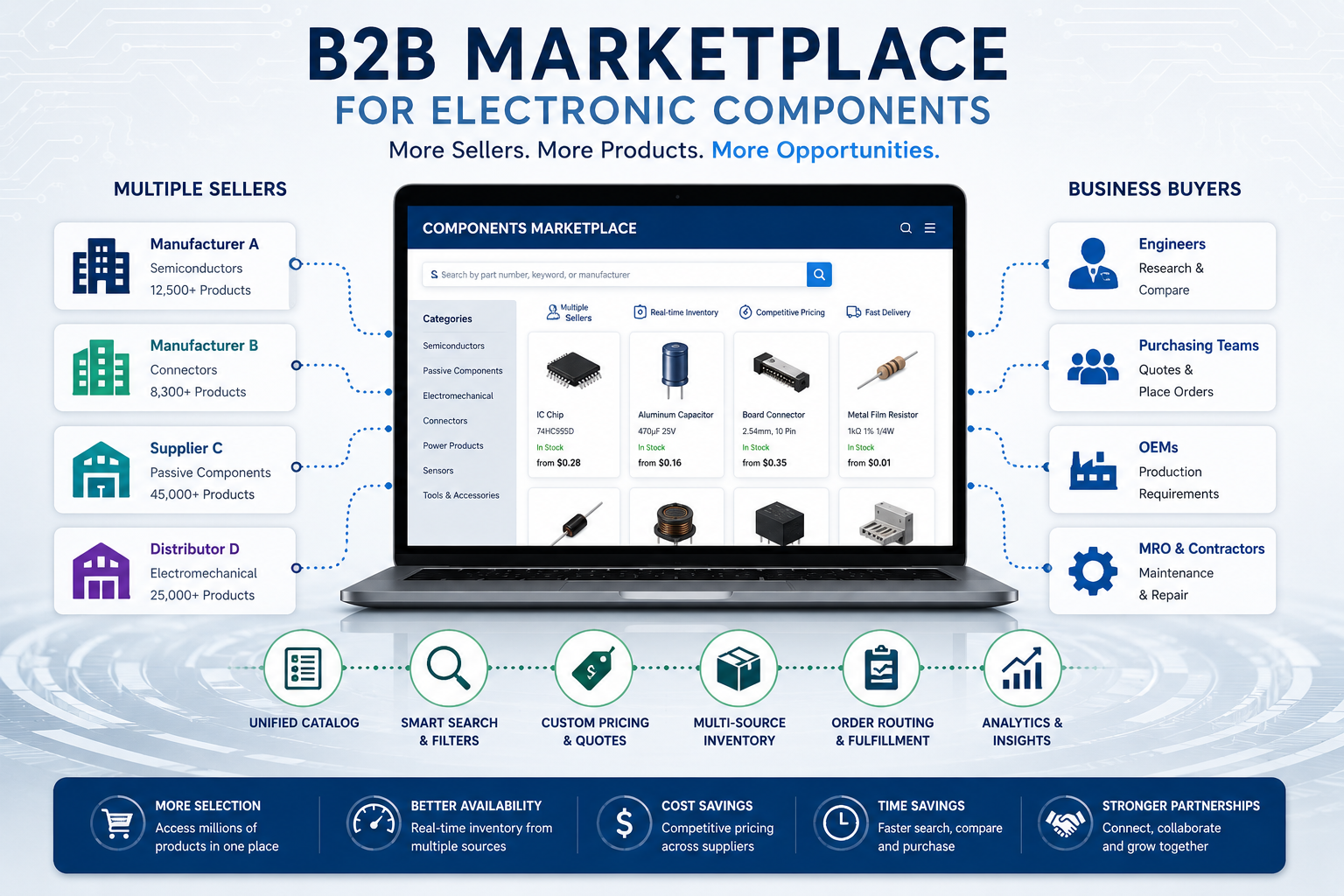
What Is a B2B Marketplace?
A B2B marketplace is an e-commerce environment where businesses buy products or services from one or more business sellers.
Unlike a traditional e-commerce website where a single company generally controls the catalog and fulfills the products being sold, a marketplace can support multiple sellers through the same digital platform.
The marketplace typically connects three primary groups:
- Marketplace Operator – The company that operates and manages the marketplace.
- Suppliers and Sellers – Manufacturers, distributors or other approved companies providing products.
- B2B Buyers – OEMs, purchasing departments, engineers, contractors, manufacturers and other business customers purchasing those products.
The marketplace operator provides the digital infrastructure connecting these participants while managing the customer experience, product information and transaction process.
B2B Marketplace vs. Traditional B2B E-Commerce
The primary difference between a B2B marketplace and a traditional B2B e-commerce website is the number of sellers and inventory sources that can participate.
A traditional distributor website might sell:
Distributor Inventory → Distributor Website → Customer
A marketplace can expand that model to:
Distributor Inventory + Manufacturer Inventory + Supplier Inventory + Partner Inventory → Marketplace → Customer
The customer still receives a unified purchasing experience, but the products may originate from multiple sources.
This model can dramatically expand the digital catalog without requiring the marketplace operator to physically stock every product being offered.
Why B2B Marketplaces Make Sense for Electronic Components
The electronic and electrical component industry is particularly well suited to B2B marketplace commerce.
A typical component distributor may represent hundreds of manufacturers and manage hundreds of thousands or millions of part numbers.
Products may include:
- Semiconductors
- Integrated circuits
- MOSFETs and transistors
- Diodes and rectifiers
- Capacitors
- Resistors
- Connectors
- Relays
- Switches
- Sensors
- Power supplies
- Circuit protection
- RF and microwave components
- Electromechanical components
- Wire and cable
- Terminal blocks
- Industrial controls
No single distributor necessarily stocks every product customers may need.
A marketplace model can help bridge that gap by combining multiple product and inventory sources into a larger searchable catalog.
Expand Your Product Catalog Without Stocking Every SKU
One of the biggest advantages of a B2B marketplace is the ability to expand product selection without purchasing and warehousing every product.
A distributor could potentially combine:
Stocked Products + Manufacturer Products + Supplier Products + Drop-Ship Products + Marketplace Products
within a single e-commerce catalog.
This creates a significantly larger digital product offering while allowing different suppliers to manage or fulfill portions of the catalog.
For electronic component distributors, the traditional line card can effectively evolve into a much larger digital product ecosystem.
Create a Single Destination for Component Buyers
Engineers and purchasing teams often search multiple websites to locate the components they need.
They may visit manufacturer websites for technical documentation, distributor websites for inventory and marketplaces to locate difficult-to-find products.
A well-designed electronic component marketplace can consolidate more of that process into one location.
Customers can potentially:
- Search multiple manufacturers
- Compare products
- Review specifications
- Download datasheets
- Check inventory
- Compare availability
- View customer pricing
- Request quotations
- Purchase products
- Track orders
The easier it becomes to research and purchase components, the more valuable the marketplace becomes to the customer.
Product Data Is the Foundation of a Component Marketplace
A large catalog has limited value if customers cannot accurately find and evaluate the products.
That makes product data management one of the most important parts of an electronic component marketplace.
Product records may require:
- Manufacturer name
- Manufacturer part number
- Product category
- Product family
- Technical description
- Electrical characteristics
- Mechanical characteristics
- Voltage
- Current
- Frequency
- Power
- Dimensions
- Operating temperature
- Package or case
- Compliance information
- Images
- Datasheets
- Drawings
- Certifications
- Cross references
When products originate from multiple manufacturers and suppliers, this information may arrive in completely different formats.
Successful marketplace development therefore requires processes for normalizing, categorizing and enriching product information before presenting it to customers.
Technical Search and Parametric Filtering
Search is especially important when a B2B marketplace contains hundreds of thousands or millions of electronic components.
Customers should not have to manually browse thousands of products to find the correct part.
An advanced marketplace can provide:
- Manufacturer part-number search
- Partial part-number search
- Keyword search
- Manufacturer filtering
- Category filtering
- Parametric search
- Technical attribute filtering
- Cross-reference search
- Related products
- Product substitutions
- Alternative components
For example, an engineer searching for a capacitor might narrow thousands of products by capacitance, voltage, tolerance, dielectric, package size and operating temperature.
The marketplace becomes much more valuable when it helps the customer identify the correct product instead of simply displaying more products.
Real-Time Inventory From Multiple Sources
Inventory is another critical component of B2B marketplace e-commerce.
Marketplace inventory may originate from:
- Distributor warehouses
- Branch locations
- Manufacturers
- Authorized suppliers
- Third-party warehouses
- Fulfillment partners
- Marketplace sellers
Connecting these inventory sources can provide customers with a much broader picture of product availability.
Instead of simply displaying what is available in one warehouse, the marketplace can potentially identify inventory throughout an entire supplier network.
For electronic components, where availability and lead times can directly affect production schedules, access to accurate inventory information can become a significant competitive advantage.
B2B Marketplace Pricing Is More Complex Than Retail Pricing
Consumer marketplaces can often display one primary selling price.
B2B component distribution can be significantly more complicated.
Pricing may depend on:
- Customer classification
- Contract pricing
- Manufacturer agreements
- Quantity
- Order volume
- Customer location
- Sales territory
- Product category
- Customer-specific discounts
- Payment terms
A marketplace designed for distributors and manufacturers should be capable of applying these business rules without forcing every customer into the same pricing structure.
When a customer signs into their account, the platform should be able to determine the appropriate product access, pricing, discounts and purchasing terms.
Support Quotes, Purchase Orders and B2B Workflows
B2B purchasing often involves more than adding a product to a shopping cart and paying by credit card.
Electronic component customers may require:
- Request for quote (RFQ)
- Purchase orders
- Credit terms
- Net payment terms
- Quantity quotations
- Approval workflows
- Saved purchasing lists
- Quick-order entry
- Part-number uploads
- Reordering
- Multiple buyers per account
- Order history
A true B2B marketplace platform should support the purchasing processes businesses already use rather than forcing industrial buyers into a consumer retail workflow.
Supplier and Seller Management
A multivendor marketplace introduces another important requirement: supplier management.
The marketplace operator may need tools for:
- Supplier onboarding
- Seller approval
- Catalog submissions
- Product data validation
- Inventory feeds
- Pricing updates
- Order routing
- Fulfillment rules
- Seller performance
- Returns
- Reporting
The objective should be to make it easy for approved suppliers to participate while maintaining consistent product information and customer service standards across the marketplace.
ERP Integration for B2B Marketplaces
For many electronic component distributors and manufacturers, the ERP remains the central operational system.
The marketplace may need to exchange information with the ERP involving:
- Products
- Customers
- Pricing
- Inventory
- Orders
- Invoices
- Shipping
- Taxes
- Credit limits
- Payment terms
- Purchase history
APIs, EDI and other integration methods can automate the exchange of this information between the marketplace and existing business systems.
Effective integration reduces duplicate data entry and helps ensure customers receive current information.
Marketplace Order Routing and Fulfillment
When products originate from multiple suppliers, the platform must determine where orders should go.
A single customer order could potentially include products fulfilled by several different sources.
The marketplace may need to automatically:
- Identify the product supplier
- Verify inventory
- Split orders
- Route orders to suppliers
- Calculate shipping
- Send fulfillment instructions
- Receive shipment updates
- Update customer order status
- Provide tracking information
Automating these processes becomes increasingly important as marketplace transaction volume grows.
Different Types of B2B Marketplaces
There is no single marketplace model that works for every business.
Distributors and manufacturers can build marketplaces around different strategies.
Distributor Marketplace
A distributor expands its existing e-commerce catalog by incorporating products and inventory from additional manufacturers and suppliers.
Manufacturer Marketplace
A manufacturer sells its own products while potentially incorporating complementary products or services from approved partners.
Industry Marketplace
Multiple manufacturers and distributors participate in a marketplace focused on a particular industry, technology or product category.
Procurement Marketplace
The platform is designed primarily to help organizations consolidate purchasing across approved suppliers.
Private B2B Marketplace
Products, pricing and suppliers are available only to authorized customers or defined customer groups.
Hybrid Marketplace
The marketplace operator sells its own inventory while also allowing approved third-party sellers to offer additional products.
For many established electronic component distributors, the hybrid marketplace can be particularly attractive because it allows existing inventory and supplier relationships to remain at the center of the customer experience while extending product selection.
B2B Marketplace Revenue Models
A marketplace can create revenue in several ways depending on the business model.
Potential revenue sources include:
- Product margins
- Transaction commissions
- Supplier fees
- Subscription fees
- Listing fees
- Premium placement
- Advertising
- Promoted products
- Fulfillment services
- Data services
- Value-added services
An established distributor may not even need to treat marketplace fees as the primary objective.
The larger opportunity may be increasing product selection, attracting additional customers, increasing order frequency and capturing purchases that might otherwise go to a competitor.
B2B Marketplace SEO Creates Long-Tail Search Opportunities
A marketplace containing thousands of manufacturers, categories and products can create a significant SEO opportunity.
Each properly structured product can potentially become another entry point from Google and other search engines.
Marketplace SEO should include optimization of:
- Product pages
- Manufacturer pages
- Category pages
- Subcategory pages
- Product titles
- Meta descriptions
- Technical specifications
- Internal linking
- Image optimization
- Canonical URLs
- XML sitemaps
- Structured data
- Product schema
This is especially powerful for electronic components because buyers frequently search for exact manufacturer part numbers, technical specifications and product combinations.
A marketplace with properly structured technical data can potentially capture thousands of highly specific long-tail searches that indicate strong purchasing intent.
Marketplace Product Data and AI Search
Structured product information is becoming increasingly valuable beyond traditional search engines.
AI-powered search and product discovery systems work best when information is clearly organized and descriptive.
For electronic and electrical components, this means creating structured content around:
- Manufacturer
- Part number
- Product type
- Specifications
- Applications
- Compatibility
- Alternatives
- Datasheets
- Availability
- Related products
Building a marketplace around structured technical data can therefore support traditional site search, SEO and emerging AI-driven product discovery.
Connecting B2B Marketplaces With Omnichannel E-Commerce
A marketplace does not have to operate independently from the rest of the business.
It can become another component of a broader omnichannel e-commerce strategy.
A distributor or manufacturer might connect:
Corporate Website + B2B E-Commerce + Marketplace + Sales Team + ERP + Warehouses + Suppliers
through a common commerce architecture.
Product information, customer accounts, inventory, pricing and orders can then move between these channels instead of being maintained in separate systems.
From B2B E-Commerce Website to Digital Marketplace
Companies do not necessarily need to replace their existing e-commerce operation to introduce marketplace capabilities.
An established distributor can evolve gradually.
The process might look like:
Existing E-Commerce → Expanded Supplier Catalog → External Inventory → Multivendor Products → B2B Marketplace
This allows the company to build on its existing customers, product data, supplier relationships and digital infrastructure.
What to Look for in a B2B Marketplace Platform
For distributors and manufacturers, marketplace technology should support the complexity of real-world B2B commerce.
Important capabilities may include:
- Large product catalogs
- Multiple sellers
- Supplier onboarding
- Product data management
- Customer-specific pricing
- Customer-specific product access
- Quantity pricing
- Real-time inventory
- Multiple warehouses
- Technical search
- Parametric filtering
- RFQs and quotations
- Purchase orders
- Credit terms
- Order routing
- ERP integration
- CRM integration
- API connectivity
- SEO management
- Analytics and reporting
The platform should also be capable of scaling as the number of products, suppliers, customers and transactions increases.
Building a B2B Marketplace for Electronic and Electrical Components
Launching a successful marketplace starts with understanding the business model rather than simply selecting technology.
Key questions include:
- Who will operate the marketplace?
- Who can sell products?
- Who can purchase products?
- Which products will be included?
- Who controls pricing?
- Where will inventory originate?
- Who fulfills each order?
- How will suppliers submit product information?
- How will orders reach suppliers?
- How will customer-specific pricing work?
- How will the marketplace integrate with the ERP?
- How will product data be standardized?
- How will the marketplace generate revenue?
Answering these questions before development helps determine the correct marketplace architecture.
DistyMan B2B Marketplace Development for Electronic Component Companies
DistyMan provides e-commerce design, development, integration, product content and digital marketing services for electronic and electrical component distributors and manufacturers.
Our experience with complex technical catalogs allows us to develop digital commerce solutions around the requirements of manufacturers, distributors, engineers, purchasing teams and B2B customers.
DistyMan can develop marketplace and e-commerce solutions using our proprietary technology or integrate with third-party platforms and existing business systems.
Marketplace capabilities can include:
- B2B marketplace development
- Multivendor catalogs
- Manufacturer and supplier integration
- Large electronic component catalogs
- Product data management
- Customer-specific pricing
- Managed product access
- Quantity pricing
- Real-time inventory
- Multiple warehouse inventory
- ERP integration
- API and EDI integration
- Supplier inventory feeds
- Order routing
- Technical search and filtering
- SEO optimization
- Digital marketing
The objective is not simply to build a larger online catalog. It is to create a scalable digital commerce environment that connects products, suppliers, inventory and customers.
Turn Your Product Catalog Into a B2B Marketplace
For electronic and electrical component distributors and manufacturers, a B2B marketplace can transform an existing e-commerce website into a much larger digital sales channel.
Instead of limiting customers to products stocked by one company, marketplace technology can connect inventory and products from multiple manufacturers, suppliers and warehouses through a unified purchasing experience.
When combined with structured product data, technical search, customer-specific pricing, real-time inventory, ERP integration and automated order routing, the marketplace becomes much more than another place to buy products.
It becomes a digital ecosystem connecting:
Manufacturers → Distributors → Suppliers → Products → Inventory → Customers
For companies operating large electronic and electrical component catalogs, that can create new opportunities to expand product selection, strengthen supplier relationships, improve the purchasing experience and generate additional digital revenue.