The way customers purchase electronic components and electrical components continues to change. Engineers, purchasing teams, OEMs, contractors and consumers increasingly move between manufacturer websites, distributor websites, B2B portals, online marketplaces, search engines and other digital channels before completing a purchase.
For electronic component distributors and manufacturers, this creates both an opportunity and a technology challenge.
Traditional e-commerce focused primarily on operating a single online store. Modern omnichannel e-commerce requires companies to connect products, customers, pricing, inventory, orders and product information across multiple digital sales channels.
An online marketplace can become an important part of that strategy by allowing distributors and manufacturers to expand product availability, reach additional buyers and introduce new suppliers or product categories without necessarily carrying every product in their own inventory.
But simply connecting products to marketplaces is not an omnichannel strategy.
Successful digital commerce requires a coordinated approach to e-commerce, marketplaces, product data, inventory, pricing, customer management, ERP integration and digital marketing.
For distributors and manufacturers operating complex electronic and electrical component catalogs, the following best practices provide a framework for building an e-commerce operation capable of supporting multiple channels while maintaining a consistent customer experience.
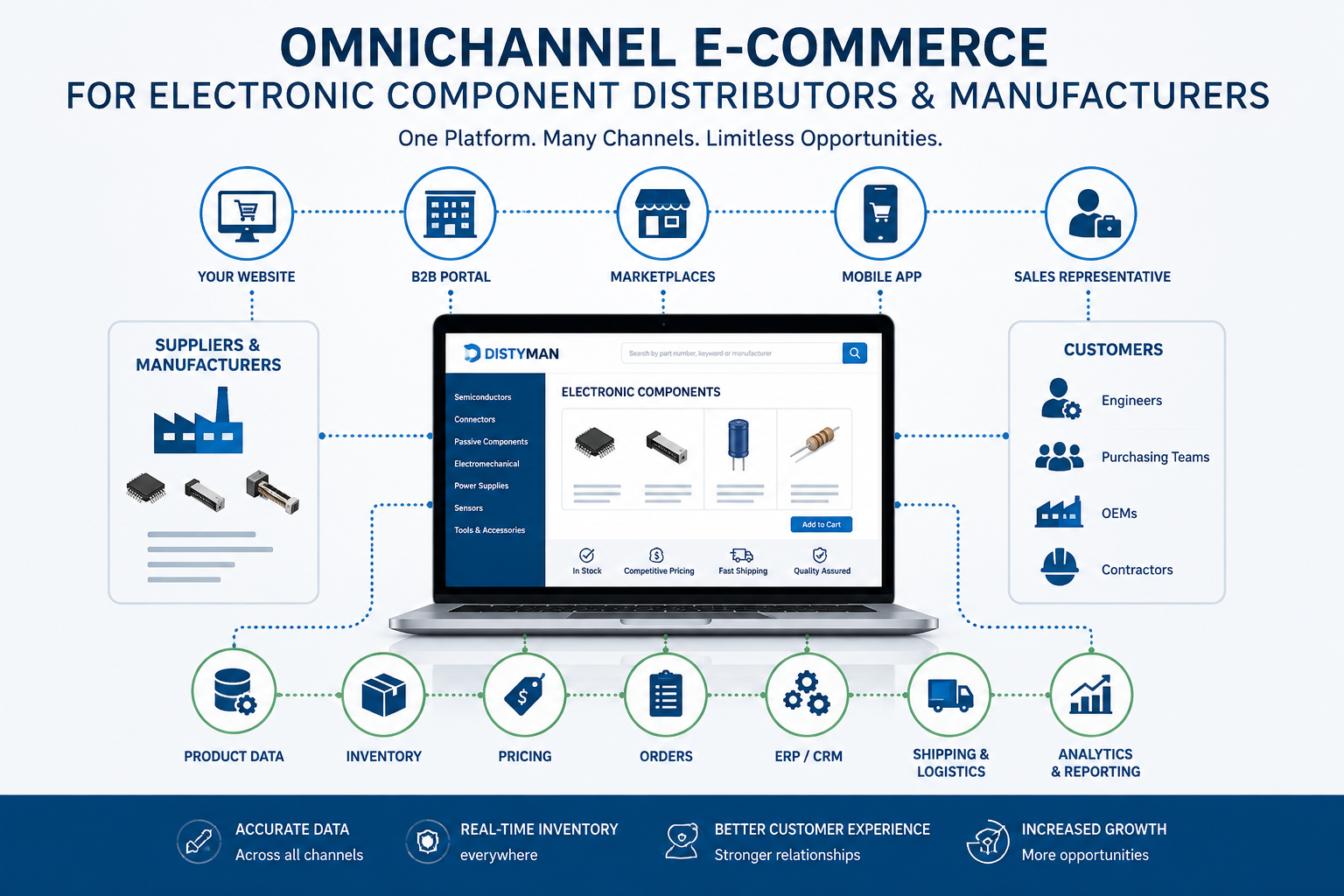
What Is Omnichannel E-Commerce?
Omnichannel e-commerce connects multiple customer touchpoints and sales channels into a coordinated commerce environment.
Depending on the business, these channels may include:
- Corporate websites
- B2B e-commerce websites
- B2C retail stores
- Customer purchasing portals
- Distributor websites
- Manufacturer websites
- Third-party marketplaces
- Dealer portals
- Sales representatives
- Mobile devices
- Search engines
- Social and digital advertising
- Procurement systems
- EDI and API connections
The objective is not simply to sell through more channels. The goal is to provide customers with consistent access to products, specifications, pricing, availability and purchasing capabilities wherever they interact with your business.
For electronic component companies, this can be particularly important because purchasing decisions frequently involve multiple people and multiple systems.
An engineer may discover a component through Google, review technical specifications on a manufacturer website, check inventory through a distributor, send the part number to purchasing and ultimately place the order through a B2B account or procurement system.
An effective omnichannel platform helps connect these experiences.
1. Build the Marketplace Around Your Overall E-Commerce Strategy
A marketplace should not operate as an isolated digital project.
Instead, marketplace commerce should become part of the company's broader e-commerce and omnichannel strategy.
Products sold through a marketplace should ideally connect with the same infrastructure supporting your primary website, including:
- Product information
- Categories
- Pricing
- Inventory
- Customer information
- Order processing
- ERP systems
- Fulfillment
- Analytics
This approach can make it easier to manage multiple sales channels without creating independent databases and workflows for every marketplace.
For distributors and manufacturers, the goal should be to manage commerce centrally while distributing accurate information wherever customers choose to purchase.
2. Create a Clear Marketplace Strategy
Before adding thousands or millions of products to marketplaces, companies should determine exactly what the channel is expected to accomplish.
Marketplace objectives may include:
- Reaching new customers
- Increasing product exposure
- Expanding available inventory
- Entering new markets
- Testing new product categories
- Supporting additional manufacturers
- Increasing revenue from existing product data
- Providing customers with a larger selection
- Supporting B2B and B2C buyers simultaneously
An electronic component distributor, for example, might use marketplace capabilities to supplement its stocked inventory with products available directly from manufacturers or approved suppliers.
A manufacturer might use marketplaces to reach buyers who would otherwise purchase primarily through distributors.
The technology should support the business model rather than dictate it.
3. Expand Product Selection Without Sacrificing Quality
One of the greatest advantages of the marketplace model is the ability to expand product selection.
This is particularly relevant to the electronic and electrical component industry, where buyers may need access to enormous catalogs containing products such as:
- Semiconductors
- Capacitors
- Resistors
- Connectors
- Relays
- Switches
- Circuit protection
- Power supplies
- Sensors
- RF and microwave components
- Electromechanical components
- Wire and cable
- Terminal blocks
- Power components
- Industrial controls
However, more products do not automatically create a better e-commerce experience.
Product expansion must be accompanied by strong catalog management, product classification and technical search capabilities.
Customers still need to find the correct component quickly.
4. Make Product Data the Foundation of Omnichannel Commerce
Product information is one of the most important components of electronic component e-commerce.
Unlike many consumer products, electronic and electrical components may require dozens or even hundreds of technical attributes.
A product record may include:
- Manufacturer
- Manufacturer part number
- Product family
- Description
- Electrical characteristics
- Dimensions
- Materials
- Operating temperature
- Voltage
- Current
- Frequency
- Packaging
- Compliance information
- Datasheets
- Drawings
- Images
- Certifications
- Cross references
This information should be structured so it can support websites, marketplaces, catalogs, search engines and other digital channels.
Strong product data improves more than usability. It can also support SEO, site search, filtering, product recommendations and AI-driven product discovery.
For distributors managing hundreds of thousands or millions of SKUs, product data architecture becomes one of the most important parts of an omnichannel e-commerce strategy.
5. Connect Real-Time Inventory Across Channels
Few things frustrate a buyer more than finding the correct component, placing an order and discovering that the product is unavailable.
Inventory should therefore be synchronized across e-commerce websites, warehouses, ERP systems and marketplaces whenever possible.
For distributors, inventory may exist across:
- Multiple warehouses
- Branch locations
- Manufacturer inventory
- Supplier inventory
- Third-party fulfillment locations
- Marketplace sellers
An effective omnichannel platform can aggregate this information and provide customers with more accurate availability.
This becomes especially valuable for electronic components where availability and lead times can directly influence purchasing decisions.
6. Support B2B Customer-Specific Pricing
Marketplace and omnichannel strategies must account for one major difference between traditional retail and industrial distribution: not every customer necessarily pays the same price.
Electronic and electrical component distributors frequently maintain complex pricing structures based on:
- Customer classifications
- Contract pricing
- Manufacturer agreements
- Quantity breaks
- Volume discounts
- Negotiated pricing
- Geographic regions
- Sales territories
- Customer groups
A modern B2B e-commerce platform should be capable of recognizing the customer and automatically presenting the correct products, pricing and purchasing options.
This capability becomes increasingly important when integrating multiple sales channels into a unified commerce environment.
7. Integrate ERP, CRM and Business Systems
An e-commerce website should not become another isolated database.
For many distributors and manufacturers, the ERP remains the central system for business operations.
A modern omnichannel e-commerce architecture may need to exchange information with ERP and other enterprise systems, including:
- Product information
- Inventory
- Customer accounts
- Pricing
- Orders
- Purchase history
- Shipping
- Taxes
- Credit limits
- Payment terms
- Quotations
API, EDI and other integration technologies can automate these processes and reduce manual data entry.
The result is a more scalable e-commerce operation in which information can move automatically between business systems and customer-facing channels.
8. Deliver Powerful Technical Search and Filtering
Electronic component customers often know exactly what they need.
Sometimes they have a complete manufacturer part number. Other times they know only the electrical or mechanical characteristics required for their application.
A successful component marketplace should support both purchasing behaviors.
Search capabilities may include:
- Part-number search
- Partial part-number search
- Manufacturer search
- Keyword search
- Parametric search
- Category filtering
- Attribute filtering
- Cross-reference search
- Related products
- Product alternatives
For large catalogs, faceted navigation and parametric filtering are particularly important.
Instead of browsing thousands of products, an engineer should be able to narrow a category based on relevant specifications until only suitable components remain.
9. Maintain a Consistent Customer Experience Across Channels
Omnichannel commerce should make purchasing easier, not more complicated.
Customers should encounter consistent information whether they interact with a manufacturer website, distributor portal, marketplace or mobile device.
Important areas of consistency include:
- Product descriptions
- Technical specifications
- Images
- Branding
- Categories
- Availability
- Pricing
- Documentation
- Customer support
Consistency helps customers trust the information they are using to make engineering and purchasing decisions.
10. Optimize Marketplace Products for SEO
Expanding an e-commerce catalog can create significant organic search opportunities when the underlying product information is properly structured.
Every additional manufacturer, category and product can potentially create another search entry point.
SEO opportunities for component distributors and manufacturers include optimizing:
- Product pages
- Category pages
- Manufacturer pages
- Product titles
- Meta descriptions
- Technical specifications
- Images
- Internal links
- Structured data
- Product schema
- Canonical URLs
- XML sitemaps
Technical product information can also capture highly specific searches.
Instead of competing only for broad phrases such as electronic components, a distributor may generate traffic from thousands of searches involving specific part numbers, product families and technical specifications.
This long-tail search traffic can be particularly valuable because the visitor frequently has a defined purchasing requirement.
11. Connect Marketplaces With Your Digital Marketing
Adding products to a marketplace does not guarantee that customers will find them.
Marketplace products should become part of the company's broader digital marketing strategy.
That can include:
- Search engine optimization
- Google Ads
- Shopping campaigns
- Email marketing
- Manufacturer promotions
- Retargeting
- Content marketing
- Press releases
- Social media
- Product announcements
- Selection guides
- Application notes
The more channels share accurate product information, the more opportunities buyers have to discover your company and products.
An omnichannel strategy therefore combines commerce and marketing rather than treating them as separate initiatives.
Marketplace E-Commerce for Electronic Component Distributors
For distributors, a marketplace strategy can dramatically expand the concept of the traditional line card.
Instead of displaying only products physically stocked in company warehouses, a distributor may be able to combine:
Owned inventory + supplier inventory + manufacturer inventory + marketplace inventory
into a much broader digital product offering.
The distributor continues to provide value through its brand, technical expertise, customer relationships and purchasing experience while offering customers access to a significantly larger product selection.
This can help distributors compete with larger online component marketplaces without necessarily investing capital in stocking every available SKU.
Marketplace E-Commerce for Electronic Component Manufacturers
Manufacturers can also benefit from an omnichannel marketplace strategy.
Historically, many component manufacturers depended almost entirely on distributors and sales representatives for product availability.
Digital commerce provides additional options.
Manufacturers can combine:
Direct e-commerce + distributor inventory + marketplace sales + sales representatives
into a coordinated channel strategy.
This does not necessarily mean replacing distribution.
Instead, digital channels can complement existing distributor relationships by making products easier to discover, research and purchase.
The objective should be to allow customers to purchase through the channel that works best for them.
From Multichannel to Omnichannel E-Commerce
There is an important distinction between multichannel and omnichannel commerce.
Multichannel businesses sell through multiple channels.
Omnichannel businesses connect those channels.
For example, a distributor might operate:
- A corporate website
- A B2B store
- A marketplace account
- An inside sales department
- An ERP system
- Multiple warehouses
If each system operates independently, the company has multiple channels.
If product information, customers, inventory, pricing and orders flow between those systems, the company begins operating an omnichannel e-commerce environment.
Building a Unified Commerce Architecture
As marketplace operations grow, managing separate systems for every channel can become increasingly difficult.
A unified commerce architecture creates a central foundation for managing critical business information.
A unified platform can potentially manage:
Products → Customers → Pricing → Inventory → Orders → Fulfillment → Marketplaces
while APIs connect external systems such as ERP, CRM, payment, shipping and marketing platforms.
For distributors and manufacturers with complicated business rules, this architecture can significantly reduce duplicate data and administrative overhead.
The Future of Electronic Component Marketplaces
The electronic component industry is particularly well suited to marketplace and omnichannel commerce because of its enormous product catalogs and complex global supply chain.
Customers increasingly expect immediate access to:
- Product specifications
- Datasheets
- Pricing
- Inventory
- Lead times
- Alternatives
- Cross references
- Purchasing options
At the same time, distributors and manufacturers need to manage these experiences across a growing number of digital channels.
The companies that succeed will not necessarily be those operating the greatest number of channels. They will be the companies that connect those channels most effectively.
DistyMan Omnichannel E-Commerce for Distributors and Manufacturers
DistyMan provides e-commerce design, development, product content and digital marketing services for electronic and electrical component distributors and manufacturers.
Our experience with complex technical catalogs allows us to build e-commerce environments around the requirements of component buyers, engineers, purchasing teams, sales organizations and product managers.
DistyMan can design, develop, integrate and optimize e-commerce websites using our proprietary platform or third-party e-commerce technologies.
Solutions can support requirements such as:
- B2B and B2C e-commerce
- Omnichannel commerce
- Marketplace integration
- Large product catalogs
- Customer-specific pricing
- Managed customer access
- Real-time inventory
- Multiple warehouses
- ERP integration
- APIs and data feeds
- Technical search and filtering
- Product specifications
- Datasheets and documentation
- SEO
- Digital marketing
- Marketplace product feeds
The objective is to create a connected digital commerce environment where your technology supports your business model, not the other way around.
Turn Your Product Catalog Into an Omnichannel Sales Platform
For electronic component distributors and manufacturers, the opportunity extends far beyond launching another online store.
A modern digital strategy can connect your product catalog with customers across your website, B2B portal, distributor network, marketplaces, search engines and other digital channels.
When e-commerce, marketplaces, product data, inventory, pricing, ERP integration and digital marketing operate together, each channel can reinforce the others.
The result is an omnichannel e-commerce platform designed to make your products easier to find, evaluate and buy wherever your customers choose to do business.