B2C retail eCommerce has become one of the most important channels for businesses selling directly to consumers. From global retailers and direct-to-consumer (DTC) brands to specialty stores and emerging online businesses, companies use eCommerce platforms to reach customers, manage products, process orders, personalize shopping experiences, and grow revenue.
In 2026, having an online store is no longer enough. Consumers expect fast-loading websites, mobile-first shopping, intelligent search, personalized product discovery, secure checkout, real-time inventory, flexible payment options, and seamless experiences across digital channels.
That makes choosing the right B2C retail eCommerce platform a critical business decision.
A modern platform needs to do more than display products and process transactions. It needs to support SEO, website performance, AI-driven product discovery, scalable product catalogs, digital marketing, analytics, integrations, and an increasingly demanding consumer shopping journey.
DistyMan is designed as a modern eCommerce platform for businesses that want to build high-performance, SEO-friendly, and scalable B2C retail eCommerce experiences.
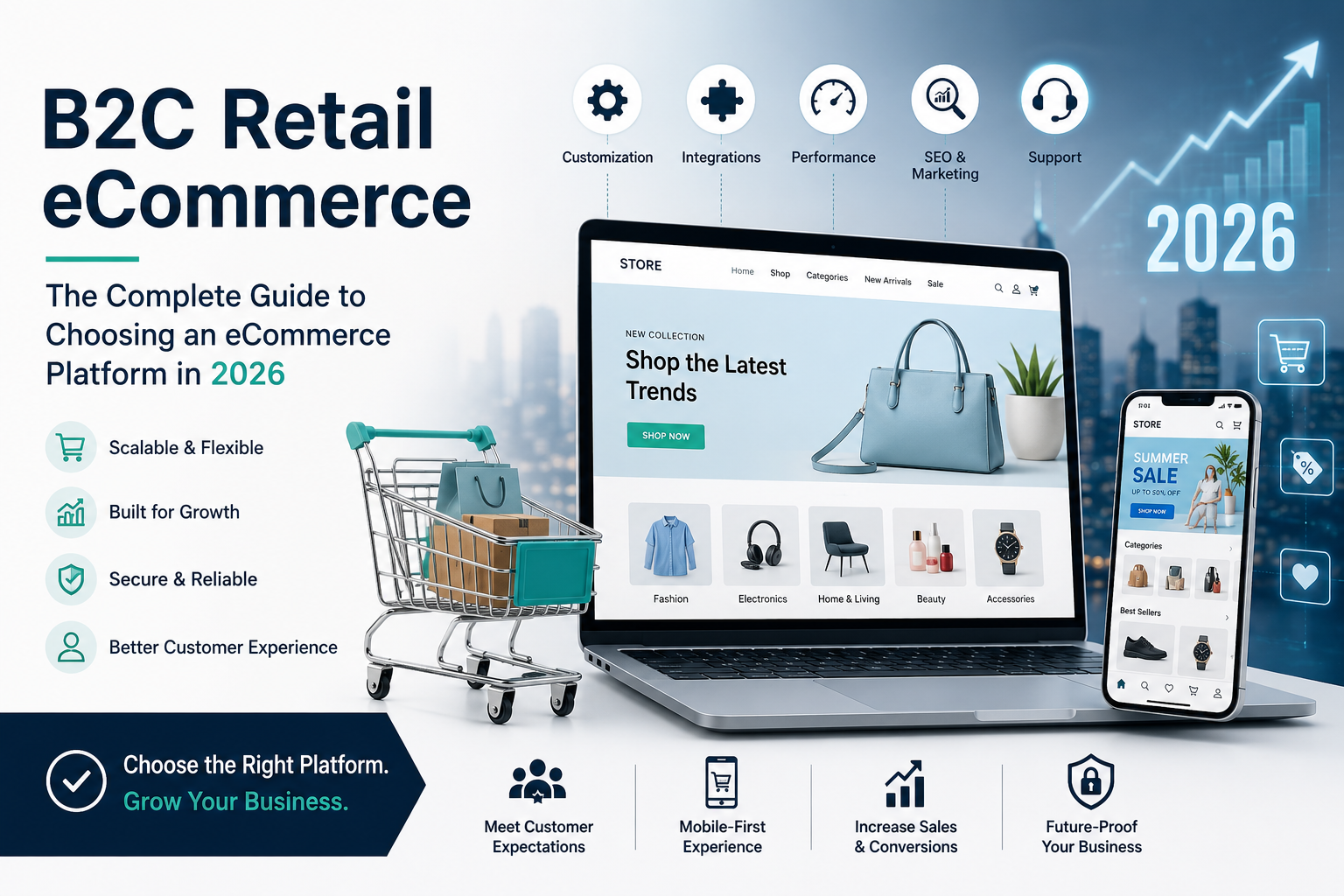
What Is B2C eCommerce?
B2C eCommerce, or Business-to-Consumer eCommerce, is the online business model in which companies sell products or services directly to individual consumers.
Unlike B2B commerce, where transactions often involve negotiated pricing, purchase orders, multiple buyers, and complex approval processes, B2C eCommerce is generally designed around a faster and more consumer-focused buying journey.
A typical B2C transaction can involve:
- Product discovery
- Site search
- Product comparison
- Product recommendations
- Shopping cart
- Online payment
- Order confirmation
- Shipping and fulfillment
- Customer service
- Returns and exchanges
B2C customers can discover products through search engines, social media, marketplaces, advertising, email marketing, AI assistants, direct website visits, and other digital channels.
The eCommerce platform sits at the center of these experiences.
How B2C Retail eCommerce Has Changed in 2026
The modern B2C shopping experience is increasingly influenced by speed, convenience, personalization, and discoverability.
Consumers expect websites to work seamlessly across smartphones, tablets, and desktop computers. They also expect search results to be relevant, product information to be comprehensive, and checkout to require as little friction as possible.
At the same time, retailers need their eCommerce platforms to support:
- Large and growing product catalogs
- Search engine optimization
- AI and machine-readable content
- Fast page delivery
- Mobile commerce
- Personalized shopping experiences
- Multiple payment methods
- Inventory synchronization
- Order management
- Marketing integrations
- Analytics and reporting
- Omnichannel commerce
- Scalable infrastructure
This means choosing a B2C eCommerce platform is increasingly a technology, marketing, and revenue decision—not simply a website decision.
Types of B2C eCommerce
B2C eCommerce encompasses several different business models.
Direct-to-Consumer Retail
Direct-to-consumer, or DTC, brands sell directly to customers through their own websites and digital channels.
Examples include apparel brands, electronics companies, beauty companies, furniture retailers, specialty stores, and consumer packaged goods businesses.
A strong DTC eCommerce platform helps these businesses control the complete customer journey, from product discovery through checkout and post-purchase support.
Online Retail Stores
Traditional retailers increasingly use eCommerce websites to complement physical stores.
A modern retail eCommerce platform can connect online product catalogs, inventory, fulfillment, and customer experiences to support both digital and physical retail operations.
Online Marketplaces
Online marketplaces bring multiple sellers and consumers together on a single platform.
Marketplace commerce requires specialized functionality for seller management, product catalogs, payments, commissions, inventory, and order fulfillment.
Subscription Commerce
Subscription businesses provide products or services to customers on a recurring basis.
Examples include subscription boxes, household products, software, memberships, and other recurring purchases.
An eCommerce platform supporting subscription commerce should make recurring orders, customer management, and billing workflows easier to manage.
Digital Products and Services
B2C commerce is not limited to physical products.
Businesses can sell:
- Software
- Digital downloads
- Online courses
- Memberships
- Media
- Digital subscriptions
- Services
Because digital products do not require traditional shipping, the customer journey can often be completed entirely online.
On-Demand Commerce
On-demand commerce allows consumers to purchase products or services when they need them.
Food delivery, transportation, home services, and other digitally enabled services are examples of this model.
Why the eCommerce Platform Matters for B2C Retail
The eCommerce platform is the technology foundation behind the online shopping experience.
A poorly optimized platform can create slow page speeds, complicated checkout processes, weak SEO performance, and difficult-to-manage product catalogs.
A modern B2C eCommerce platform should help retailers improve both the customer experience and operational efficiency.
1. Website Performance
Website speed directly influences the shopping experience.
Consumers are less likely to remain on slow websites, particularly when shopping from mobile devices.
For retailers with thousands or millions of products, platform architecture becomes particularly important. Every additional script, image, application, and unnecessary request can affect page performance.
DistyMan is designed with performance as a core consideration, supporting lightweight pages, CDN delivery, optimized assets, and scalable infrastructure.
Fast pages can also make it easier for search engines and AI systems to discover and process large amounts of product content.
2. SEO-Friendly eCommerce
Organic search remains an important acquisition channel for B2C retailers.
An SEO-friendly eCommerce platform should provide the technical foundation required for search visibility, including:
- Clean URLs
- Product structured data
- Canonical URLs
- Metadata management
- Indexable product pages
- Search-friendly category pages
- Internal linking
- XML sitemaps
- Mobile optimization
- Fast page performance
- Crawl-efficient architecture
For retailers with large product catalogs, technical SEO becomes even more important.
Thousands of products can generate thousands of URLs. Millions of products can create an enormous indexing challenge.
The platform therefore needs to help retailers manage crawlability, indexation, and structured product information at scale.
AI-Ready eCommerce in 2026
The way consumers discover products is changing.
In addition to traditional search engines, shoppers increasingly interact with AI-powered discovery tools, conversational interfaces, and recommendation systems.
This creates a new requirement for B2C eCommerce platforms:
Product information needs to be understandable not only to people and search engines, but also to machines and AI systems.
DistyMan supports an AI-ready approach to eCommerce content, helping businesses structure product information for modern digital discovery.
Machine-readable product information can include:
- Product descriptions
- Specifications
- Attributes
- Pricing
- Availability
- Categories
- Brand information
- Product identifiers
- Structured data
The goal is to make product information easier for search engines, AI systems, and other digital technologies to understand and process.
Mobile-First B2C eCommerce
Mobile commerce is central to modern B2C retail.
Customers may discover a product on a smartphone, research it on a laptop, and complete the purchase from another device.
A B2C eCommerce platform should therefore provide responsive experiences across:
- Smartphones
- Tablets
- Laptops
- Desktop computers
Mobile-first eCommerce also means optimizing navigation, product images, search, checkout, and payment experiences for smaller screens.
A fast mobile experience can be particularly important for retailers competing for organic traffic and paid advertising clicks.
Personalization and Product Discovery
Consumers increasingly expect online stores to understand what they are looking for.
Personalization can include:
- Product recommendations
- Recently viewed products
- Related products
- Personalized search results
- Customer-specific promotions
- Relevant category suggestions
- Personalized merchandising
For retailers with large catalogs, intelligent product discovery can help customers find the right products faster.
Search functionality is particularly important.
A visitor who cannot quickly find a product may leave the website and purchase from a competitor.
What to Look for in a B2C eCommerce Platform
Choosing an eCommerce platform should involve more than comparing the number of features.
Retailers should evaluate how the platform performs across technology, SEO, marketing, operations, and customer experience.
1. Scalability
Your platform should be able to grow with your business.
Consider:
- Product catalog size
- Website traffic
- Number of orders
- Number of customers
- Geographic expansion
- Marketing campaigns
- Seasonal traffic spikes
- Number of integrations
A platform that works for 1,000 products may not necessarily be the right architecture for 100,000 or 1 million products.
2. Customization and Flexibility
Every retail business has different requirements.
Your eCommerce platform should provide flexibility for:
- Product pages
- Category pages
- Navigation
- Checkout
- Promotions
- Customer accounts
- Search
- Content
- Integrations
- Design
Flexibility allows retailers to create differentiated shopping experiences instead of forcing every business into the same template.
3. Product Catalog Management
Product data is the foundation of retail eCommerce.
A modern platform should make it easy to manage:
- Product names
- Descriptions
- Images
- Videos
- Specifications
- Variations
- SKUs
- Categories
- Brands
- Attributes
- Pricing
- Inventory
- SEO metadata
Large catalogs require efficient product data management and structured information.
4. Advanced eCommerce Search
Site search is one of the most important features for large B2C stores.
Customers should be able to search using product names, brands, categories, attributes, and relevant keywords.
Advanced search can include:
- Autocomplete
- Filters
- Faceted navigation
- Typo tolerance
- Synonyms
- Attribute-based filtering
- Related products
- Search analytics
Better search can reduce friction and improve product discovery.
5. Inventory and Order Management
Retailers need accurate visibility into inventory and orders.
A B2C eCommerce platform should support integration with inventory, warehouse, ERP, shipping, and fulfillment systems.
Important capabilities include:
- Real-time inventory visibility
- Multi-location inventory
- Order tracking
- Automated fulfillment workflows
- Shipping integrations
- Returns management
- Inventory synchronization
6. Payment Flexibility
Consumers expect convenient and secure payment options.
Depending on the market, retailers may need to support:
- Credit and debit cards
- Digital wallets
- PayPal
- Buy Now, Pay Later
- Alternative payment methods
The checkout process should minimize unnecessary steps while maintaining appropriate security controls.
7. Marketing Integrations
An eCommerce platform should work with the rest of your marketing technology stack.
Useful integrations include:
- Email marketing
- CRM
- Marketing automation
- Advertising platforms
- Social commerce
- Analytics
- SEO tools
- Customer loyalty platforms
The objective is to create a connected customer acquisition and retention strategy.
8. Analytics and Reporting
Retailers need visibility into what customers are doing.
Analytics can help businesses understand:
- Traffic
- Conversion rates
- Revenue
- Average order value
- Product performance
- Search behavior
- Cart abandonment
- Customer acquisition
- Repeat purchases
Good reporting turns eCommerce data into actionable business decisions.
Omnichannel B2C Commerce
Modern consumers rarely shop through a single channel.
A customer may:
- Discover a product through Google.
- Visit the retailer's website.
- Compare products on a smartphone.
- Visit a physical store.
- Purchase online.
- Pick up the order in-store.
- Return the product through another channel.
An omnichannel eCommerce strategy connects these experiences.
Depending on the retailer's requirements, this can include:
- Online stores
- Physical stores
- Mobile commerce
- Marketplaces
- Social commerce
- Click-and-collect
- Buy Online, Pick Up In Store
- Ship-from-store
- Multiple fulfillment locations
The eCommerce platform should provide the technology foundation for these connected experiences.
Headless and Composable B2C Commerce
Headless commerce separates the customer-facing frontend from the commerce backend.
This architecture can provide greater flexibility for retailers that want to build custom digital experiences.
Composable commerce takes the concept further by allowing businesses to assemble different commerce capabilities based on their requirements.
Potential benefits include:
- Greater flexibility
- Faster innovation
- Custom customer experiences
- Easier integration
- Independent technology components
- Reduced dependence on a single architecture
However, composable commerce also introduces additional technical complexity.
For many retailers, the right choice depends on the size of the business, technical resources, product catalog, integration requirements, and long-term growth strategy.
DistyMan: A Modern B2C eCommerce Platform
DistyMan is designed for businesses that want a modern eCommerce platform focused on performance, scalability, SEO, and AI-ready commerce.
Rather than treating website performance and SEO as secondary features, DistyMan is built around the idea that the storefront itself should be optimized for modern digital discovery.
Performance-Focused Architecture
DistyMan emphasizes lightweight, high-performance eCommerce pages.
The platform can use modern infrastructure and optimization techniques including CDN delivery, compressed assets, and optimized HTML to reduce unnecessary page weight.
For retailers, this can help create faster product and category experiences.
SEO-Ready Product Pages
Product pages are among the most valuable assets on an eCommerce website.
DistyMan supports an SEO-focused architecture designed to help retailers build indexable product pages with structured product information.
This can help businesses target long-tail product searches and build organic visibility across large catalogs.
AI-Ready Product Content
As product discovery increasingly moves toward AI-powered interfaces, structured product information becomes more important.
DistyMan supports AI-oriented content architecture, including machine-readable product information designed to make product data easier for modern search and AI systems to process.
Large Product Catalogs
B2C retailers can have thousands, hundreds of thousands, or millions of products.
The eCommerce platform needs to be capable of organizing product data without sacrificing usability or performance.
DistyMan's architecture is designed for businesses that require structured product catalogs, category organization, filtering, and scalable product discovery.
Flexible eCommerce Architecture
Businesses can integrate their eCommerce environment with external applications and business systems as required.
This can include:
- ERP
- CRM
- Payment gateways
- Inventory systems
- Shipping platforms
- Marketing platforms
- Analytics
- Customer service systems
- Third-party applications
Why Speed, SEO and AI Matter Together
Historically, eCommerce optimization focused heavily on conversion rate and user experience.
Those remain important, but modern retail websites also need to optimize for discovery.
A product needs to be:
Discoverable → Crawlable → Understandable → Fast → Relevant → Easy to Purchase
That means the eCommerce platform influences the entire digital commerce funnel.
A technically strong product page can help:
- Search engines discover product information
- Customers find products faster
- AI systems understand product attributes
- Users navigate the site more efficiently
- Retailers improve the shopping experience
This is why platform architecture matters.
B2C eCommerce Platform Checklist
| Capability | What to Evaluate |
|---|---|
| Performance | Page speed, page size, server response, caching, and CDN delivery |
| SEO | Structured data, URLs, metadata, crawlability, and indexability |
| AI Readiness | Machine-readable product information and structured product data |
| Mobile | Responsive and mobile-first shopping experience |
| Product Catalog | Product, SKU, variation, attribute, and category management |
| Search | Site search, filters, facets, autocomplete, and product discovery |
| Scalability | Products, traffic, customers, orders, and transaction volume |
| Checkout | Simplicity, speed, security, and payment flexibility |
| Inventory | Real-time inventory and synchronization with business systems |
| Orders | Fulfillment, shipping, tracking, returns, and order management |
| Marketing | CRM, email, advertising, analytics, and marketing integrations |
| Analytics | Sales, traffic, product, search, and conversion reporting |
| Architecture | Headless, API, integration, and development capabilities |
| Security | Secure payments, authentication, access controls, and data protection |
| Flexibility | Customization, extensibility, design, and business process flexibility |
How to Choose the Right B2C eCommerce Platform
There is no single eCommerce platform that is perfect for every retailer.
The right platform depends on your:
- Product catalog
- Business model
- Customer base
- Traffic levels
- Technical requirements
- Marketing strategy
- Integration requirements
- Budget
- Growth plans
However, businesses should avoid evaluating platforms based solely on the number of features listed on a vendor website.
Instead, evaluate the complete customer journey.
Ask:
- How quickly does the website load?
- How easily can customers find products?
- How well can search engines crawl the catalog?
- How effectively can AI systems understand product information?
- How easily can the platform scale?
- How flexible is the architecture?
- How easily can it integrate with existing business systems?
These questions provide a better basis for evaluating a B2C eCommerce platform.
The Future of B2C Retail eCommerce
B2C commerce will continue to evolve as consumers adopt new technologies and new ways of discovering products.
The next generation of retail eCommerce will increasingly combine:
- AI-powered product discovery
- Conversational commerce
- Personalized shopping
- Faster mobile experiences
- Structured product data
- Omnichannel fulfillment
- Automated merchandising
- Intelligent search
- Headless and composable architectures
- Data-driven personalization
Retailers that build their eCommerce infrastructure around these trends will be better positioned to adapt as digital commerce continues to change.
Conclusion
A successful B2C retail eCommerce website requires much more than an attractive storefront.
Businesses need a platform that combines performance, SEO, mobile optimization, product discovery, scalability, integrations, analytics, and AI readiness.
The eCommerce platform is the foundation connecting customers, products, marketing, inventory, orders, and digital discovery.
DistyMan is built to provide businesses with a modern foundation for high-performance B2C retail eCommerce, helping retailers create faster, more scalable, and search-friendly digital commerce experiences.
For businesses evaluating a new eCommerce platform in 2026, the most important question is no longer simply:
"Can this platform sell products online?"
The better question is:
"Can this platform help my products get discovered, understood, purchased, and delivered efficiently across the modern digital commerce ecosystem?"
That is the standard modern B2C eCommerce platforms need to meet.