B2C retail eCommerce has become one of the most important ways retailers sell directly to consumers. In 2026, consumers expect online stores to be fast, easy to use, mobile-friendly, personalized, secure, and available whenever they want to shop.
For retailers, having an online store is no longer enough. The technology behind the store can directly influence website performance, search visibility, customer experience, conversion rates, and long-term growth.
Choosing the right B2C eCommerce platform is therefore one of the most important decisions a retail business can make.
This guide explains what B2C retail eCommerce is, the features retailers should look for in an eCommerce platform, and how modern technologies such as AI, SEO, personalization, and high-performance web architecture are changing online retail in 2026.
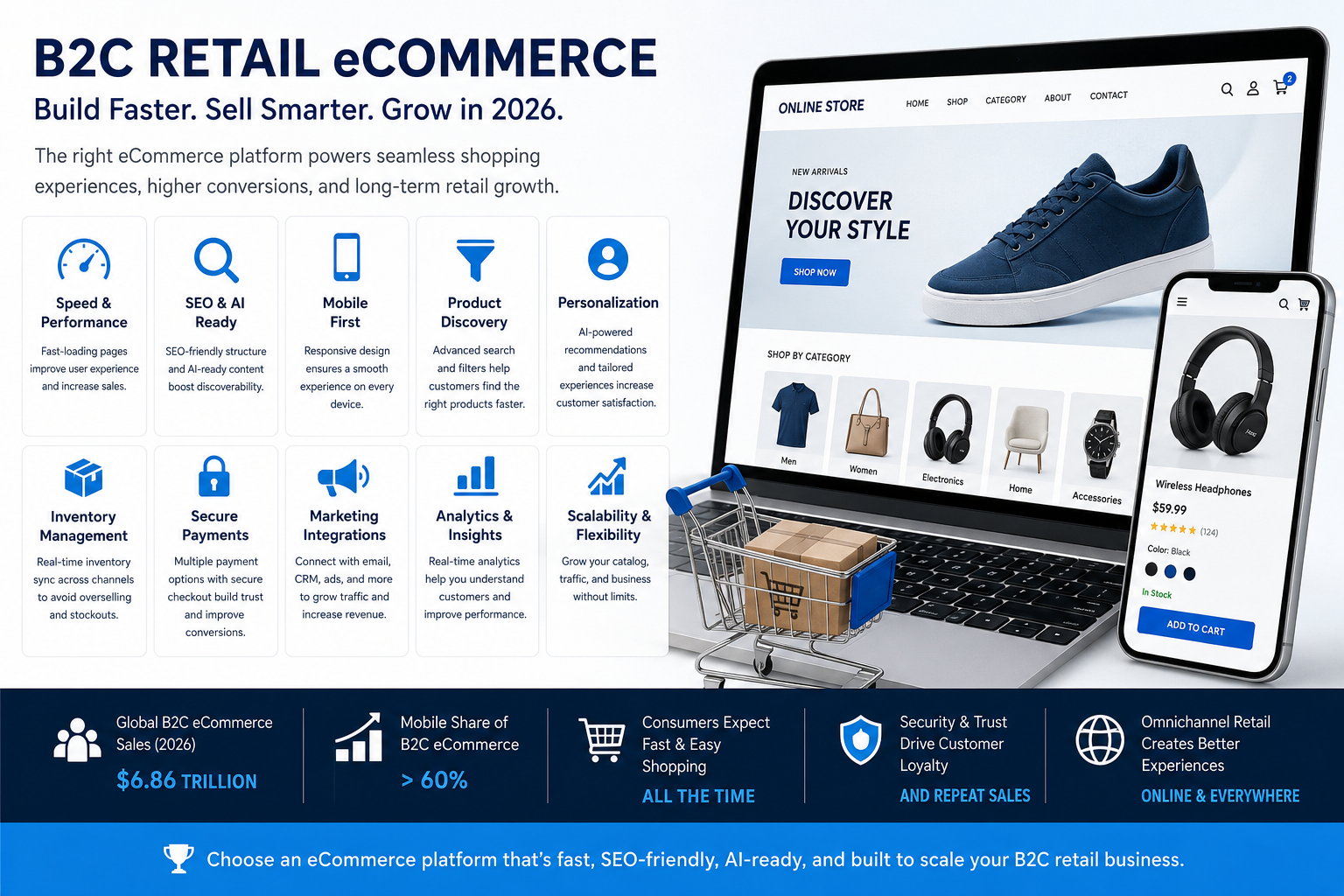
What Is B2C Retail eCommerce?
B2C retail eCommerce, or Business-to-Consumer retail eCommerce, is the process of selling products directly to individual consumers through an online store.
A typical B2C eCommerce customer can:
- Visit an online store
- Search or browse products
- View product information and images
- Compare products
- Add products to a shopping cart
- Complete checkout
- Make a payment
- Receive the order
- Return and purchase products again
B2C retail eCommerce is used by retailers selling products such as:
- Electronics
- Clothing
- Home goods
- Beauty products
- Sporting goods
- Furniture
- Consumer accessories
- Food and specialty products
- Tools
- Appliances
- Consumer packaged goods
The objective is to make the entire shopping experience simple, fast, and convenient.
A modern B2C eCommerce platform provides the technology required to manage products, customers, shopping carts, payments, orders, content, search, promotions, analytics, and the online customer experience.
Why B2C Retail eCommerce Matters in 2026
Consumers have become accustomed to purchasing products online.
They expect:
- Fast-loading websites
- Simple navigation
- Accurate product information
- Powerful product search
- High-quality product images
- Mobile-friendly shopping
- Personalized recommendations
- Multiple payment options
- Simple checkout
- Fast order processing
- Easy returns
- Secure transactions
At the same time, competition between online retailers continues to increase.
A retailer's website must therefore do more than display products. It must help customers discover products, understand their options, make purchasing decisions, and complete transactions with as little friction as possible.
This makes the underlying B2C retail eCommerce platform extremely important.
What Is a B2C eCommerce Platform?
A B2C eCommerce platform is the software infrastructure used to operate an online retail business.
Depending on the platform, it can manage:
- Product catalogs
- Product categories
- Product variants
- Product specifications
- Customer accounts
- Shopping carts
- Checkout
- Payments
- Orders
- Promotions
- Discounts
- Product search
- Inventory
- Content
- SEO
- Analytics
- Customer communications
The platform also controls important technical aspects of the online store, including how pages are generated, delivered, indexed, and experienced by customers.
That makes platform selection much more important than simply choosing a website design.
Why Your B2C eCommerce Platform Matters
The platform behind an online retail store can affect almost every part of the customer journey.
Scalability for Retail Growth
A B2C retailer may start with a relatively small product catalog and eventually grow to thousands or hundreds of thousands of products.
Traffic can also increase dramatically during:
- Holiday shopping
- Product launches
- Promotional campaigns
- Seasonal sales
- Advertising campaigns
- Special events
The eCommerce platform must be capable of handling growth without creating unnecessary performance problems.
A scalable B2C eCommerce platform should support increasing:
- Product volumes
- Website traffic
- Customer accounts
- Orders
- Transactions
- Content
- Search activity
Customer Experience Is Critical
The online shopping experience can determine whether a visitor becomes a customer.
Consumers do not want to struggle with:
- Slow pages
- Complicated navigation
- Poor search results
- Missing product information
- Difficult checkout
- Broken links
- Poor mobile experiences
A successful B2C retail website should make it easy for customers to move from product discovery to purchase.
The best eCommerce platforms provide retailers with the tools to create a smooth and intuitive customer experience.
Mobile B2C eCommerce
Mobile devices are an essential part of modern online shopping.
Consumers use smartphones to search for products, research brands, compare products, read reviews, and make purchases.
A B2C eCommerce platform should therefore be designed for mobile performance from the beginning.
Important mobile capabilities include:
- Responsive layouts
- Fast page loading
- Mobile-friendly navigation
- Touch-friendly controls
- Optimized images
- Simple product search
- Easy checkout
- Mobile payment support
SEO for B2C Retail eCommerce
Search engine optimization is one of the most important digital marketing strategies for online retailers.
Consumers frequently search Google and other search engines for specific products, brands, categories, specifications, and purchasing information.
A B2C eCommerce platform should provide a strong technical foundation for SEO.
Important SEO capabilities include:
- Search-friendly URLs
- Product metadata
- Category metadata
- Structured data
- Product schema
- Breadcrumbs
- Canonical URLs
- XML sitemaps
- Internal linking
- Crawlable product pages
- Fast page performance
- Optimized page structures
For retailers with large catalogs, these capabilities become especially important.
Thousands of product pages can create significant SEO opportunities, but only if search engines can efficiently access, understand, and index those pages.
Website Speed and B2C eCommerce
Website performance is one of the most important considerations when selecting a B2C eCommerce platform.
Online shoppers expect websites to respond quickly.
Large pages can contain:
- Product images
- JavaScript
- CSS
- Tracking scripts
- Applications
- Reviews
- Recommendations
- Third-party services
If these resources are poorly optimized, page sizes can become unnecessarily large and websites can become slow.
Slow websites can create friction during the shopping experience.
For retailers, the goal should be to create product pages that are:
Fast. Lightweight. Search-friendly. Mobile-friendly. Easy to navigate.
DistyMan is designed around a performance-first eCommerce architecture focused on lightweight pages, fast delivery, SEO, and scalable product catalogs.
The platform emphasizes:
- Lightweight web pages
- CDN delivery
- Image optimization
- Compression
- Efficient page rendering
- Structured data
- SEO-friendly architecture
- AI-ready product information
AI and B2C Retail eCommerce
Artificial intelligence is changing how consumers discover and research products.
Consumers can increasingly use AI-powered tools to:
- Find products
- Compare products
- Research specifications
- Understand product differences
- Discover brands
- Ask shopping questions
- Get product recommendations
This creates a new opportunity for retailers.
Product information needs to be structured, accurate, comprehensive, and understandable by both people and machines.
A modern B2C eCommerce platform should therefore consider AI visibility as part of its overall search strategy.
DistyMan supports AI-ready eCommerce through structured product information and machine-readable content designed to make product information easier for modern search and AI systems to understand.
What to Look for in a B2C Retail eCommerce Platform
1. Customization and Flexibility
Every retail business has different products, branding, customers, pricing strategies, and requirements.
A B2C eCommerce platform should allow retailers to customize:
- Product pages
- Category pages
- Navigation
- Checkout
- Promotions
- Customer experiences
- Content
- Branding
The platform should provide flexibility without requiring excessive development for every change.
2. Product Catalog Management
Product information is at the center of B2C retail eCommerce.
The platform should make it easy to manage:
- Products
- Categories
- Brands
- Variants
- Attributes
- Specifications
- Images
- Videos
- Product descriptions
- Related products
- Pricing
- Availability
3. Product Search and Filtering
Customers should be able to find products quickly.
A strong B2C eCommerce platform should provide effective search and filtering capabilities.
Customers may want to search by:
- Product name
- Brand
- Category
- Price
- Size
- Color
- Material
- Features
- Specifications
- Availability
4. Inventory Management
Accurate inventory information is essential for online retail.
Customers expect product availability information to be accurate.
A B2C eCommerce platform should provide tools for:
- Inventory tracking
- Stock levels
- Product availability
- Inventory updates
- Order management
- Fulfillment
- Returns
5. Payment Flexibility
Consumers expect convenient and secure payment options.
Depending on the market and business model, retailers may need to support:
- Credit cards
- Debit cards
- Digital wallets
- PayPal
- Buy Now, Pay Later
- Other payment methods
6. Marketing Integration
Marketing is critical to B2C retail eCommerce.
An eCommerce platform should work with marketing technologies that help retailers attract and retain customers.
- Email marketing
- Promotions
- Discount codes
- Abandoned-cart campaigns
- Customer segmentation
- Product recommendations
- Loyalty programs
- Social media integration
- Advertising integrations
- SEO tools
7. Personalization
Consumers increasingly expect relevant shopping experiences.
Personalization can include:
- Recommended products
- Recently viewed products
- Relevant promotions
- Personalized content
- Search recommendations
- Related products
AI can make personalization even more powerful by analyzing customer behavior and product information.
8. Analytics and Reporting
Retailers need accurate data to understand how their online store is performing.
- Revenue
- Orders
- Conversion rates
- Average order value
- Product performance
- Customer behavior
- Search activity
- Cart abandonment
- Traffic sources
- Customer retention
9. Security
Consumers expect online retailers to protect their information.
Retailers should evaluate:
- Secure checkout
- Payment security
- Customer account protection
- Fraud prevention
- Data protection
- Platform updates
- Access controls
10. Customer Support
Even a well-designed eCommerce platform can encounter technical issues.
Important considerations include:
- Technical support
- Documentation
- Developer resources
- Platform monitoring
- Troubleshooting
- Updates
- Maintenance
Why DistyMan for B2C Retail eCommerce?
DistyMan is designed for retailers that want a modern eCommerce platform focused on speed, SEO, scalability, AI visibility, and customer experience.
Rather than treating performance as an afterthought, DistyMan emphasizes performance as part of the underlying eCommerce architecture.
The platform is designed to support:
- B2C online stores
- Large product catalogs
- Fast product pages
- SEO-friendly websites
- Mobile shopping
- AI-ready product content
- Product search
- Product filtering
- Inventory management
- Customer accounts
- Online payments
- Promotions
- Analytics
- Personalized shopping experiences
Performance as a Competitive Advantage
Many eCommerce platforms can provide the basic functionality required to launch an online store.
The difference often comes down to how efficiently that functionality is delivered.
A retailer should ask:
- How large are my pages?
- How quickly do my product pages load?
- How many resources does each page require?
- How easily can search engines crawl my website?
- How well does the website perform on mobile devices?
- Can customers quickly find the products they want?
- Is my product information structured for modern search and AI?
DistyMan takes a performance-first approach, with an emphasis on lightweight pages, fast delivery, SEO, structured content, and AI-ready product information.
The Future of B2C Retail eCommerce in 2026
AI-Powered Product Discovery
AI is becoming increasingly important in how consumers research products. Retailers need product information that is accurate, detailed, structured, and accessible to modern AI systems.
Faster Websites
Performance will continue to matter. Retailers that provide fast, responsive shopping experiences can reduce friction and create better experiences for customers.
Personalized Shopping
Consumers increasingly expect online stores to understand their interests and provide relevant recommendations.
Mobile-First Commerce
Smartphones will continue to play an important role in product discovery and online purchasing.
Better Product Search
As product catalogs become larger, search and filtering become increasingly important. Consumers want to find the right product quickly rather than browse through hundreds of irrelevant results.
AI-Ready SEO
Traditional SEO is evolving. Retailers now need to think about how product information can be understood not only by search engines but also by AI-powered search and shopping systems.
How to Choose the Best B2C eCommerce Platform
Before selecting a platform, retailers should evaluate the following:
Product Catalog Size
Can the platform efficiently manage your current and future product catalog?
Performance
How fast are product and category pages?
SEO
Does the platform provide the technical foundation needed for organic search?
Mobile Experience
Does the platform provide fast and intuitive mobile shopping?
Product Search
Can customers quickly find products using search and filters?
AI Readiness
Can your product information be structured for AI-powered discovery?
Personalization
Can the platform provide relevant product recommendations and experiences?
Scalability
Can the platform grow with your retail business?
Total Cost
What will you actually spend on software, development, hosting, integrations, maintenance, and transaction-related costs?
B2C Retail eCommerce Platform Checklist
| Requirement | What to Evaluate |
|---|---|
| Performance | Page speed and page size |
| SEO | Crawlability, schema, metadata and URLs |
| AI | Structured and machine-readable product information |
| Mobile | Mobile speed and usability |
| Product Catalog | Products, variants and attributes |
| Search | Product search and filtering |
| Inventory | Accurate product availability |
| Payments | Secure payment options |
| Marketing | Promotions and marketing integrations |
| Personalization | Recommendations and relevant content |
| Analytics | Sales and customer insights |
| Security | Secure transactions and customer data |
| Scalability | Ability to support future growth |
| Flexibility | Customization and integrations |
| Support | Technical assistance and resources |
Conclusion: Build a Better B2C Retail eCommerce Store
The right B2C retail eCommerce platform should do much more than provide an online shopping cart.
It should provide the foundation for a fast, searchable, secure, mobile-friendly, scalable, and intelligent retail website.
In 2026, successful B2C retailers should focus on:
- Website speed
- SEO
- AI visibility
- Mobile performance
- Product discovery
- Personalization
- Product information
- Inventory accuracy
- Secure checkout
- Analytics
- Scalability
DistyMan is built around these priorities.
With a performance-focused architecture, SEO-friendly product pages, structured product information, AI-ready content, and modern eCommerce capabilities, DistyMan provides retailers with a foundation designed for the next generation of B2C retail eCommerce.
If you are looking for a B2C eCommerce platform in 2026, evaluate more than features and pricing. Look at the technology behind the storefront—and how that technology affects speed, SEO, customer experience, and long-term growth.
Frequently Asked Questions About B2C Retail eCommerce
What is B2C retail eCommerce?
B2C retail eCommerce is the process of selling products directly from a business to individual consumers through an online store.
What is a B2C eCommerce platform?
A B2C eCommerce platform is software used to operate an online retail store, including product catalogs, shopping carts, checkout, payments, orders, search, customer accounts, content, and analytics.
What features should a B2C eCommerce platform have?
Important features include product catalog management, product search, filtering, inventory management, secure payments, SEO tools, mobile optimization, analytics, personalization, marketing integrations, scalability, and strong website performance.
Why is website speed important for B2C eCommerce?
Fast websites provide a better shopping experience and can help reduce friction during product discovery and checkout. Website performance is also an important consideration for technical SEO and mobile commerce.
Is SEO important for B2C retail eCommerce?
Yes. SEO can help consumers discover products through search engines. A strong B2C eCommerce platform should provide SEO-friendly URLs, structured data, metadata, crawlable pages, internal linking, and fast performance.
How is AI changing B2C eCommerce?
AI is changing product discovery, product recommendations, search, personalization, and shopping research. Retailers should provide structured and detailed product information that can be understood by AI-powered systems.
What makes DistyMan different?
DistyMan focuses on high-performance B2C eCommerce with an emphasis on fast pages, SEO, scalable product catalogs, structured product information, mobile performance, and AI-ready content.
What should retailers consider when choosing a B2C eCommerce platform?
Retailers should evaluate performance, SEO, mobile experience, product catalog capabilities, search, inventory, payments, personalization, analytics, security, scalability, flexibility, support, and total cost of ownership.