B2C Retail eCommerce is changing rapidly in 2026. Manufacturers, distributors, wholesalers, brands, and suppliers are moving beyond traditional sales channels and adopting digital commerce platforms to connect directly with retailers, simplify ordering, improve product discovery, and manage increasingly complex retail relationships.
Retailers today expect more than product catalogs and sales representatives. They want real-time product information, pricing, inventory visibility, fast ordering, personalized experiences, digital communication, and seamless purchasing workflows.
This shift is creating a new generation of B2C retail eCommerce platforms designed to connect suppliers with retail businesses through faster, smarter, and more scalable digital commerce experiences.
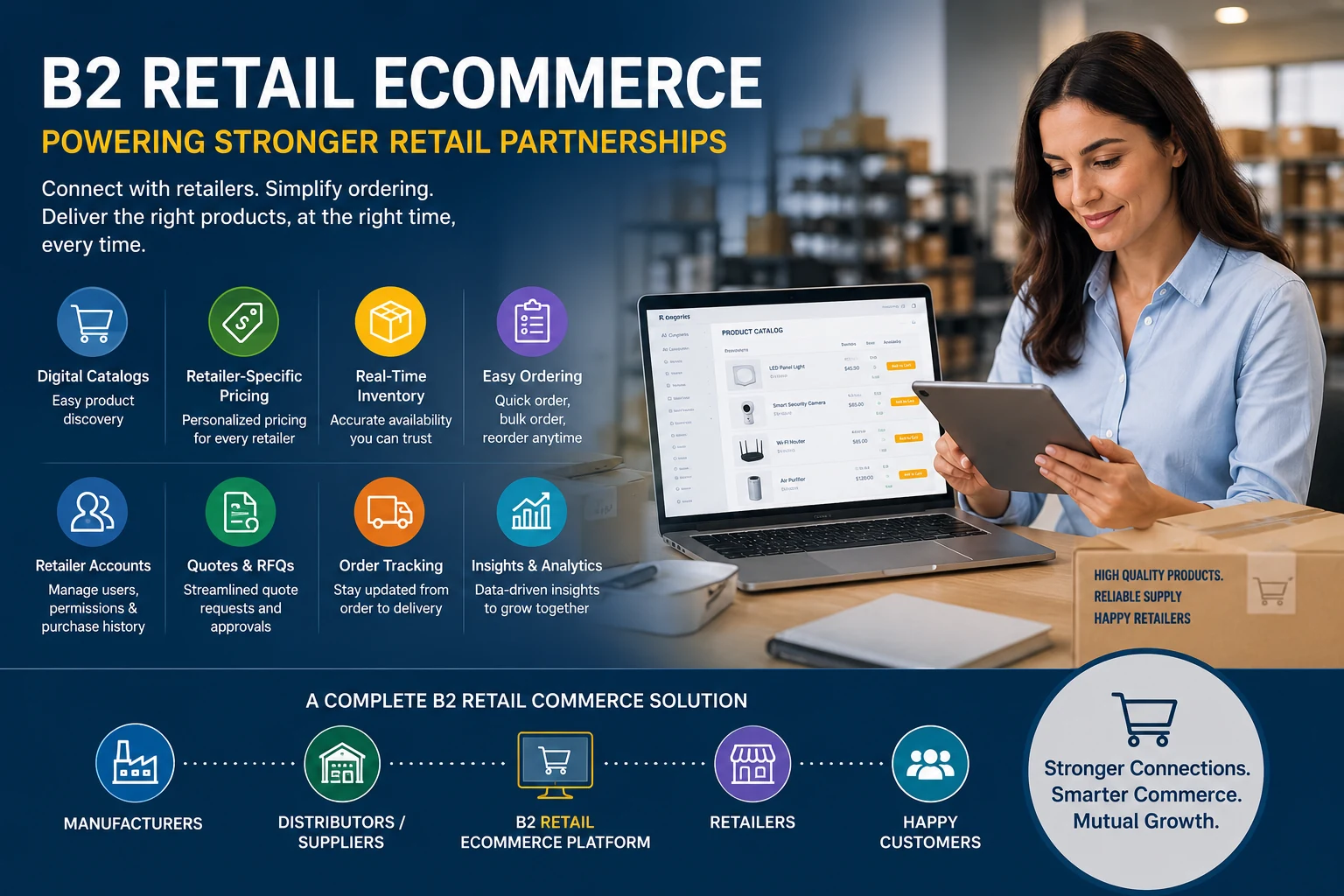
What Is B2C Retail eCommerce?
B2C Retail eCommerce refers to digital commerce that enables manufacturers, distributors, wholesalers, brands, and suppliers to sell products directly to retail businesses through an online platform.
It combines the convenience of a modern B2C eCommerce experience with the pricing, ordering, product information, inventory, and account-management capabilities required for retail purchasing.
A manufacturer, brand, distributor, or wholesaler can use a B2C retail eCommerce platform to provide retailers with:
- Digital product catalogs
- Retailer-specific pricing
- Wholesale pricing
- Product availability
- Bulk ordering
- Quick reorder functionality
- Product specifications
- Digital product documentation
- Order management
- Inventory visibility
- Request for Quote (RFQ) functionality
- Account management
- Promotions and discounts
- Personalized product recommendations
The objective is simple: make it easier for retailers to discover, purchase, reorder, and manage products digitally.
Why B2C Retail eCommerce Is Growing in 2026
Retail businesses are under constant pressure to respond quickly to changing customer demand. They need to find products, compare suppliers, check availability, place orders, and replenish inventory without waiting for traditional sales processes.
At the same time, manufacturers and distributors are managing increasingly large product catalogs, complex supply chains, multiple inventory locations, and rapidly changing product data.
B2C retail eCommerce helps connect these two sides digitally.
Instead of relying exclusively on phone calls, emails, spreadsheets, PDFs, printed catalogs, and sales representatives, suppliers can provide retailers with a centralized digital commerce experience.
This creates a more efficient supplier-to-retailer eCommerce ecosystem while giving sales teams more time to focus on relationships, strategic accounts, and business development.
Key B2C Retail eCommerce Trends in 2026
1. Retailers Expect Consumer-Grade Digital Experiences
Retail buyers are also consumers. They are accustomed to fast websites, intelligent search, personalized recommendations, mobile ordering, transparent product information, and simple checkout experiences.
They increasingly expect the same convenience when purchasing products for their retail businesses.
A modern B2C retail eCommerce platform should therefore combine the convenience of consumer shopping with the purchasing capabilities required by retailers.
Retailers should be able to:
- Search for products quickly
- Compare products
- View pricing
- Check availability
- Review specifications
- Place bulk orders
- Reorder products
- Request quotes
- Manage their accounts
- Track orders
The result is a digital retail purchasing experience that reduces friction between suppliers and retailers.
2. AI Is Transforming Retail Commerce
Artificial intelligence is becoming a major component of modern eCommerce. For B2C retail businesses, AI can improve everything from product discovery and search to customer service, merchandising, content creation, and recommendations.
Retailers may no longer need to know the exact product name or SKU to find what they need.
Instead, AI-powered search can interpret natural-language requests such as:
"Show me products suitable for outdoor retail displays under $100."
An intelligent commerce platform can interpret the request and present relevant products based on categories, attributes, applications, pricing, availability, and other product data.
AI can help B2C retail eCommerce businesses with:
- AI-powered product search
- Product recommendations
- Automated product descriptions
- Product categorization
- Attribute extraction
- Related-product discovery
- Alternative-product recommendations
- Customer support
- Personalized merchandising
- Inventory forecasting
- Content creation
- SEO optimization
AI is also changing how retailers discover products online. Suppliers need product information that can be understood not only by traditional search engines but also by AI-powered search engines and large language models (LLMs).
This makes structured, accurate, and machine-readable product information increasingly important.
3. SEO Is Becoming a Major B2C Retail Growth Channel
For manufacturers, distributors, wholesalers, and brands, organic search can provide a powerful way to attract retailers looking for products and suppliers.
A well-optimized B2C retail eCommerce website can generate visibility through:
- Product pages
- Category pages
- Brand pages
- Manufacturer pages
- Application pages
- Product comparison pages
- Buying guides
- Technical content
- Product specifications
- Frequently asked questions
Large product catalogs create particularly significant SEO opportunities. Every product can potentially become a search landing page, every category can target a broader commercial search, and every manufacturer or brand can provide another discovery path.
However, this only works when product pages are fast, crawlable, indexable, technically optimized, and rich in useful information.
4. Website Speed Matters More Than Ever
Retail buyers do not want to wait for slow product pages.
A B2C retail eCommerce website may contain thousands or even millions of products, along with images, specifications, inventory information, pricing, filters, and third-party integrations.
Without an optimized architecture, these elements can make websites unnecessarily slow.
Modern B2C retail eCommerce platforms should prioritize:
- Fast page loading
- Lightweight pages
- Content Delivery Network (CDN) delivery
- Image optimization
- Efficient caching
- Mobile performance
- Core Web Vitals
- Minimal unnecessary scripts
- Search-engine accessibility
- Scalable infrastructure
Performance is not simply a technical consideration. A faster website creates a better retailer experience while supporting SEO, product discovery, engagement, and conversion rates.
5. Advanced Product Search Is Essential
Retailers often need to find products quickly. For suppliers with large catalogs, basic keyword search is not enough.
Modern B2C retail eCommerce search should support:
- SKU searches
- Manufacturer part numbers
- Product attributes
- Brands
- Categories
- Product specifications
- Applications
- Price ranges
- Availability
- Related products
- Alternative products
- Compatibility
- Natural-language searches
Advanced filtering and parametric product search can significantly reduce the time required to find the right product.
This is particularly important for industries with technical or highly specialized products, including electronic components, electrical components, industrial products, replacement parts, and engineered products.
6. Personalized Retailer Experiences
Not every retailer should see the same products, prices, promotions, or inventory.
B2C retail eCommerce platforms can provide personalized experiences based on retailer accounts and purchasing behavior.
For example, a retailer could see:
- Retailer-specific pricing
- Contract pricing
- Previously purchased products
- Recommended products
- Frequently reordered products
- Relevant promotions
- Available inventory
- Preferred brands
- Custom product catalogs
This turns a standard eCommerce website into a personalized digital sales channel for retailers.
7. Mobile Ordering Is Becoming Standard
Retailers increasingly use smartphones and tablets to research products and manage purchasing activities.
B2C retail eCommerce platforms therefore need to provide fast, responsive mobile experiences.
Mobile functionality can include:
- Product search
- Product specifications
- Inventory checking
- Quick ordering
- Reordering
- RFQ requests
- Order tracking
- Account management
- Digital catalogs
A mobile-friendly supplier platform allows retailers to place orders whenever and wherever they need to.
8. Digital Product Information Is Becoming a Competitive Advantage
Retailers need accurate product information before they purchase. For many products, especially electronic components, electrical components, industrial products, and other technical products, product information can be just as important as price.
A modern B2C retail eCommerce platform should provide structured information such as:
- Product specifications
- Dimensions
- Technical attributes
- Manufacturer information
- Datasheets
- Product images
- Applications
- Compatibility information
- Packaging information
- Availability
- Related products
- Alternative products
Better product information helps retailers make faster purchasing decisions while creating more opportunities for search engines and AI systems to understand the product catalog.
9. Automation Is Reducing Manual Retail Ordering
Traditional supplier-to-retailer commerce often depends heavily on manual processes. Orders may arrive through:
- Phone calls
- Spreadsheets
- Sales representatives
- PDFs
- Manual purchase orders
Digital B2C retail commerce can automate many of these processes.
Retailers can search the catalog, select products, review pricing, submit orders, request quotes, and track purchases through a centralized platform.
This reduces manual work for both retailers and suppliers. Sales teams can spend more time developing customer relationships instead of processing routine orders.
10. B2C Retail eCommerce Is Becoming More Data-Driven
Every digital interaction creates useful commerce data.
Suppliers can analyze:
- Product searches
- Product views
- Orders
- Reorders
- Quote requests
- Popular categories
- Frequently searched products
- Retailer purchasing patterns
- Conversion rates
- Abandoned orders
- Product demand
This information can help suppliers improve merchandising, inventory planning, product recommendations, marketing campaigns, and retailer engagement.
When combined with AI, commerce data can become an even more powerful tool for predicting demand and personalizing the retailer experience.
The Importance of Scalability in B2C Retail eCommerce
One of the biggest challenges for manufacturers, distributors, and wholesalers is managing large product catalogs.
A supplier may have thousands, hundreds of thousands, or millions of products. The eCommerce platform must be able to manage these catalogs without sacrificing website performance, search quality, SEO, or customer experience.
Scalable B2C retail eCommerce infrastructure should support:
- Large product catalogs
- Complex product attributes
- Multiple brands
- Multiple manufacturers
- Multiple inventory sources
- Retailer-specific pricing
- Large numbers of customer accounts
- High-volume searches
- API integrations
- ERP integrations
- CRM integrations
- Inventory synchronization
The platform should grow with the business rather than become a limitation as the catalog and customer base expand.
DistyMan for B2C Retail eCommerce
DistyMan is a SaaS eCommerce platform designed for manufacturers, distributors, wholesalers, suppliers, retailers, and businesses with complex product catalogs and digital commerce requirements.
The platform provides a foundation for businesses that want to create high-performance digital commerce channels for retailers while connecting eCommerce with product data, inventory, pricing, ERP systems, and other business applications.
DistyMan can support a modern B2C retail eCommerce strategy through:
- High-performance eCommerce
- Large product catalogs
- Advanced product search
- Parametric filtering
- SEO-optimized product pages
- Structured product information
- AI-ready product content
- Retailer-specific experiences
- Digital catalogs
- RFQ workflows
- Product discovery
- Inventory integration
- ERP and third-party integrations
- Scalable commerce infrastructure
For businesses with large and complex catalogs, the combination of speed, search, SEO, structured product data, integrations, and scalable eCommerce architecture can provide a strong foundation for digital retail growth.
B2C Retail eCommerce, SEO and AI Are Converging
The future of B2C retail commerce is not simply about putting a product catalog online. It is about making that catalog discoverable everywhere.
Retailers may discover products through:
- Google and traditional search engines
- AI search
- LLM-based assistants
- Product discovery platforms
- Social media
- Supplier websites
- Digital marketplaces
This means product information must be structured, accurate, accessible, and optimized across multiple discovery channels.
A modern B2C retail eCommerce platform should therefore connect three important areas:
Commerce
Enable retailers to search, purchase, reorder, request quotes, and manage their accounts.
SEO
Make products, categories, brands, manufacturers, applications, and technical information discoverable through organic search.
AI
Make product information understandable to AI-powered discovery, search, recommendation, and purchasing systems.
This convergence is creating a new model of AI-ready retail commerce.
The Future of B2C Retail eCommerce
The future of B2C retail eCommerce will be defined by speed, automation, personalization, AI, product discovery, and digital connectivity.
Manufacturers, distributors, wholesalers, and brands that modernize their retail commerce infrastructure can create stronger relationships with retailers while reducing manual processes and improving product visibility.
Leading B2C retail eCommerce strategies will increasingly focus on:
- AI-powered product discovery
- Advanced retail product search
- High-performance eCommerce
- Large-scale product catalogs
- Retailer-specific pricing
- Personalized shopping experiences
- Mobile ordering
- Digital product catalogs
- Automated ordering
- SEO-driven product discovery
- AI-ready product information
- Data-driven merchandising
- Scalable eCommerce infrastructure
The fundamental shift is clear: retailers want the convenience of modern eCommerce combined with the pricing, product information, inventory, and purchasing capabilities required for professional buying.
Businesses that deliver this experience will be better positioned to compete in the rapidly evolving retail commerce market.
Build Your B2C Retail eCommerce Strategy With DistyMan
Whether you are a manufacturer, distributor, wholesaler, brand, supplier, or retail-focused business, your eCommerce platform is becoming an increasingly important part of your retail sales strategy.
DistyMan provides a modern foundation for building fast, scalable, SEO-friendly, AI-ready B2C retail eCommerce websites designed to help businesses connect their products with retailers more efficiently.
From large electronic and electrical component catalogs to industrial, technical, and specialized products, DistyMan provides the commerce technology needed to make complex product catalogs easier to search, discover, manage, and purchase.
The future of retail commerce is digital.
The opportunity is to make your product catalog faster to discover, easier to purchase, and smarter to manage.