B2B eCommerce for distributors has evolved far beyond putting a product catalog and shopping cart online.
For electronic and electrical component distributors, a modern eCommerce website can become a complete digital sales and customer-service platform—connecting products, technical specifications, manufacturers, inventory, customer-specific pricing, quotes, purchase orders, account information and ERP data.
The challenge is that electronic component distribution is significantly more complex than conventional retail eCommerce.
Distributors may manage hundreds of thousands or millions of SKUs, thousands of technical attributes, multiple warehouses, numerous manufacturers and customers with individually negotiated prices and purchasing terms.
This guide explains what electronic and electrical component distributors should consider when building a modern B2B eCommerce platform capable of improving customer service, increasing online sales and supporting long-term growth.
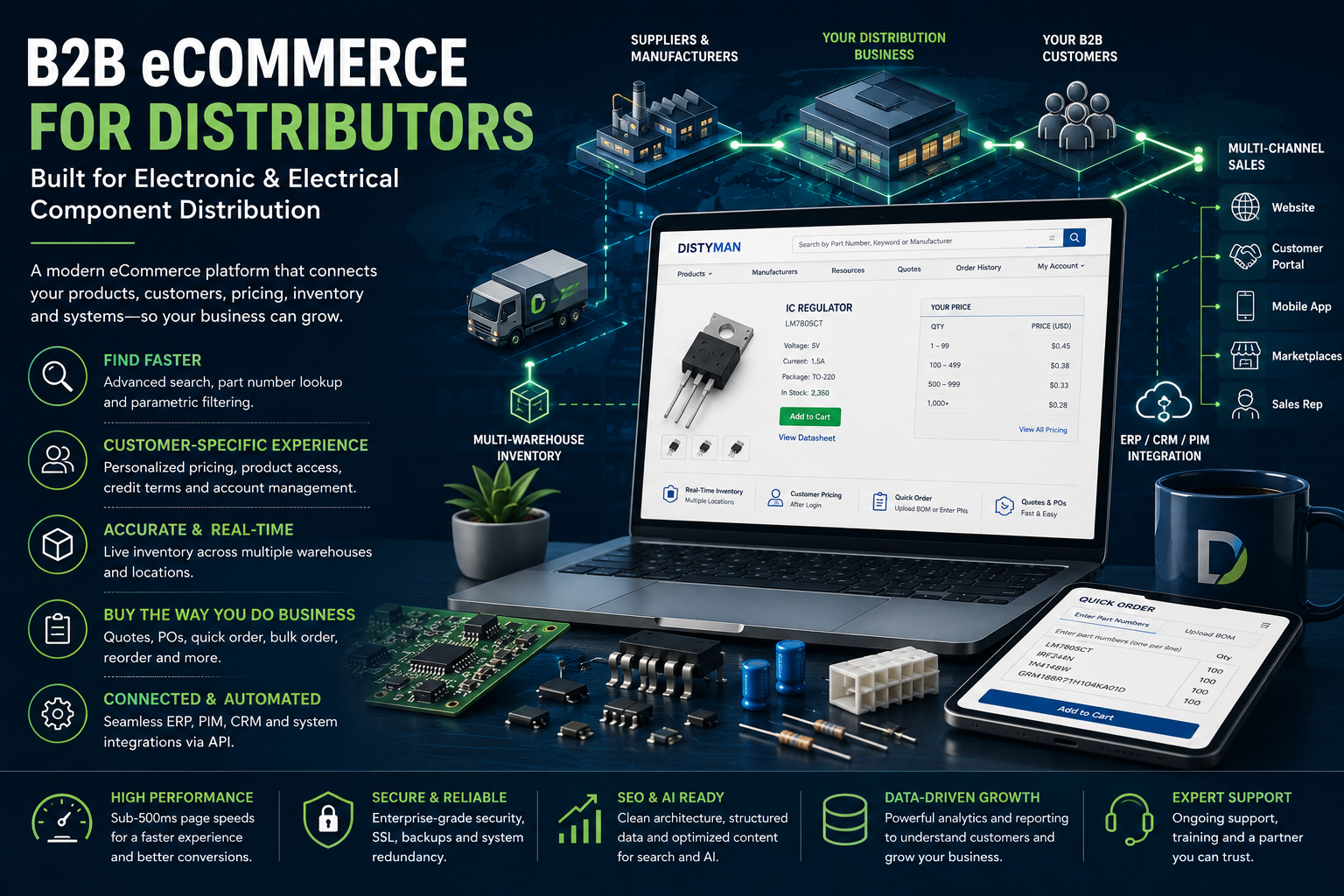
What Is B2B eCommerce for Distributors?
B2B distributor eCommerce is the online sale of products from a distributor to businesses, organizations and other professional buyers.
Unlike consumer eCommerce, where most customers see the same products, prices and checkout options, B2B transactions can depend on the identity of the customer.
A B2B distributor website may need to determine:
- Who the customer is
- Which products the customer can purchase
- What pricing the customer receives
- Available quantity discounts
- Credit terms
- Credit limits
- Payment methods
- Shipping options
- Tax requirements
- Purchasing permissions
For an electronic component distributor, the platform must combine these B2B requirements with sophisticated technical product discovery.
Why B2B eCommerce Is Important for Electronic Component Distributors
Today's B2B buyers expect to accomplish more online without contacting a salesperson for every routine request.
Engineers and purchasing professionals want to search for products, review specifications, check stock, see their pricing, download documentation, request quotes and place orders when it is convenient for them.
A strong B2B eCommerce website can give customers access to your business 24 hours a day while automating many repetitive sales and customer-service processes.
Potential benefits include:
- 24/7 online ordering
- Faster product discovery
- Improved customer self-service
- Reduced manual order entry
- Fewer routine pricing inquiries
- Better access to technical information
- More efficient reordering
- Expanded geographic reach
- Increased organic search visibility
- More scalable sales operations
Why Electronic Component Distribution Requires Specialized eCommerce
Electronic and electrical components create product-data and purchasing challenges that generic eCommerce platforms may not address without significant configuration or development.
A distributor may need to manage:
- Hundreds of thousands or millions of SKUs
- Hundreds of manufacturers
- Manufacturer part numbers
- Distributor SKUs
- Thousands of technical attributes
- Datasheets
- Technical drawings
- CAD files
- Compliance documentation
- Multiple packaging options
- Real-time inventory
- Multiple warehouses
- Customer-specific pricing
- Quantity price breaks
- Contract pricing
- Purchase orders
- Credit terms
The eCommerce architecture must make this complexity manageable for the distributor while keeping the customer experience simple.
Your Product Catalog Is the Foundation of B2B eCommerce
For an electronic component distributor, product data is one of the most valuable assets behind the website.
Every product needs to be structured so customers can find, understand and compare it.
A comprehensive product record may include:
- Manufacturer
- Manufacturer part number
- Distributor part number
- Product family
- Category and subcategory
- Short description
- Detailed technical description
- Specifications
- Parametric attributes
- Images
- Datasheets
- Technical drawings
- CAD models
- Compliance documents
- RoHS and REACH information
- Packaging
- Inventory
- Lead times
- Pricing
- Quantity breaks
- Related products
- Accessories
- Cross-references
- Alternative components
Well-structured product information supports almost everything else the website needs to accomplish, including search, filtering, SEO, AI search visibility, comparison and integration.
Product Search Can Make or Break Distributor eCommerce
Search is one of the most important features of an electronic component distributor website.
Many visitors do not want to browse. They arrive with a part number, manufacturer or technical requirement already in mind.
A distributor search engine should accommodate:
- Exact manufacturer part numbers
- Partial part numbers
- Distributor SKUs
- Manufacturer names
- Product names
- Technical keywords
- Product families
- Specifications
- Categories
- Cross-references
Search should return relevant results quickly and give customers tools to refine those results without repeatedly starting over.
Parametric Search Helps Engineers Find the Right Components
Electronic components are frequently selected by specification rather than appearance or price.
This makes parametric filtering one of the most valuable tools an electronic component distributor can provide.
Depending on the product category, filters can include:
- Voltage
- Current
- Resistance
- Capacitance
- Power
- Frequency
- Package type
- Mounting style
- Temperature range
- Dimensions
- Material
- Connector type
- Number of positions
- Manufacturer
- Availability
- Compliance status
Effective filtering allows customers to reduce thousands of products to a manageable group that meets their engineering requirements.
Customer-Specific Pricing Is Essential for B2B Distributors
One of the biggest differences between B2C and B2B eCommerce is pricing.
An electronic component distributor may have thousands of customers with different negotiated agreements.
The eCommerce platform may need to manage:
- Customer-specific pricing
- Contract pricing
- Customer classifications
- Quantity price breaks
- Volume discounts
- Manufacturer-specific agreements
- Promotional pricing
- Account-specific catalogs
When a customer logs in, the website should recognize the account and automatically display the appropriate products, pricing and purchasing options.
Real-Time Inventory Helps Customers Make Faster Decisions
Availability is critical in electronic component distribution.
If a buyer cannot determine whether a product is available, they may immediately search another distributor.
Integrating the website with inventory and ERP systems can provide information such as:
- Current stock
- Inventory by warehouse
- Incoming inventory
- Expected availability
- Lead times
- Backorder status
- Minimum order quantities
- Packaging quantities
Accurate availability information can reduce unnecessary inquiries and help buyers make purchasing decisions without leaving the website.
ERP Integration Connects eCommerce to the Distributor's Business
For many distributors, the ERP is the operational center of the company.
It may control customer records, inventory, pricing, orders, credit and other information required by the eCommerce platform.
B2B eCommerce ERP integration can synchronize:
- Products
- Customers
- Customer classifications
- Inventory
- Pricing
- Contract pricing
- Credit limits
- Payment terms
- Orders
- Invoices
- Order history
- Shipping information
Connecting these systems reduces duplicate data entry and helps keep the website synchronized with the rest of the organization.
Connect eCommerce with Your Complete Technology Stack
Modern distributor eCommerce may require integration with much more than an ERP.
APIs and automated data connections can connect the website with:
- ERP platforms
- CRM systems
- PIM systems
- Warehouse management systems
- Accounting software
- Manufacturer data feeds
- Shipping carriers
- Tax services
- Payment processors
- Email marketing platforms
- Analytics platforms
- Online marketplaces
The objective is to create a connected commerce environment where information can move efficiently between customers, the website and internal systems.
Support How B2B Buyers Actually Place Orders
B2B purchasing does not always follow a conventional add-to-cart and credit-card checkout process.
Distributors should support the purchasing methods their customers already use.
These can include:
- Credit card checkout
- Purchase orders
- Net payment terms
- Request for quote
- Quick-order forms
- Part-number entry
- BOM uploads
- Bulk ordering
- Saved carts
- Saved product lists
- Reordering
- Order approval workflows
- Multiple shipping addresses
The objective should be to remove friction from the purchasing process rather than forcing every customer through the same workflow.
Make Reordering Fast and Easy
Repeat business is particularly important in B2B distribution.
Existing customers should not have to search for the same products every time they place an order.
Customer accounts can provide access to:
- Order history
- Frequently purchased products
- Saved lists
- Saved carts
- Previous quotes
- Invoices
- One-click or quick reordering
Making repeat purchases easier increases the value of the website to existing customers and can strengthen long-term relationships.
Turn Your Website into a 24/7 Customer Service Platform
A B2B distributor website can automate many of the questions customers would otherwise send to sales or customer service.
Logged-in customers can potentially access:
- Current pricing
- Inventory
- Order status
- Order history
- Invoices
- Quotes
- Tracking information
- Account information
- Technical documentation
Self-service does not replace the distributor's sales team. It gives customers another way to interact with the business while allowing salespeople to spend more time on relationships and higher-value opportunities.
Website Speed Matters for Large Electronic Component Catalogs
Performance is particularly important when customers repeatedly search, filter and compare products.
A buyer may generate dozens of page requests while narrowing thousands of components to the few that meet a particular application.
Slow responses add friction to every stage of that process.
DistyMan develops high-performance eCommerce environments, with optimized implementations capable of delivering sub-500ms page response times under appropriate configurations and infrastructure.
Faster performance can improve usability, customer engagement, conversion opportunities, mobile experiences and technical SEO.
Mobile-Friendly B2B eCommerce Is No Longer Optional
Engineers, purchasing professionals, technicians and sales representatives increasingly access distributor websites from phones and tablets.
A responsive electronic component website should allow users to:
- Search products
- Filter specifications
- Review product information
- Download datasheets
- Check inventory
- View account pricing
- Request quotes
- Review orders
- Place orders
The mobile experience should be designed around the same B2B purchasing tasks as the desktop experience.
SEO Can Turn Your Product Catalog into a Customer Acquisition Channel
Electronic component distributors have a significant SEO opportunity because every manufacturer, category, product family and individual part can represent a potential search entry point.
Effective distributor SEO can include:
- SEO-friendly product URLs
- Crawlable product pages
- Optimized category pages
- Manufacturer landing pages
- Unique page titles
- Meta descriptions
- Canonical URLs
- XML sitemaps
- Product schema
- Structured data
- Breadcrumb navigation
- Internal linking
- Optimized images
- Fast page performance
- Mobile optimization
A well-structured catalog can create thousands of opportunities to reach engineers and buyers searching for specific electronic and electrical components.
Use Technical Content to Expand Organic Search Visibility
SEO opportunities extend beyond product pages.
Distributors can create authoritative technical content around the products and markets they serve.
Examples include:
- Product selection guides
- Application guides
- Technical articles
- Product comparisons
- Frequently asked questions
- Manufacturer guides
- Product-family guides
- Cross-reference resources
- New product announcements
This content can attract customers earlier in the buying process while building topical authority around important product categories.
Prepare Your Product Data for AI Search
Product discovery is expanding beyond traditional search engines.
Engineers and buyers increasingly use AI-powered search and assistants to research products, compare technologies and identify potential suppliers.
Electronic component distributors can make their content easier for search and AI systems to understand by providing:
- Structured product specifications
- Clear product descriptions
- Manufacturer information
- Detailed category content
- Application information
- Product schema
- Technical FAQs
- Selection guides
- Authoritative educational content
Clear, structured and authoritative product information strengthens the foundation for visibility across both traditional and emerging product-discovery channels.
Use Analytics to Understand How Customers Buy
One advantage of digital commerce is the ability to understand how customers interact with the catalog.
Useful measurements can include:
- Product searches
- Zero-result searches
- Popular categories
- Popular manufacturers
- Most-viewed products
- Organic search traffic
- Quote requests
- Conversion rates
- Average order value
- Cart abandonment
- Repeat purchases
- Mobile usage
- Website performance
These insights can help distributors improve product data, search, navigation, inventory strategy, marketing and customer experience.
B2B eCommerce Can Strengthen the Manufacturer-Distributor Relationship
A distributor website also serves as an important digital connection between manufacturers and end customers.
Manufacturers can provide product information, specifications, images, datasheets, technical documents and other digital assets that distributors can organize into a consistent customer experience.
Distributor websites can then help manufacturers gain greater visibility for their products while making those products easier for engineers and buyers to find.
Better product data and digital merchandising can benefit the manufacturer, distributor and customer simultaneously.
Unified B2B and B2C eCommerce for Distributors
Some electronic and electrical component distributors serve both businesses and individual consumers.
A unified eCommerce platform can support these audiences through the same underlying product and technology infrastructure while providing different experiences based on customer type.
The platform can control:
- Product access
- Customer classifications
- Pricing
- Quantity discounts
- Payment methods
- Credit terms
- Promotions
- Checkout options
- Account functionality
This can reduce the complexity of operating separate systems while maintaining the functionality required by different customer groups.
How to Choose a B2B eCommerce Platform for Distribution
The right platform should be selected according to the requirements of the business rather than simply choosing the most recognizable technology.
Questions to consider include:
- How many products must the platform manage?
- How complex is the product data?
- Do customers need parametric search?
- Is customer-specific pricing required?
- How many customer classifications are needed?
- Does inventory come from multiple warehouses?
- Does the website need real-time ERP integration?
- Are quotes and purchase orders required?
- Does the platform support SEO at scale?
- Can the architecture support fast page performance?
- Are APIs available for future integrations?
- Can it support both B2B and B2C?
- Can the platform grow with the business?
The objective is not to find the platform with the longest feature list. It is to select technology capable of supporting your products, customers and business processes.
DistyMan B2B eCommerce for Electronic Component Distributors
DistyMan specializes in design, development, eCommerce, product data and digital marketing for electronic and electrical component distributors and manufacturers.
We can design, develop, integrate and optimize eCommerce websites using the DistyMan proprietary platform or third-party technologies such as Shopify, BigCommerce and WooCommerce.
Our capabilities include:
- B2B eCommerce strategy
- Website design and UX/UI
- B2B eCommerce development
- Electronic component catalog development
- Advanced product search
- Parametric filtering
- Customer-specific pricing
- Real-time inventory integration
- ERP integration
- API development
- CRM and PIM integration
- Product data management
- Technical writing and illustration
- Catalog and selection guide design
- Search engine optimization
- AI search optimization
- Content marketing
- Google Ads management
- Marketplace integration
- Hosting and CDN
- Security and backups
- Ongoing support and optimization
Build B2B eCommerce Around the Way Your Distribution Business Works
Successful distributor eCommerce is not about forcing a complex B2B business into a conventional online store.
It is about bringing products, technical data, search, inventory, customer pricing, purchasing, ERP systems, SEO and customer service together in a digital environment that makes doing business easier.
When implemented correctly, B2B eCommerce can help electronic and electrical component distributors serve existing customers more efficiently while creating an entirely new channel for attracting and converting buyers.
DistyMan can design and develop the technology around your catalog, customers, integrations and business requirements.
Your technology should support your business—not dictate it.
Frequently Asked Questions About B2B eCommerce for Distributors
What is B2B eCommerce for distributors?
B2B eCommerce for distributors is an online commerce environment designed to sell products to businesses and professional buyers. It can include customer-specific pricing, technical catalogs, inventory, quotes, purchase orders, account management, credit terms and ERP integration.
Why do electronic component distributors need specialized eCommerce?
Electronic component distributors often manage extremely large catalogs containing detailed technical specifications, manufacturer part numbers, datasheets, complex pricing and inventory across multiple locations. Specialized eCommerce functionality helps make this information searchable and manageable.
What features should a B2B distributor website include?
Important features can include advanced product search, parametric filtering, customer-specific pricing, real-time inventory, quotations, purchase orders, account management, order history, quick ordering and integration with ERP and other business systems.
Can B2B eCommerce integrate with a distributor's ERP?
Yes. ERP integration can synchronize product, customer, inventory, pricing, credit, order and invoice information between the distributor's internal systems and the eCommerce website.
Can B2B customers have different prices?
Yes. A B2B eCommerce platform can support customer-specific prices, contract pricing, quantity discounts, customer classifications and other account-specific pricing structures.
Can a distributor sell B2B and B2C through the same website?
Yes. A unified eCommerce platform can serve both business and retail customers while controlling pricing, product access, account functionality, payment methods and purchasing workflows according to customer type.
How does SEO help electronic component distributors?
SEO can make product, category, manufacturer and technical content discoverable when engineers and purchasing professionals search for electronic components, part numbers, specifications and suppliers. A large, properly structured catalog can create thousands of organic-search entry points.
Can DistyMan work with an existing eCommerce platform?
Yes. DistyMan can design, develop, integrate and optimize eCommerce using its proprietary technology or third-party platforms such as Shopify, BigCommerce and WooCommerce depending on the distributor's requirements.