A modern B2B website should do much more than explain who your company is. For an electronic or electrical component distributor or manufacturer, your website should function as a searchable product catalog, technical resource, customer service portal, marketing platform and 24/7 sales channel.
Engineers and purchasing professionals arrive with specific objectives. They may need to locate a part number, filter products by technical specifications, download a datasheet, check inventory, compare components, request a quote or place an order.
The best B2B websites make every one of these tasks easier.
These B2B website best practices explain how electronic and electrical component companies can improve website design, eCommerce, user experience, SEO, product discovery, performance and conversions while building a digital platform capable of supporting long-term growth.
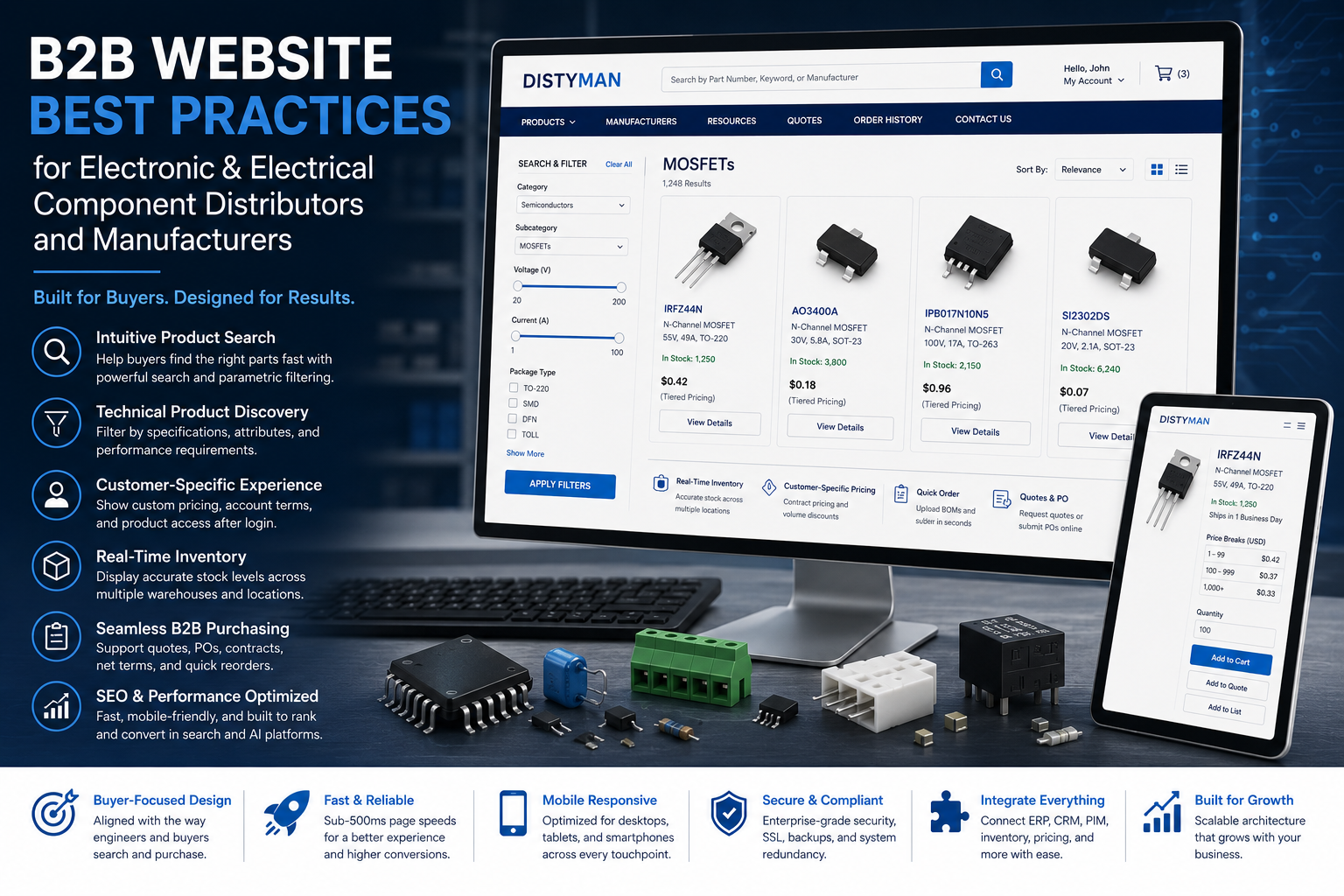
1. Design Your B2B Website Around the Buyer
One of the biggest mistakes in B2B website design is organizing the website around the company's internal structure instead of the customer's objectives.
Electronic component buyers typically arrive because they need to accomplish something.
- Find a specific part number
- Locate a product meeting technical requirements
- Compare components
- Check stock and availability
- Review specifications
- Download a datasheet
- Find an alternative component
- Request a quote
- Place an order
- Review previous purchases
Your navigation, search tools, category structure and page layouts should be designed around these objectives.
A successful B2B distributor website reduces the number of steps between identifying a requirement and finding the right product.
2. Make Product Search a Priority
Search is one of the most important functions on an electronic component website.
Buyers frequently know exactly what they need and may enter a manufacturer part number, partial part number, keyword, specification or product family directly into the search box.
A strong search system should recognize:
- Manufacturer part numbers
- Distributor SKUs
- Partial part numbers
- Product names
- Manufacturer names
- Technical terminology
- Specifications
- Product categories
- Common abbreviations
Search results should also provide useful filtering options so buyers can quickly narrow large groups of electronic or electrical components.
3. Use Parametric Search and Technical Filtering
Conventional retail filters such as brand, price and color are not enough for technical products.
Electronic component buyers often select products based on detailed engineering specifications.
Depending on the product category, filters might include:
- Voltage
- Current
- Resistance
- Capacitance
- Power rating
- Frequency
- Package type
- Mounting type
- Temperature range
- Dimensions
- Material
- Connector type
- Number of positions
- Compliance requirements
Well-designed parametric filtering can turn a catalog containing hundreds of thousands of SKUs into an efficient engineering and purchasing tool.
4. Build a Logical Product Category Structure
Category architecture affects both customer experience and SEO.
Products should be organized using terminology that customers, engineers and purchasing professionals understand rather than internal company terminology.
For example, an electronic component distributor might organize products into categories such as:
- Semiconductors
- Connectors
- Capacitors
- Resistors
- Inductors
- Relays
- Switches
- Sensors
- Power Supplies
- Circuit Protection
- Electromechanical Components
- Tools and Accessories
Logical categories help users browse products while creating valuable landing pages that search engines can index for relevant electronic and electrical component searches.
5. Create Detailed, Searchable Product Pages
Product pages are among the most valuable pages on an electronic component distributor or manufacturer website.
Each page should provide enough information for a buyer or engineer to understand the product without searching multiple external sources.
Useful product information can include:
- Manufacturer
- Manufacturer part number
- Distributor part number
- Product description
- Technical specifications
- Parametric attributes
- Product images
- Datasheets
- Technical drawings
- CAD files
- Compliance documentation
- Inventory availability
- Pricing
- Quantity discounts
- Minimum order quantities
- Packaging information
- Related products
- Accessories
- Alternative products
Detailed product pages improve usability while creating highly specific content that can rank for manufacturer names, part numbers, specifications and long-tail product searches.
6. Optimize Your B2B Website for Search Engines
SEO should be incorporated into the architecture of a B2B website rather than added after development.
Electronic component manufacturers and distributors have a particularly valuable SEO opportunity because their websites can contain thousands or even millions of highly specific product, category and manufacturer pages.
Important B2B SEO elements include:
- SEO-friendly URLs
- Unique page titles
- Optimized meta descriptions
- Proper H1 and H2 structure
- Canonical URLs
- XML sitemaps
- Product schema and structured data
- Breadcrumb navigation
- Internal linking
- Optimized category content
- Fast page performance
- Mobile optimization
- Crawlable product information
A technically strong website gives search engines a clearer understanding of your products, manufacturers, categories and areas of expertise.
7. Optimize for Buying Intent, Not Just Search Volume
High search volume does not necessarily mean high business value.
B2B electronic component SEO should target searches that indicate what the buyer actually wants to accomplish.
A broad phrase such as "electronic components" may generate substantial search volume, but highly specific searches can indicate much stronger purchasing intent.
Examples might include:
- Electronic component distributor
- Electrical component supplier
- Buy electronic components online
- Electronic component manufacturer
- Manufacturer part number searches
- Specific component specifications
- Component alternatives
- Component cross references
- Datasheet searches
- In-stock component searches
These long-tail searches can bring highly qualified engineers and purchasing professionals directly to relevant product pages.
8. Build Content Around the Entire B2B Buying Journey
Not every visitor is ready to place an order.
Engineers may be researching technologies months before production begins. Purchasing departments may be evaluating suppliers. Existing customers may simply need technical documentation.
Your website should provide useful content throughout the buying process.
Research
- Technical articles
- Application guides
- Selection guides
- Educational resources
Product Evaluation
- Specifications
- Parametric search
- Product comparisons
- Datasheets
- Technical drawings
Supplier Evaluation
- Manufacturer information
- Certifications
- Quality standards
- Company capabilities
- Inventory information
Purchasing
- Pricing
- Quotes
- Purchase orders
- Credit terms
- Checkout
Supporting the complete journey increases the likelihood that customers continue using your website as they move from research to purchasing.
9. Provide Real-Time Inventory Information
Availability is critical in electronic component purchasing.
A buyer may find the perfect product, but if availability is unclear, they may immediately search another distributor.
Integrating your website with inventory and ERP systems can allow customers to see current quantities across one or multiple warehouses.
Accurate inventory information reduces unnecessary inquiries while helping purchasing professionals make faster decisions.
10. Support Customer-Specific B2B Pricing
B2B pricing is rarely one-size-fits-all.
Electronic and electrical component distributors may have different pricing agreements for OEMs, contract manufacturers, dealers, government customers and other accounts.
A B2B eCommerce website may need to support:
- Customer-specific pricing
- Contract pricing
- Customer classifications
- Quantity discounts
- Volume pricing
- Manufacturer-specific agreements
- Special promotions
- Account-specific product access
Once authenticated, customers should automatically receive the pricing and purchasing options associated with their account.
11. Make B2B Purchasing Easy
B2B buyers increasingly expect the convenience they experience when shopping online as consumers, but business purchasing often requires more sophisticated workflows.
A B2B electronic component website may need to accommodate:
- Credit card orders
- Purchase orders
- Net payment terms
- Quotes
- Quick-order forms
- Part-number uploads
- Bulk orders
- Saved carts
- Reordering
- Order approvals
- Multiple shipping addresses
The objective is simple: eliminate unnecessary friction between finding a product and completing the purchase.
12. Integrate Your Website with Your ERP and Business Systems
A B2B website should not operate as an isolated system.
For many electronic component distributors, the ERP controls products, inventory, customers, pricing, credit, orders and purchasing information.
Connecting these systems allows information to flow between your internal operation and your customer-facing website.
Integration can include:
- ERP systems
- CRM platforms
- PIM systems
- Warehouse systems
- Accounting platforms
- Shipping systems
- Tax services
- Payment gateways
- Manufacturer data feeds
- Marketplace platforms
Effective integration reduces manual work and helps keep product, inventory, pricing and customer information synchronized.
13. Make Website Speed a Competitive Advantage
Website performance affects almost every part of the digital experience.
Consider a buyer filtering a category containing 50,000 electronic components. If every filter selection requires several seconds to load, the process quickly becomes frustrating.
Fast product searches, category pages and product pages allow engineers and purchasing professionals to work efficiently.
DistyMan develops high-performance eCommerce environments capable of delivering sub-500ms page response times under appropriate configurations and infrastructure.
Faster performance can improve usability, engagement and conversions while supporting stronger technical SEO and Core Web Vitals.
14. Design for Mobile B2B Buyers
Engineers, sales representatives, technicians and purchasing professionals increasingly research products from mobile devices.
Your B2B website should provide a consistent experience across desktops, laptops, tablets and smartphones.
Mobile users should be able to:
- Search products
- Navigate categories
- Filter technical specifications
- Review product data
- Download datasheets
- Check inventory
- Access customer accounts
- Request quotes
- Place orders
Responsive design should be considered from the beginning rather than treated as a desktop website adapted for smaller screens.
15. Make Trust and Credibility Easy to Find
Trust is especially important when companies are evaluating a new component manufacturer or distributor.
Buyers may be placing significant orders or selecting components that will become part of products manufactured for years.
Useful trust signals include:
- Quality certifications
- Security certifications
- Authorized distributor status
- Manufacturer partnerships
- Years in business
- Industry experience
- Customer testimonials
- Case studies
- Warranty information
- Security and privacy information
These elements should be easy to find rather than buried deep inside the website.
16. Create SEO Topic Clusters Around Your Products and Expertise
Product pages alone should not carry your entire SEO strategy.
Manufacturers and distributors can build stronger topical authority by creating groups of related content around important product categories and applications.
For example, a MOSFET category could connect to content about:
- What is a MOSFET?
- Types of MOSFETs
- How to select a MOSFET
- MOSFET applications
- MOSFET specifications
- Power MOSFETs
- MOSFET FAQs
- MOSFET manufacturer pages
- Individual MOSFET product pages
Internal links between these pages help customers explore the subject while providing search engines with clearer signals about your expertise.
17. Optimize Your Electronic Component Website for AI Search
Product discovery is expanding beyond traditional search engines. Buyers increasingly use AI-powered search tools and assistants to research products, technologies, suppliers and technical questions.
Electronic component websites can improve their visibility across traditional and AI-driven search by providing clear, authoritative and structured information.
Important elements include:
- Structured product specifications
- Clear product descriptions
- Manufacturer information
- Detailed category content
- Schema markup
- Technical articles
- Frequently asked questions
- Selection guides
- Comparison content
- Application information
The more clearly your website explains what a product is, what it does, how it is specified and where it is used, the easier it becomes for search and AI systems to understand your content.
18. Use Calls to Action That Match Buyer Intent
Not every website visitor is ready for the same next step.
A visitor reading an educational article may want to explore products, while a purchasing professional viewing an in-stock component may be ready to order immediately.
Useful calls to action can include:
- View Products
- View Specifications
- Download Datasheet
- Check Availability
- Request a Quote
- Add to Cart
- Compare Products
- Contact Technical Support
- Talk to Sales
Matching the call to action to the user's intent creates a more natural path through the website.
19. Continuously Improve Your B2B Website
A B2B website should never be considered finished.
Search behavior changes. Product catalogs grow. New manufacturers are added. Customer expectations evolve. Search engines change and new AI discovery channels emerge.
Website performance should therefore be monitored and improved continuously.
Areas to review include:
- Search queries
- SEO rankings
- Organic traffic
- Product search performance
- Zero-result searches
- Page speed
- Core Web Vitals
- Conversion rates
- Cart abandonment
- Popular products
- Popular categories
- Customer behavior
These insights can identify opportunities to improve navigation, search, content, SEO and eCommerce performance.
Your B2B Website Should Be a Sales Platform, Not an Online Brochure
The most important B2B website best practice is also the simplest: build the website around what your customers need to accomplish.
For an electronic or electrical component manufacturer or distributor, that means much more than attractive design.
Your website should help customers find products, evaluate specifications, check inventory, access pricing, download technical information, request quotes and place orders as efficiently as possible.
When product data, search, eCommerce, ERP integration, SEO, performance and user experience work together, the website becomes more than a marketing tool.
It becomes an extension of your sales and customer service organization that works 24 hours a day.
Build a Better B2B Website with DistyMan
DistyMan specializes in website design, development, eCommerce, product data management, SEO and digital marketing for electronic and electrical component manufacturers and distributors.
We can design, develop, integrate and optimize eCommerce websites using the DistyMan platform or third-party technologies such as Shopify, BigCommerce and WooCommerce.
Our capabilities include:
- B2B website design
- B2B eCommerce development
- Electronic component catalog development
- Parametric product search
- ERP integration
- API development
- Customer-specific pricing
- Real-time inventory integration
- Product data management
- Technical writing
- Catalog and selection guide design
- Search engine optimization
- AI search optimization
- Digital marketing
- Website performance optimization
- Hosting, CDN, security and backup
Your technology should support your business—not dictate it.
Whether you are rebuilding an existing distributor website, launching a manufacturer website, integrating an ERP, improving product search or developing a complete B2B eCommerce platform, DistyMan can build the technology and digital experience around your requirements.
Frequently Asked Questions About B2B Websites
What makes a good B2B website for an electronic component distributor?
A strong electronic component distributor website combines fast product search, technical filtering, detailed specifications, current inventory, customer-specific pricing, account management and efficient ordering with strong SEO and responsive design.
Why is product search important for electronic component websites?
Electronic component buyers frequently search by exact or partial part numbers and technical specifications. Fast, accurate search helps engineers and purchasing professionals find appropriate products without navigating large catalogs manually.
Should a B2B distributor website integrate with an ERP?
In many cases, yes. ERP integration can synchronize products, customers, inventory, pricing and orders between the website and internal business systems, reducing duplicate data entry and providing customers with more current information.
How can an electronic component distributor improve SEO?
Effective electronic component SEO combines technically optimized product pages, category pages, manufacturer pages, structured specifications, schema markup, internal linking, educational content, fast performance and crawlable website architecture.
Can one website support both B2B and B2C customers?
Yes. A unified eCommerce platform can provide different pricing, product access, account features and checkout workflows based on customer type while maintaining a common product catalog and technology infrastructure.
Does website speed matter for B2B eCommerce?
Yes. Speed is particularly important for large technical catalogs where customers may perform repeated searches, filters and product comparisons. Faster pages reduce friction and can improve usability, engagement, conversions and technical SEO.